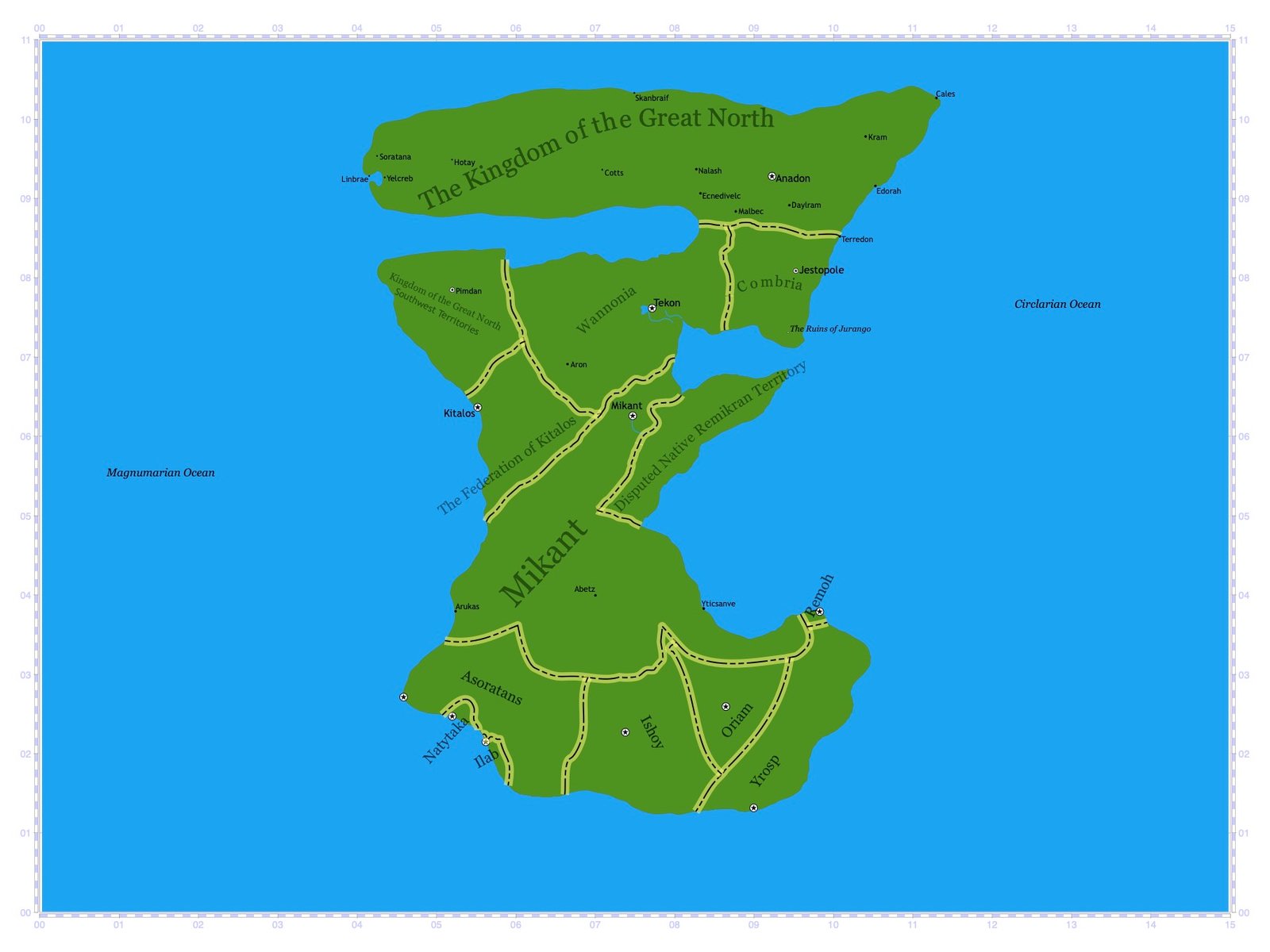
Combria: 1100-1125
Between the years 1100 and 1125, Combria achieved unprecedented population growth and economic prosperity, as an additional trade alliance was formed with neighboring Jurango.
President William Jeson was descended from the Kontacet family; however, pressure from the Leon family, from whom his wife, Maria, was descended, led Jeson to enact a few somewhat "sketchy" deeds, i.e. tax exemptions. The epitome of such came with the arrival of Arthur Chadwick in 1127.
Arthur Chadwick: The Early Years
Very soon after his arrival in Combria, the young Arthur Chadwick was appointed one of the Combrian National Councillors. Although favored greatly by the Leons, Chadwick's mysterious past alarmed the Kontacets. Nors Braedon, an assistant to Jeson in the mission against Taeac, ventured to Skanbraif, Chadwick's city of birth. Here, Braedon discovered that Chadwick had attempted the rape and murder of a significant noblewoman. Upon return to Jestopole, Braedon filed formal charges against Chadwick. On trial, Chadwick was convicted in the presence of plausible evidence; and Jeson ordered his removal from office as deportation back to the Great North.
Chadwick arrived back in the Great North in 1129, and was due to be arrested for his crimes; however, an anonymous family member bailed him out, privileging him from such an arrest. It was at this point that Chadwick saw his opportunity to return to Combria and regain his status.
Chadwick Seizes Power
In 1131, President Jeson developed an illness and became bedridden. Anticipating his death, he appointed George Mateon to succeed him, a move approved unanimously by the Council.
However, there was trouble within the Combrian population, as rural communities were increasingly unhappy with Jeson's open policies on diplomacy, primarily with the Wannonians and Jurangans. Chadwick began rallying these dissidents, vowing to stage a coup to overthrow the Combrian establishment and make himself President of Combria, and promising to, as President, revoke Jeson's rules. Between 1131 and 1132, numerous shootings and lynchings ensued, as President Jeson issued an order for Chadwick's arrest. However, Chadwick managed to evade the authorities. In December 1132, President Jeson died and was succeeded by Mateon. Within that month, Chadwick and his forces launched a coordinated attack on the capital city Jestopole, during which President Mateon was killed and the Kontacet establishment defeated. Promptly, Chadwick swore himself in as the new President of Combria.
In the year that followed, President Chadwick revoked the diplomatic trade policies with Wannonia, ordered the construction of a wall at the Wannonian border, and imposed tariffs on goods between Combria and Jurango.
1135: The Conquering of Jurango
By the end of 1133, Jurango was already beginning to suffer economically as a result of the tariffs. To dispel popular grievances against him, Chadwick authorized the continuation of the Bridge over the St. Eschel River, a project started by President Jeson years earlier. In 1135, the Bridge was nearing completion, but Chadwick witheld workers' paychecks until Jurango would surrender sovereignty of an island in the River further West. As a result, the Jurangan laborers rebelled and began tearing apart the Bridge, prompting Chadwick to deploy the Combrian Armed Forces. Jurango considered Chadwick's response to be an act of war and dispatched its own military forces, thus beginning the Combria-Jurango War. As the war was unfolding, Chadwick came forward with public determination to conquer Jurango and claim it for Combria.
Before long, the War came to a gridlock status; and Chadwick called upon Wannonia for assistance, promising to restore diplomacy with them as an exchange. Wannonia agreed only upon the condition that a portion of Jurangan territory was handed to them. By November 1135, the combined forces defeated the Jurangans and brought the Jurangan capital to utter ruin.
After the war, the Bridge project was continued by Combrian workers, and was completed in 1142. And that very same year, it was named Bridgetown. All Jurangan territories were now under the sole control of Combria, as Chadwick rolled back on his promises made to Wannonia. This would lead to diplomatic friction between the two nations in the years to come.
The Formation of the Federation of Kitalos
On 9 December 1121, King Andrew of the Great North gave the Southern portion of Pimdanian territories to Mikant. The local population in this region had been demonstrating public grievances over high taxes, lack of representation (as only Great Northerners could vote in Parliamentary elections), and the restriction of trade to Great Northern markets. As a result of this, the Kitalan nationality began to resurface. And thus, King Andrew's 1121 deal with Mikant would divide the population by constructing a wall between Great Northern and Mikanian claims, as Kitalans were made to build it, themselves, while the population would not be granted freedom of travel between the two regions.
Morstoros Imalan was a notable Kitalan who believed in Kitalan unity. As he was made to work on the wall, he began secretly recruiting rebelling forces. On 2 April 1124, these forces attacked, utilizing the mastered art of guerilla warfare via spellfire concealment and quiet gliders which served as an effective air force. The results were catastrophic for the Great North, as the conflict led to heavy casualties and the loss of Kitalos and surrounding territories. On 3 May, the threat of a coup in Linbrae prompted King Andrew, fearing further contempt by the humiliating costs of the war, withdrew Great Northern forces from the region and signed a peace treaty with the Kitalans.
The Mikanian Acquisition of Arukas, Abetz, and Yticsanve
In 1125, heroic stories stemming from the revolution in Kitalos inspired dissidents to overthrow the ruling power in nearby Arukas. In place of the overthrown Monarchy was established a federation. But by 1126, this democratic government was bankrupt; and, in a desperate financial deal, said government signed a deal to sell all of its territories to Mikant. Later that year, Mikant signed a deal with the Kitalan Federation to acquire Kitalan land between the two territories.
In 1127, Abetz and Yticsanve experienced coups in a similar way. Both of these territories, however, fell under relatively disorganized systems of martial law, against which dissidents in Abetz fought, in their nation respectively, leading to a brief civil conflict. In the ensuing chaos, Mikant bought and acquired both territories.