Wannonian Enhancement
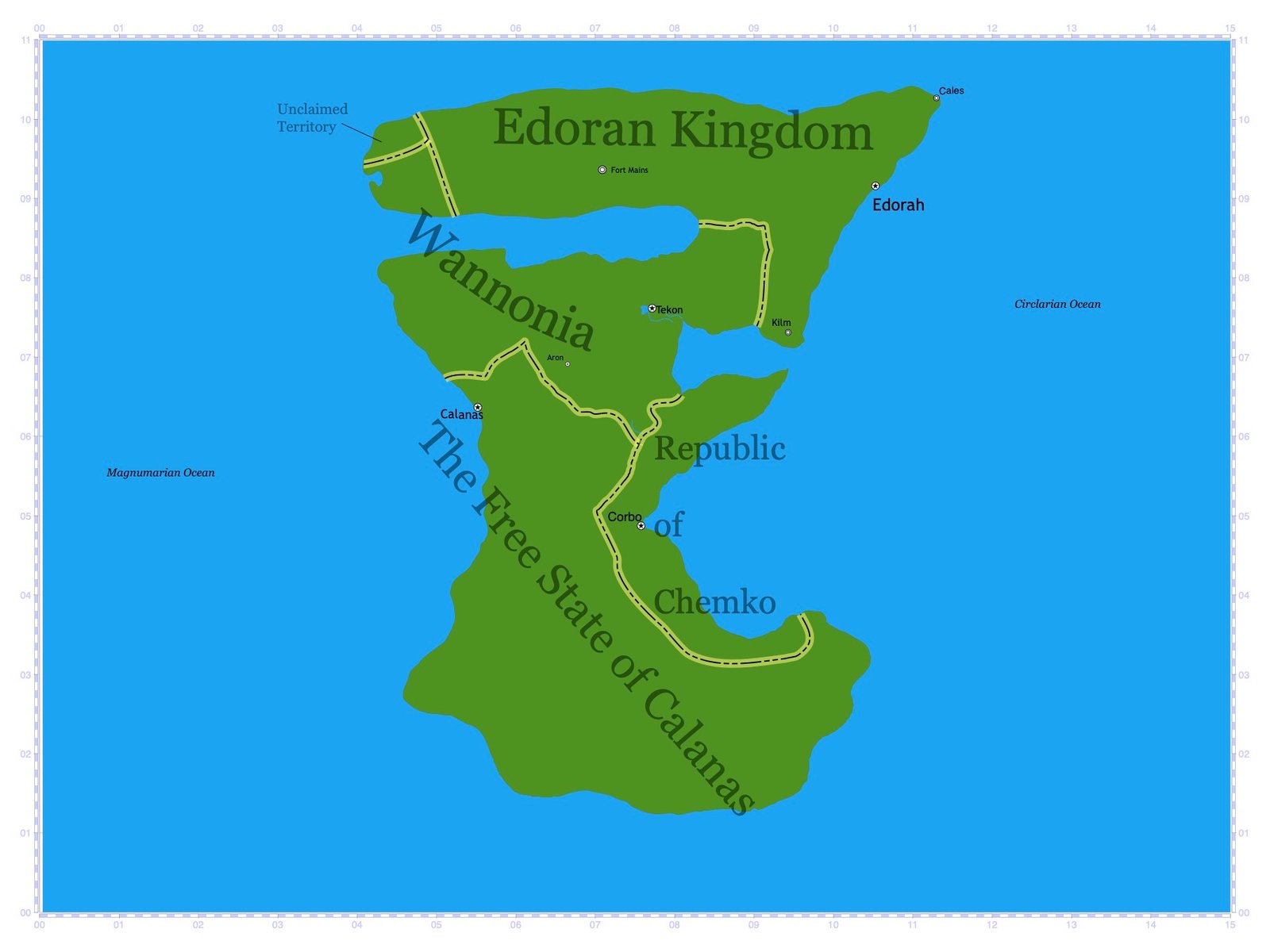
Such gridlock was broken when Zyron, a spy for Wannonia, went inside Fort Mains undetected. There, he heard information about the Edoran Commander, Gerald Commonwell, who had designed and still possessed plans for the Edoran catapults. Zyron also learned of the location of Commonwell. The Wannonian spy returned to Tekon and reported this to Emperor Kamon II, who, in November 113 CE, dispatched an assassin named Milon, who went to Commonwell's location: in the King's Castle in Edora proper. Here, Milon entered undetected and located the office of Commonwell, who he then killed, before finding the plans on the Commander's desk and took them back to Tekon. It was in Tekon that an engineer named Carthos expanded on the stolen plans. Carthos enhanced the catapult idea by employing flaxweed for twine, which help to increase projectile range. He then placed his entire prototype on a rotating base for better aim, designed a counterweight to help wind up the catapult faster, and expanded on the length and width of the catapult arm to load bigger rocks. Such rocks were laced by spellcrafters with various forms of stunspells.
Implementation
In June 114 CE, the Wannonians attacked Fort Mains and surrounding territories, employing the new catapult design. The Edorans could not reach them with their catapults, nor could infantry eliminate the Wannonian catapult bases without sustaining massive casualties. In September, the South Wall of Fort Mains came down; and the Wannonians charged in. Outnumbered, the Edorans, once again, fled to the Correns.
Compensation and Solution
Under King Richard's command, various engineers were paid to retrieve and enhance upon the Wannonian catapult idea. The Edoran Kingdom did have jurisdiction over a forest of silver pines, located in the Northeast section of the Moorlands. With enhanced forms of spellfire crafting at the time, rubber-like material could be made from its sap and wood pulp; however, such a material was not nearly as durable as flaxweed, all of which was owned by the Wannonians.
Between November and December 114 CE, a man named Samual Damsen, disguised as a Moorlander, entered the gates of Fort Mains, where he noted how the Wannonian catapults were constructed. Before he, mistaken as a Moorlander, could be transported back to Wannonia as a slave, Damsen escaped and returned to Edora with such ideas; and between January and April of the next year, the Edorans began construction on a new fleet of catapults. These catapults were further enhanced with the widening of the throwing end of the catapult arm, which also served as a slingshot. Here, the sling would be held from the ground until the arm of the catapult was untwined, and would then be released, launching the projectile a great deal more distance than the Wannonian catapults. The projectiles were also different, in that each was a ball of gravel, in which each piece of gravel was crafted with a combination of varying degrees of stunspells. On the catapults themselves were grassy surfaces so that they could fold down and conceal themselves in the grasses of the Moorlands.
Concealment and Strategy
In May 115 CE, two divisions of the Edoran Army, under King Richard II's orders, stationed themselves in and around Fort Mains. The first division tunneled to the interior of the Fort, one to ten soldiers at a time, and hid in a variety of planned locations, undetected and coordinated. The second division constructed the catapult-slingshots at two-thirds the calculated maximum range from the Fort, folding them into the ground until the signal was given. Such a signal would be given from within the walls of Fort Mains, in the form of a spellfire flare, by the spellcrafter, Kerlin. In June 115 CE, the Edorans attacked. The first division launched their assault at midnight; and the Wannonian commander holding the Fort was immediately killed. Kerlin then launched the signal; and the second division outside the Fort erected their catapult-slingshots, launching their projectiles. After three days, the Wannonians either had fled or were killed; and the Edorans recaptured Fort Mains.
Assault from the Moorlands
At the same time, another Edoran division swept Eastward, trapping stationed Wannonians in the Corren Mountains. After three weeks, they surrendered and were taken prisoner by the Edorans. Meanwhile, another Edoran division swept Westward, taking the South part of the Linbraen Mountains while driving the Wannonians to the North. After eleven days of being cut off from the rest of the Wannonian forces, they surrendered.
The Fall of Kamon II
In September 115 CE, Edorans scaled the border walls and swept into Wannonian homeland, where they placed Tekon under siege. They demanded Emperor Kamon II to withdraw all Wannonian Legions from the North. When Kamon II refused, his closest advisor, Kentellus, abandoned him. Edorans then convinced poor Wannonian farmers to threaten to join Edorans in the eventual felling of the Imperial capital. Still refusing to surrender but having no other available options, Emperor Kamon II committed suicide by drinking poison. Within a week, the Imperial Court appointed Murstallar I to become the next Emperor; and in October 115 CE, after succeeding at negotiating the keeping of the Linbraen Mountains in exchange for charging no tariffs for the silver pines in that region, Murstallar I signed a peace treaty with the Edoran Kingdom, thus ending the war.
One year later, the Khaps drove Wannonian forces out of the Northern part of the Linbraens.