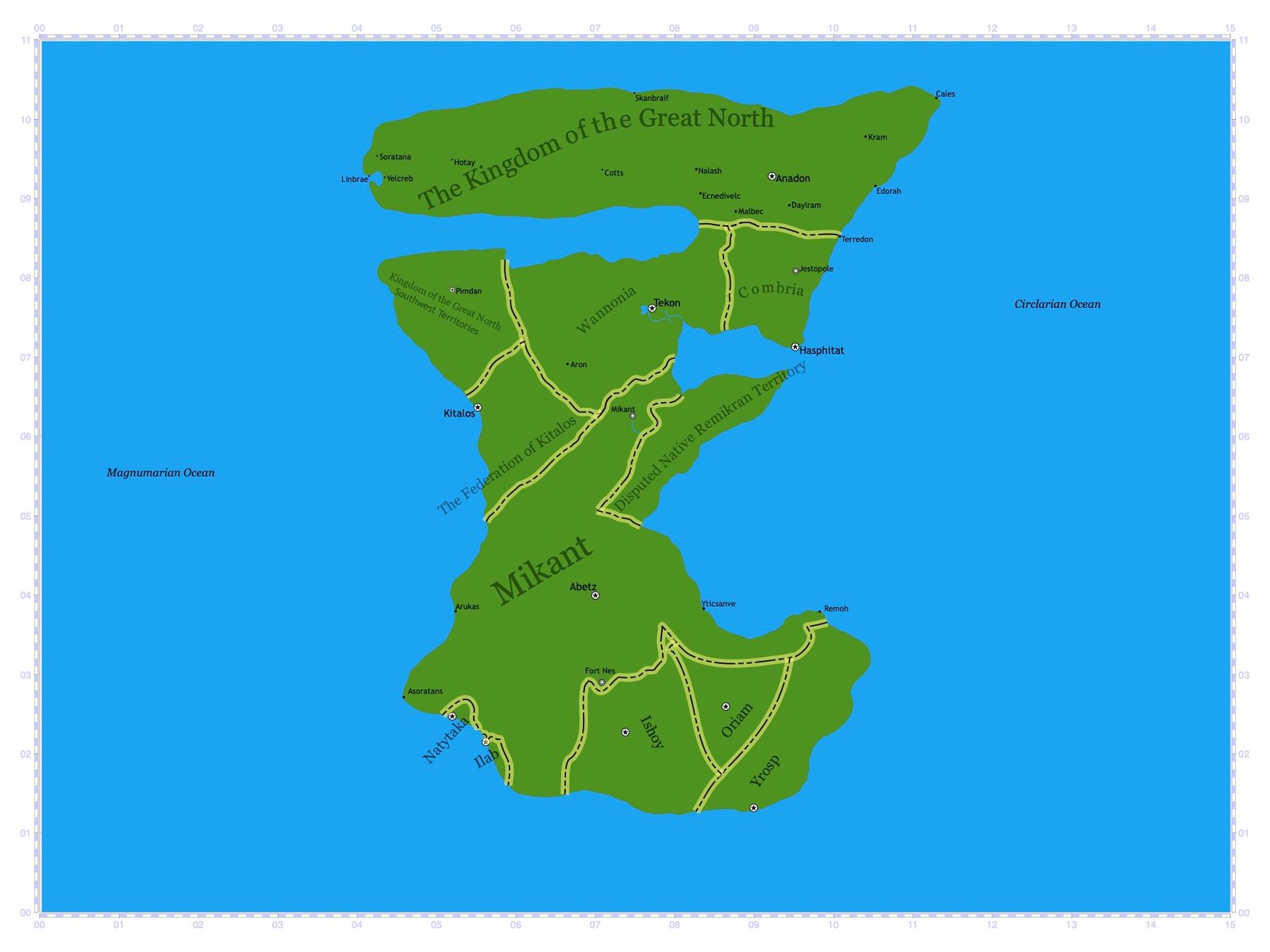
The Combria-Wannonia War
Between 1142 and 1143, Wannonia began enhancing its border wall with Combria, while Combria continued the building of theirs. Both sides during this time recruited more soldiers and erected more bases throughout their territories. In 1144, tension nearly broke, but ended with the meeting of Combrian President Chadwick and Wannonian Emperor Clastye I, who both signed a mutual peace deal to demilitarize the walls and bases. Six years later, Emperor Clastye I died and was succeeded by his son, Clastye II, who enacted heavy tolls upon Combrian travelers in an attempt to compensate for the property value lost from the Jurangan lands being promised but not given to Wannonia. Chadwick responded to the tolls by issuing traveling restrictions for Combrian businesspersons and denying entry to Wannonians, enforcing such measures at the border wall. Clastye II condemned this as a violation of the peace deal of 1144.
In 1151, Wannonia began resumed the militarization of its wall and sent a letter to Chadwick, demanding Jurangan land or reparations, or that there would be a conflict. Instead, Chadwick sent more Combrian forces to the Wannonian border and throughout the former Jurangan territories. Further North, at Null's Edge, Wannonian and Combrian forces clashed, as Chadwick's forces struck first, beginning the war.
Chadwick initially had the leading edge in this conflict, boasting of his great number of tanks and airships, as well as biplanes and a new innovation: high-winged airplanes. The Combrians gained Wannonian territory, but such gains were limited by the greater number of Wannonian soldiers, the ability of Wannonian cannons to strike the low-flying biplanes, the lack of a proper place to land Chadwick's modern aircraft, and the ability of Wannonian watercannons to effectively immobilize Chadwick's tanks. For most of the war, trench warfare ensued between infantry divisions. And Chadwick would blame ensuing domestic hardship on local indigenous groups and outspoken political opponents, carrying out measures against these two demographics.
Mikanian Acquisition of Asoratans and Remoh
Later in 1151, the Wannonians, in violation of an earlier treaty, backed a coup in the nation of Asoratans, which successfully toppled its monarchy and led to the rise of an authoritarian presidency. The Asoratanian regime invaded Mikant, where the strategy was to then attack Combria's Southern coast from the Inland Sea. However, Mikant, proving better-resourced and more cunning in strategy, outmaneuvered and captured the lands and capital city of Asoratans.
In 1152, pirates attempted to capture the city-state of Remoh. However, Mikant supplied mercenaries and supplies to them, helping them to effectively eliminate the attacking fleet. Having struggled with bankruptcy since decades past and fearing further pirate attacks, the Remohan crown sold its assets and territories to Mikanian sovereignty.
1153: The Homestead Alteration Deal
Nevertheless, the Remikran Union continued to experience problems with pirates and Wannonian forces. The Wannonian attempt to invade Mikant and conquer Combria from the South, despite being a failure, alarmed leading members of the Union. In contribution, Wannonian policies of the 1130s and 1140s forced many to become involved in black markets and join the ranks of the pirates. Many of these recruits compounded the maritime threat against Mikanian, Combrian, and even Great Northern coastlines. The three powers, in response, set up numerous coastal defenses. But such operations were costly, prompting a call for a new arrangement. In 1153, the Remikran Union, with most of the driving coalition coming from the Great North, formed the First Deal of Homestead Change, in which the Edoran Regiondom would move to Terredon, Combria would construct a fortress at the mouth of the Inland Sea, and Mikant would move its capital to Abetz.
In 1151, under President Chadwick's orders, construction began on the fortress. A round knob at the mouth on Combria's Southern Coast was flattened out so that its height was approximately 50 feet above sea level, while large amounts of granite-stone were mined from the surrounding quarries. Such material was used to construct a large diamond-shaped base about five miles in diameter. The Southern half of this would sit on the flattened-out slab sticking out into the Sea, while the Northern half went inland. The structure would contain four tiers traversed by inclines along diagonals extending from the center to the corners. The fourth tier would be occupied by a large command post, while the surrounding tiers and lands would begin developing into urban districts. The project was completed by the end of 1164.
The End of the Combria-Wannonia War
In 1163, President Chadwick launched the Aronian Offensive, in which high-winged planes dropped bombs upon the city of Aron, eliminating key strategic points. A second wave, consisting of biplanes, destroyed remaining defenses while armed infantry stormed the city, which fell that November. Aron and the Southerly Wannonian territories, including the Inland Sea coast, fell under Chadwick's control.
In the following year, Chadwick planned and launched a similar offensive upon Tekon, the capital of Wannonia. But this time, the Wannonians had launched two new inventions: missiles and revolving-bullet shotguns. Thus, the Tekonian Offensive was a disastrous failure for Chadwick, as Wannonians regained land in the South and recaptured Aron. As Chadwick's forces were made to retreat, Combrian balloons dropped spores of the Great Blight Fungus upon the flaxweed fields, a move that would eventually lead to Wannonia's downfall in the years to come.
In October 1164, Wannonians invaded Combrian territory, forcing Chadwick to surrender. On 2 November, a treaty was signed between the two powers, in which Chadwick withdrew the remainder of his forces from Wannonia. Furthermore, Chadwick was permitted to keep all former Jurangan territories under Combrian jurisdiction before the war, but had to pay reparations.
After the War
Such a loss in the war led to the worsening of conditions for Combria; and Chadwick continued to blame indigenous groups and political opponents for the misfortunes. In spite and hatred, he launched what became known as the Combrian Pure-Blood Campaign, in which masses of people related to the two groups of targets were subject to arrest, imprisonment, and brutal execution. Members of Chadwick's own Council turned against him for this, but Chadwick would have them executed as well.
Originally an appealing idea because of strategic advantage in the war against Wannonia, Chadwick decided to move the Combrian capital to the new fortress, now named Hasphitat. With an ever-increasing number of members turning against him, a majority in Chadwick's Council became opposed to his idea of such a move, which he revived after the war. However, Chadwick invoked a clause in Combrian legislation, which allowed his loyalists within the Council to vote themselves out of office, leaving room for these people to form a new Council of their own.
On 3 January 1165, Chadwick and his loyal Councillors established themselves in Hasphitat's command post, which they named the Chadwick Building. They promptly declared all Combrian territories to be under Chadwick's sovereignty. Councillors in Jestopole were unhappy with Chadwick's decisions, as a rumor was formed that he had also moved there to satisfy his second wife, Mara Jameson, and give her family a share of power. He furthermore subjected the Council of Jestopole to taxation.
A rumor reached Chadwick that one of his own loyal Councillors in Hasphitat was plotting to assassinate him. In response to this, on 4 March 1165, Chadwick suspended all functions of his own Council and deported all of his members to the North. Later, another rumor informed Chadwick that some of his closest advisors, including even his own wife, were plotting to assassinate him. So, on 2 December 1165, Chadwick vacated the Presidency and fled Hasphitat.
Chaos and Changes in Leadership
Chadwick's sudden departure gave the deported Councillors a reason to return, as the Leons and Jamesons volleyed for power. Over the next year and a half, civil war ensued as the Office of the President was left unoccupied.
In March 1167, a representative of House Esary, from the Hoblandish nation of Notulfa, intervened and instilled Marran Jameson, the father of Mara Jameson, as the next President. Jameson presided over the unstable nation, leading with a firm hand, before dying of heart failure in November 1173. With no successor in place, the nation, once again, fell into civil conflict before House Esary intervened for a second time and placed Marran Jameson Jr. in the same Office. President Jameson Jr., however, was assassinated on 11 February 1174, as the guilty party, the Leons, placed Karl Raess in power. On 3 November 1180, Raess died, suspiciously from poisoning, and, four days later, was replaced by Thomas Chadwick. On 5 May 1182, the Jamesons hired an unknown agent who assassinated Chadwick; and five days later, Harold Jameson became the President.