Historical Context: Calanasian Establishment
In 698 BCE, the Calanasian Council voted to grant all slaves universal pardon and abolish all forms of future slavery. Furthermore, involuntary labor, as a form of criminal punishment, was limited in time duration and was to be handed only to the wrongdoers when convicted. All labor in the Free State of Calanas was, from that point forward, carried out by either private/family deals or by guilds and their members. Between 700 and 360 BCE, all guilds in Calanas were traditional, needing permission from the Council to be established; and such guilds existed by region. When appropriate, permission regarding such establishments was granted by local Councils; and approvals or disapprovals on behalf of such Councils could be overturned by popular petition. Furthermore, the Councillors themselves, the deciders, were elected by the people, creating incentive, early on, to make democratic decisions. As was the case in the Republic of Karlin, family lines of guild professions dissolved as guild members were free to join or leave guilds at will.
Historical Context: Calanasian Guild Corruption
It was around 360 BCE, however, that issues similar to those in Wannonia and Karlin began to emerge with traditional guilds in Calanas. They took advantage of the involuntary labor, which was unpaid, while larger guilds bought the assets of smaller ones. In the end, very few large guilds remained, resulting in higher prices of goods as well as a sharp economic divide. In response to this, the Calanasian Council passed a measure, similar to the Karlinians, that limited wealth acquisition and asset ownership, in which exceeding such limits resulted in the imposition of a large tax designed to break each large guild into smaller ones. The measure, furthermore, abolished all forms of involuntary labor, even as criminal punishment, as well as allowed the existence of independent guilds. Between the 350s and 150s BCE, independent guilds, which did not require any approval from any Calanasian Council to exist, promoted a free and competitive market, leading to the rise of a large middle class. However, by the 230s BCE, similar issues arose with independent guilds. Because the Calanasians copied written law addressing this from the Karlinians, independent guilds, such as the ones in Karlin, were exempt from the wealth and asset limits, as well as the large taxes. Inevitably, large guilds bought the assets of smaller guilds, which, accompanying the obsoletion of traditional guilds, led to a return to higher prices for goods as well as a distinguished rift between wealthy and poor economic classes. In the summer of 234 BCE, such corruption led to a popular backlash, resulting in the emergence of the First Tahnish Rebellion. Such a Rebellion shut down Calanasian infrastructure across the Free State; however, the dispatch of Calanasian Legion troops eradicated the chaos within a few weeks, as they forced the Tahnish out of the Calanasian communities.
Owners of the large Calanasian guilds, fearing reforms similar to the ones passed in Karlin 100 years earlier wasted no time lobbying the Calanasian Council to pass laws permitting the establishment of independent guild communes.
Historical Context: Independent Guild Communes
Independent guild communes in ancient Calanas created the illusion of wealthy living standards for most of its members, who joined these organizations voluntarily. As members of these communes, they were given food, water, and large sections of land for no gold, silver, or copper in compensation. These members also attended recreational activities such as mock fencing tournaments. However, such fortunes were given in exchange for certain obligations, such as unpaid labor in certain times and places as commanded by guild ownership. The large sections of land, including all of its food crops, were shared with other guild members. Furthermore, the attendance of the recreational events was dictated and mandated by the guild owners. Failure to adhere to such guild rules resulted in expulsion from the guilds. By the beginning of the Common Era (in accordance with the Edoran Calendar), the incentive to join and remain in an independent guild commune was driven by the notion that such parties owned most of the Calanasian land and resources, as well as the climate change since 25 BCE, which led to food shortages. Those alienated by the Calanasian independent guild society were left with little to no food or resources.
Historical Context: Tahnish Oppression
In addition to the corruption of the independent guild communes, the Tahnish faced marginalization overall. Originally living in various settlements and encampments throughout the Interior Desert, the Tahnish, by this time, began practicing their own version of monotheism, incorporating the Totian Emperor Kestaven's doctrine of redemption. However, they also practiced speaking to the dead via soul gems. Only some of the Tahnish followed such religious beliefs, and warred with those who followed polytheistic beliefs. Such warfare drove members of the Tahnish population to taking refuge in the Calanasian communities, where they were initially openly rejected as "odd" for speaking to the dead. In 331 BCE, the Calanasian Council passed laws allowing the Tahnish to join guilds. However, resistance from the guild owners and members helped contribute to an atmosphere of controversy in the government within the 100 years that followed. As the independent guild system grew increasingly corrupt, higher prices and economic divide led the poor to dispute over the few-remaining resources, during which the Tahnish usually faced some degree of exclusion. In 241 BCE, a measure to rid such acts of discrimination failed in the Calanasian Council; and the election that followed brought about Councillors who legalized such discrimination and passed laws forcing the Tahnish to live within certain districts of cities and provinces. That was what led to the First Tahnish Rebellion in 234 BCE, when oppressed Tahnish populations within the assigned districts of each provincial capital rose and shut down infrastructure, unleashing a wave of terror in the form of structural fires, raids, and killings. The Calanasian Council dispatched soldiers, who ended the rebellion quickly. All Tahnish people were subsequently expelled from Calanasian lands and were forced to return to the Interior Desert.
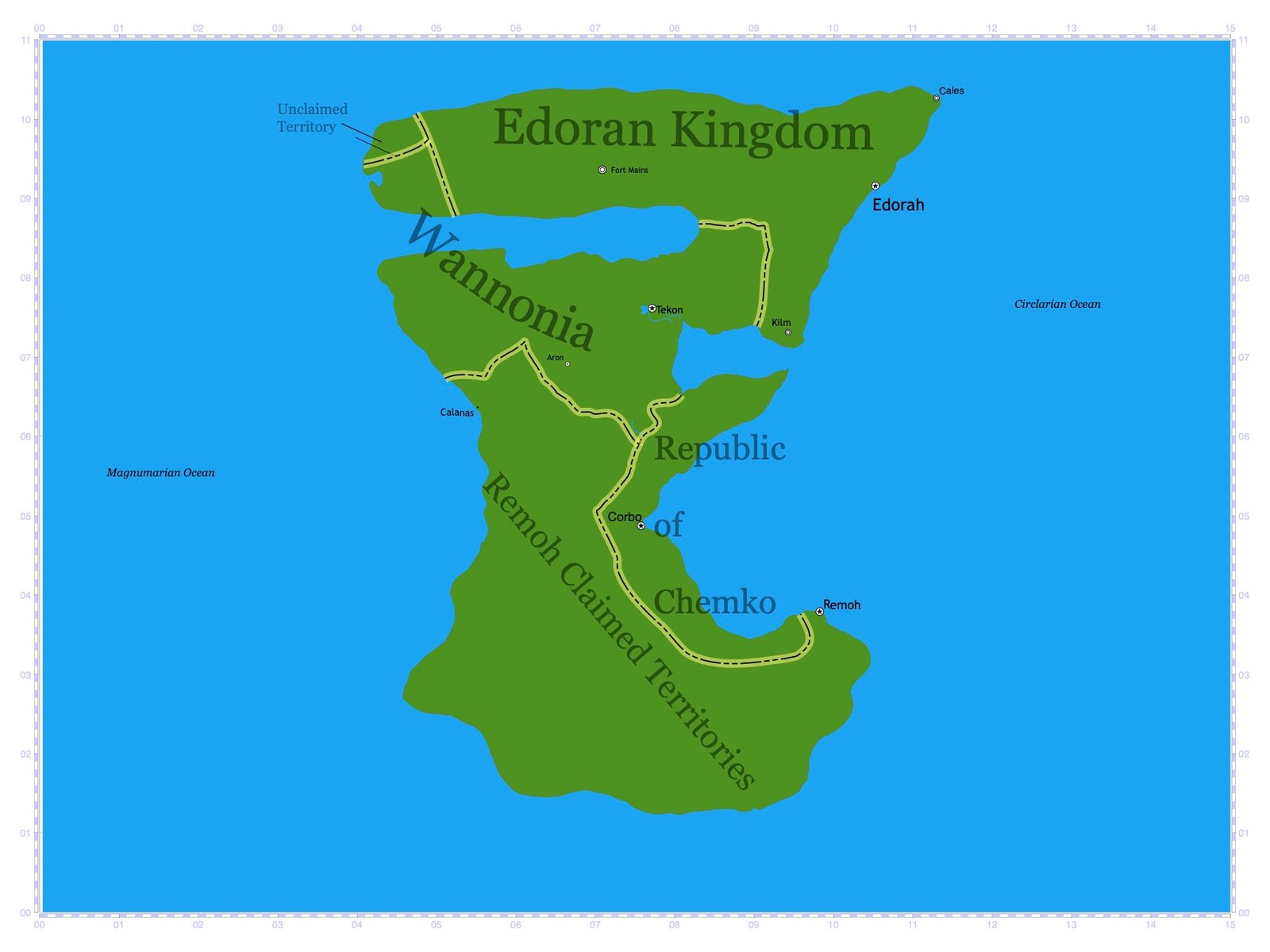
In CE 87, the Tahnish formed an armada, which began attacking Calanasian cities, beginning the Second Tahnish Rebellion. After more raids, fires, and killings, Calanasian soldiers, once again, ended the Tahnish wave of terror, forcing the Tahnish to live in two places: the Interior Desert and Remoh. Such places thus existed as managed reservations, which were guarded by the Calanasians like large prison blocks.
Remoh: The Overthrow of Calanas and the Rise of the Remohan Kingdom
By the 110s CE, Calanasians were forcing the Tahnish into smaller perimeters, resulting in a hellish upbringing for a Tahnish man named Solon. Growing up, Solon experienced the oppression carried out by the Calanasians in the form of regular community raids, where valuables and resources were stolen and family members were killed. In March 120 CE, Solon rose against the oppression and killed a Calanasian soldier. He was promptly arrested and sent to a prison in the Interior Desert, where he was sentenced to be beheaded. However, nine months later, the Tahnish in the region overthrew Calanasian Legion forces and freed Solon, who then travelled to the city of Remoh, where he led a large mass of Tahnish forces to overcome the local Calanasian forces. Anticipating retaliation, Solon organized the Tahnish masses into armies; and in June 121 CE, he planted divisions of Tahnish rebels at each of the provincial capitals, where they attacked on the same day, as part of a coordinated plan. Solon then launched the rest of his army toward Calanas proper, placing it under siege in October 121 CE. In March 123 CE, with almost the entire city on the brink of starvation, the Calanasian Council surrendered to the enemy by voting themselves out of existence and opening the city gates, through which Solon's soldiers stormed, destroying the city.
In October 123 CE, Solon returned to the city of Remoh and crowned himself King, establishing the Remohan Kingdom.