Fall From the Peak
From the late 1000s to the early 1200s, trade had been flowing between Remikra in the West and the Motanian Empire in the East. Notable crossroads such as the Midland River States, the Canticulan West Peninsula, and the Circlarian Coast of Remikra became very prosperous as a result. With the occurrence of the Meredythian Forum in 1206, peak prosperity was achieved, as financial figures began predicting even more growth in the years to come.
But then, on 12 April 1209, a notorious group of aggressive sea merchants, known as the Vandalians, under the leadership of King Vandalish, attacked and defeated the Motanian Empire. Short-changed by trade deals between the land powers over the previous two centuries, the Vandalians held contempt toward the Circlarian trade network, while noting a weakness in Motanian defenses, which were thinly stretched across vast distances of land and sea. And it was on 12 April that they took advantage, staging a coordinated attack on the Motanian capital, which caught Imperial defenses off-guard. In the end, the Emperor was assassinated, while the city fell and the Empire split into various military factions, which, in the months and years to follow, would fail to restore order in the region. Meanwhile, trade from the Motanian Empire ceased, bringing financial ruin to the markets in the Midland River States. As the Midland River State markets collapsed, trade was halted to the West Peninsula, which also collapsed economically.
In Remikra, sea trade declined significantly as a result, but economic collapse was prevented by the robust presence of domestic industries. Nevertheless, fear and terror from the fall of the Motanian Empire worsened political tensions in the Great North.
The 1225 Great Northern Double-Coronation, The Continental War Effort, The Revised Homestead Act
The economic turmoil resulted in building tension between Northern and Southern nations in Canticula, which manifested into civil conflict on the Peninsula, as the nation of Lesterre gained independence from Furthing, forcing other allied nations to join the conflict, thus beginning the Continental War in 1221.
Combria and the Great North demonstrated friendliness to the Northern Alliance in Canticula, by providing arms, ammunition, and resources to those nations. The Remikran nation of Locin was adamantly opposed to this and the Northern agenda in Canticula, but did not send help to the South, fearing diplomatic friction with the Remikran Union.
On 21 March 1225, King Peter and Queen Rebecca were coronated. As King and Queen, they vowed to improve the economy by scheduling the Circlarian Coast and North Meredythian Forums, to take place in 1226 and 1231 respectively. They also forged peace deals between independent Great Northern militias and duchies to dispel tension, which did not eradicate but nonetheless softened civil violence. And they, furthermore, authorized mercenaries to serve in the war being fought in Canticula. This sparked political controversy, as the Kitalans felt oppressed, themselves; and such sentiment began spreading throughout Combria. Lastly, the King and Queen forwarded a proposal for a Revised Homestead Act, which would cement an expansion in trade for economic stimulus.
In 1226, the Continental War in Canticula was won by the Southern democratic nations, dealing a blow to the North and its allies. In Combria, Kitalans and other minorities were inspired by this, embracing the idea of democracy. Fearing that this would lead to friction in the future, King Peter and Queen Rebecca amended the Revised Homestead Act to have Combria establish security measures in present-day Nintel to quell any potential insurgencies.
On 23 March 1227, the final version of the Revised Homestead Act was signed into law in the Great North and became ratified in the Remikran Union. Under this piece of legislation, large pieces of land in the Great North became purely of Remikran Union sovereignty, freeing them from laws of any Remikran nation and only subjecting them to Remikran Union regulations. Remikran Union Citizenship was also established, granting all people born in a Remikran Union nation such status. All border walls, especially the one between Locin and the New Combria district, were demolished in an attempt to grant all Remikran Union citizens the "right of passage."
President Henry was charged with the duty to construct a large military complex in the West. Bending to a proposal, he chose a location near Lake Maern, where a large circular lake was to be constructed between the Maernrunning and Eastrunning Rivers, in which would "float" a large semi-sphere with a flat top. Such the latter was named the Basin District, and would rotate, like a large clock, on a regular daily schedule, with its motion powered by a combination of the two opposing rivers and a special gyro-mechanism. In and around the Basin District would be constructed sophisticated military defenses, while civilian structures would be built. Such an engineering masterpiece would facilitate trade between the East and West Coasts while providing extra security for present-day Nintel.
Economic Revival in Combria, The Cotts Treaty of 1231
Although the 1226 Circlarian Coast Forum was compromised by the outbreak of Red Fever in Hasphitat, it provided incentive for the anticipation of the upcoming Forum of 1231. Throughout the late 1220s, sea trade revived while Combrian factories adhered to popular demand with the production of family-owned planes and airships.
The year 1231 is a notable one for scholars. During the North Meredythian Forum, trade was successfully re-established with prominent Meredythian trade merchants. In Combria, President Henry utilized revenue from this to fund the Basin Project, which officially began construction on 3 November of that year, after many delays. On 18 October, Edoran duchies fell victim to a coordinated attack by the ultra-Evangelist militants, against which the Edoran Regiondom and Great North responded with a measure to keep the aggressors in check within certain perimeters. That autumn, all Duchies and both Regiondoms in the Great North met in a special council in Cotts, where, on 2 December, they signed a peace compromise. Under what became known as the Cotts Peace Compromise, both Royal seats and Parliaments of the Edoran and Linbraean Regiondoms moved to the city. To further quell political frictions, open debate venues were established to resolve issues not otherwise able to be solved in Parliament or the Court. And most importantly, the Kingdom of the Great North banded with the Edoran and Linbraean Regiondoms to form a Peace Corps division, charged with the duty to curb militia violence.
1230s: Crisis in Asil
Since the early 1200s, the city of Asil had effectively established itself as a prominent center of trade. As it expanded tenfold, Asil contained large wealthy districts with beaches and baths, while inner districts served as affluent marketplaces. Numerous piers along the Bay and Coast served for the docking of trade and tourist vessels, while ancient Kitalan relics were restored, providing additional attraction.
There, however, arose an issue, in which both urban and rural regions tended to have Combrians living in the affluent areas, while Kitalans and minorities lived in the poorer ones. Such a rift existed since after the Bandits' War, and grew from year to year.
In 1216, Gerald Hall was appointed the Governor of Asil. Having an attitude of prejudice against the Kitalans and minorities, the Governor frequently associated them with theft and "witchcraft." In the years that followed, Governor Hall gradually implemented discriminatory laws, which subjected these oppressed groups to lower wages, less tax exemptions, limited access to institutions like schools and libraries, time and venue limits to public expressions such as speaking before the Council of Asil, and the allowance for businesses to discriminate against them. In the late 1220s, these groups began staging numerous public protests. In 1231, Combrian and Great Northern tourists unhappy with the presence of the protesting Kitalans and minorities petitioned a grievance of such to Governor Hall, who responded with the Zoning Ordinance of 1231. Under this provision, wealthy market districts, beaches, baths, and educational institutions required a certain visa for visitation. Such visas were granted at-will by Court Mediators, who, appointed by Hall, usually discriminated against the Kitalans and their allies. Furthermore, main roads and avenues required heavy tolls, with exception to the visas.
In October 1233, a Kitalan named Hindero Kori protested the Ordinance by staging a "walk-in" to one of the restricted areas, where he was promptly shot dead by a Combrian resident. Hall's authorities imprisoned the entire Kori family for the act, while the killer was not only not prosecuted, but awarded an honorary medal. Widespread protests were carried throughout the city as a result. To the front of these protests came two brothers, Terman and Gabon Stero, who united the Kitalans and their sympathizers into a single coalition, calling themselves Savelians.
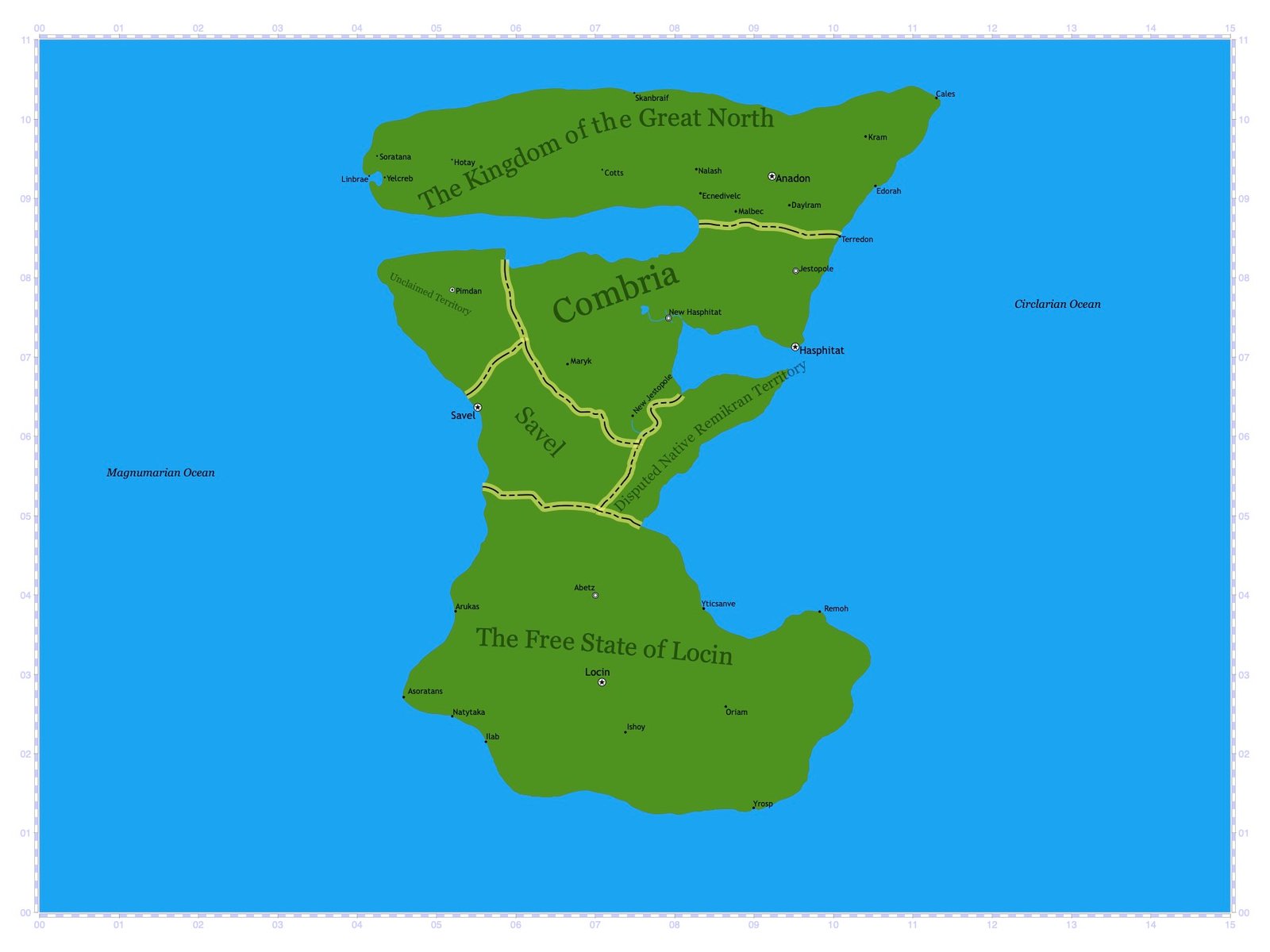
On 3 September 1235, the Stero brothers led thousands of protestors in a walk-in, forcing their way into the Government Square. Under Hall's orders, martial law officers massacred great numbers of them, killing Gabon Stero in the process. Over the next two weeks, Terman Stero organized his followers into a unified military force. And on 17 September, they stormed the city of Asil, forcing Hall to flee, as the city and countryside became the independent nation of Savel. President Henry refused to recognize the new sovereignty, calling the Savelians members of a criminal organization and sending in Combrian troops to confront them.
The Completion of New Hasphitat
On 5 January 1236, the Basin Project was officially completed, and the city of New Hasphitat established. It was at noon on this day that the Basin Clock began to turn.