Calanasian Refugees
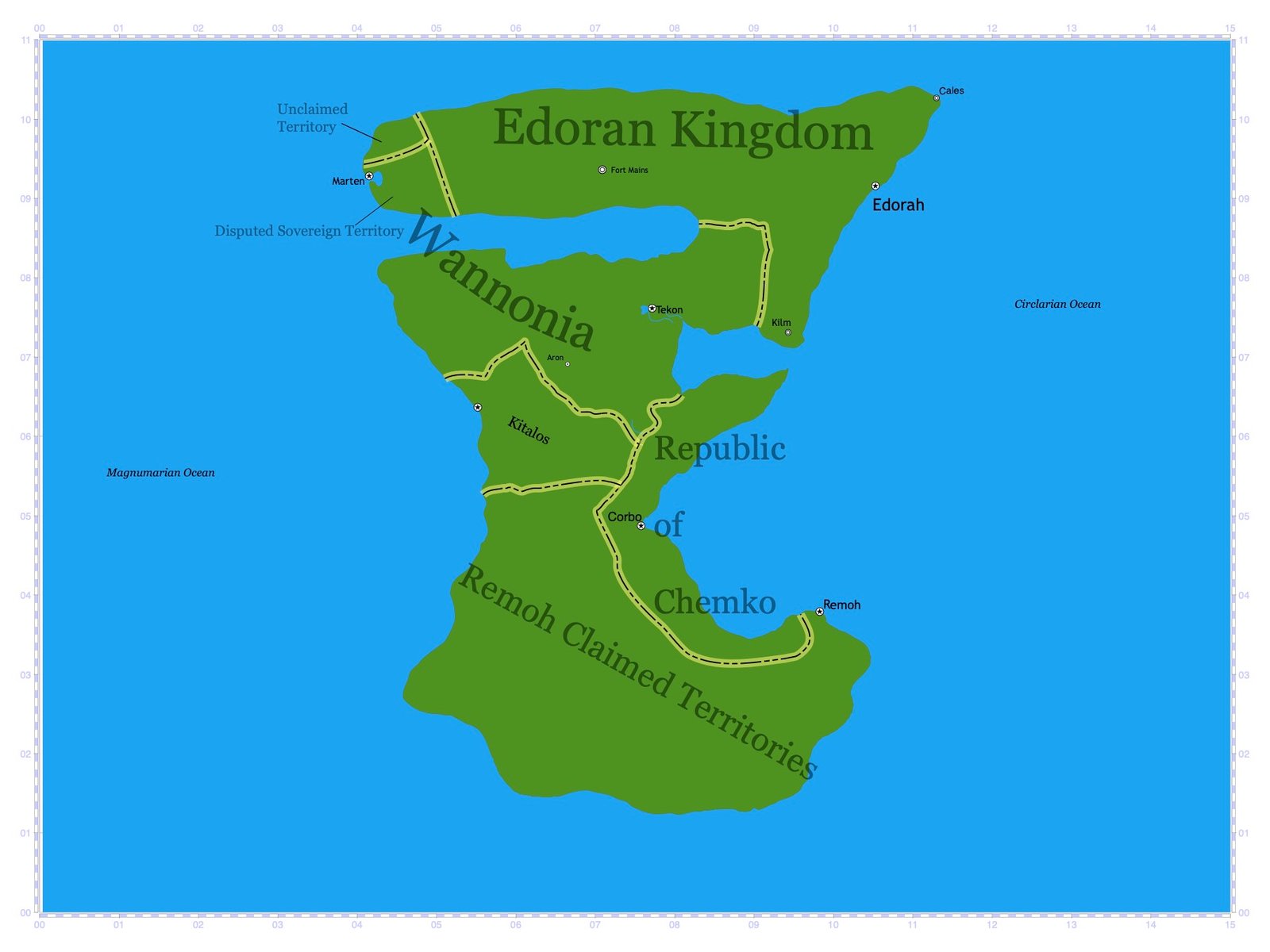
Escaping the fall of Calanas, Calanasian refugees fled to four areas: the Calanasian countryside, the Pimdanian Mountains, the sea merchant routes, and Wannonia. In the Calanasian countryside, or the Magnumarian Shield, woods and grasslands prevailed, as the area was quite remote further East, inhabited mostly by wildlife like deer. Fruits and grains were still plentiful during this time, making it easier for refugee encampments to move to other locations in the event of Remohan encounters. Nevertheless, the refugees here were constantly running to escape the brutal Remohan warriors. Meanwhile, in the Pimdanians, the climate was colder and harsher, where sources of food were more difficult to find. Furthermore, bears and wolves presented a constant threat. Those Calanasian refugees who joined the ranks of the sea merchant guilds increased the population of such traders, thus expanding and re-establishing trade routes over the Circlarian Ocean. In Wannonia, a group of Calanasians met a man named Hemos, who was born in Wannonia but whose parents were of Kitalan and Calanasian descent. The family adopted the Alconist religion, which was a partial inspiration from the happenings of the establishment of the Edoran Kingdom; although Hemos held his personal Alconist beliefs to be independent of Edoran influence. Against Murstallar I's policies, Hemos established a commune and monastery for the refugee community.
Kitalan Enlightenment
In October 124 CE, Murstallar I discovered Hemos' commune and expelled the refugees. With them, Hemos traveled, as they wandered back into the former Calanasian territories, now claimed by the Remohans, who found and killed some of them. However, Hemos and his followers, lucky enough to spare themselves from Remohan encounters, found an untouched Kitalan canton in the Magnumarian Shield, where there existed a local Kitalan Library. It was here that the Calanasian refugees studied knowledge on Kitalan society from before even the Totians came, learning about its policies on democracy, religious freedom, openness to other ethnicities, and the economy. By February 125 CE, this community was transformed into a neo-Kitalan commune. However, such a commune was divided, with those who wanted to preserve democratic principles as learned, opposed to and by those who wanted to preserve a Kitalan state through a single authoritarian regime. In March 126 CE, this commune was discovered and attacked by Remohan warriors, who nearly defeated the newfound Kitalans. However, Hemos organized an army, who successfully fended off the enemy.
Recruitment
Success in defending the commune sowed inspiration in Hemos, who now wanted to recruit an army and defeat Remohan forces in Calanas proper. Such recruitment was helped a great deal by Korban, a sea merchant and close friend of Hemos, who knew of the refugees in the Pimdanians. By September 126 CE, Korban effectively drew large numbers of Pimdanian refugees to the defended commune to the South, where Hemos indoctrinated them on the superiority of the Kitalan ethnicity, blaming democracy and lack of religious morale for the fall of ancient Kitalos to the Totians and instilling the belief that they all were obligated to reclaim the city of Calanas to destroy it and restore the old Kitalan structures. However, following the Alconist faith, Hemos charged his new recruits with building churches and monasteries instead of the old Kitalan temples. Furthermore, Hemos would establish a line of Kings to rule from Kitalos, preserving the newly established nation.
Battle and Victory
Hemos and Korban wasted no time preparing for battle, setting up seventeen secret fortresses along the Southern edge of the Pimdanians. In March 127 CE, the Kitalans launched a wave of attack upon the occupied city of Calanas. In Calanas, the Remohans, lacking strategies and defense engineering to preserve their newly acquired territorial spoils, were ill-prepared; and very shortly, Calanas fell. In the wake of Calanas' capture, Remohans were either slaughtered or taken prisoner. Subsequently, Totian and Calanasian buildings were demolished via spellfire discharges, with parts of these transported to a secluded location not far from the city. And in October 127 CE, Hemos crowned himself King of the Kitalans.
The Kitalan Restoration
The parts from the aforementioned secluded location were, upon King Hemos' orders, transported back to the city, where they were used to rebuild and restore the old Kitalan buildings. However, there were a few exceptions. First, a large palace was built for the King. Second, a large Alconist cathedral was constructed on the other side of this palace from an elaborate town square. Meanwhile, throughout the newly-claimed Kitalan territories, churches and monasteries were built. Kitalan territorial boundaries were officially drawn in the years that followed, as large walls were constructed to face the Remohan territories, as well as Wannonia, against whom Hemos had a grudge. Fortresses and castles were built throughout the land as a second line of defense.
In the city of Kitalos proper, King Hemos ruled with an iron fist, building a government structure of absolute monarchism to reflect his philosophies. Like the Edorans, he established the Alconist faith to be the only acceptable practice of religion, and, very soon, began persecuting those opposed to his doctrine, as well as those opposed to the idea of having a King.
The Flight of the Persecuted
Between 127 and 129 CE, those persecuted by King Hemos fled North to the lower sector of the Linbraen territories, which were still under Wannonian jurisdiction. Such an area, however, was quite remote, and provided resources, in the form of fish for food and silver pines for fuel, so that Kitalan refugees could easily escape Wannonian authorities by going either further inland and into the mountains or to the remote coastal areas. It was here that they formed an alliance with the Khapian people, the regional indigenous population, who shared with them the grievance of having to live under an oppressive authoritarian regime. Very soon, the Kitalans, under the leadership of a man named Fredon, and the Khapians, led by Zohn, signed an alliance granting both sides mutual mercenary obligations. Soon after, they established Marten, a settlement along the South-facing shoreline of the present-day Bay of Linbrae. In anticipation of Wannonian intervention, they fortified the city with walls of wood, crafted large numbers of spears, bows and arrows, and swords, and trained large numbers of young, healthy males and females with no regard to ethnicity.
Wannonian Onslaught
In the early weeks of 129 CE, Wannonians discovered the settlement of Marten and dispatched a Legion to defeat them. In April, the Legion arrived, where they encountered a seemingly weak enemy front, through which the Wannonians easily penetrated before marching into Marten's interior. But it was in Marten's interior that the Wannonian Legion was ambushed and slaughtered by the rest of Marten's forces. News of this reached Emperor Marstallar I, who, in 130 CE, sent over three more Wannonian Legions. These Legions arrived to find Marten impenetrable, as heavy casualties were inflicted upon them by the relentless Martenian spears and arrows. Advisors repeatedly suggested to Murstallar I to end the costly war; but the Emperor was determined to see victory.