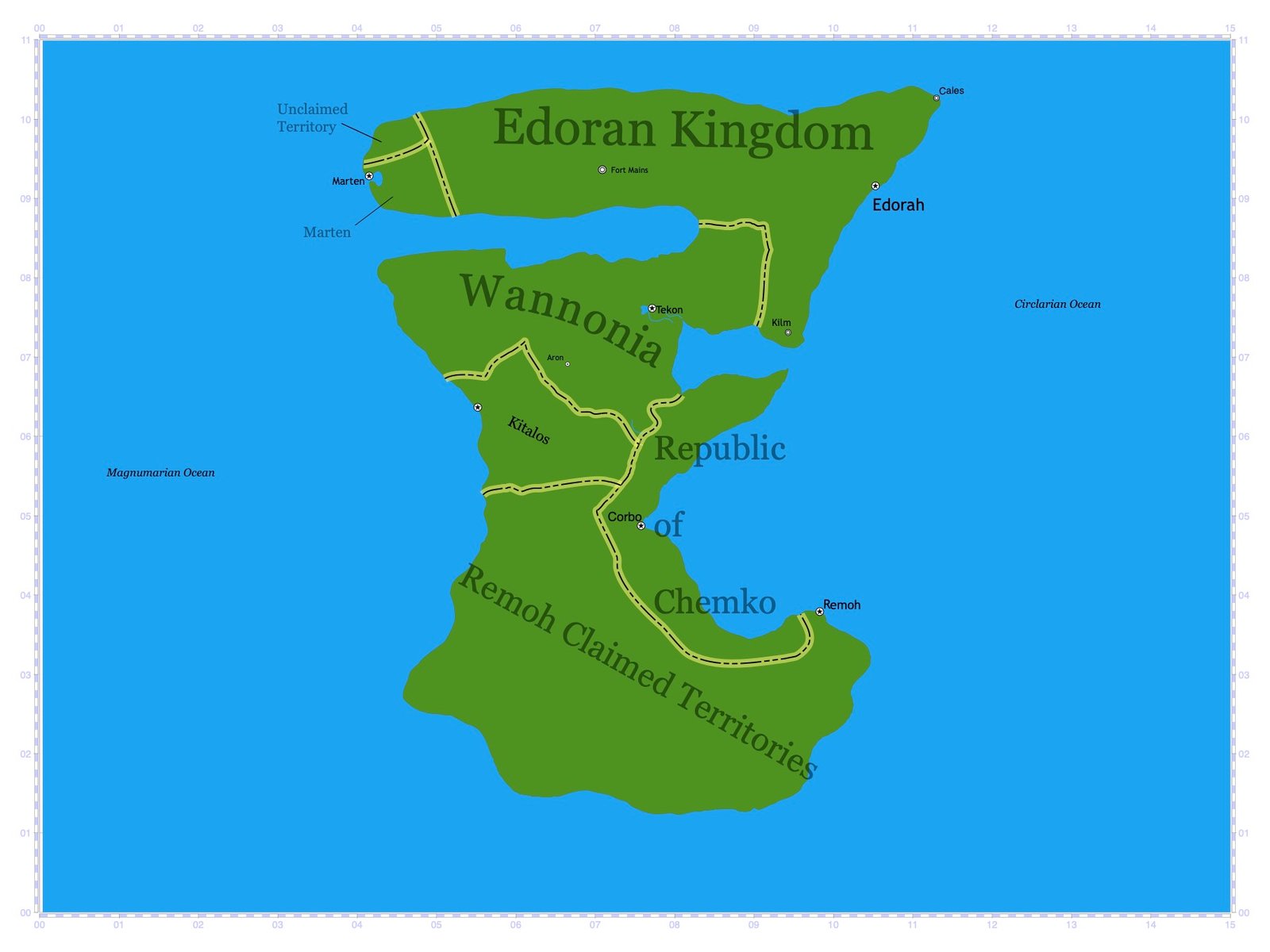
The Martenian Battlefront
Karmaye was a messenger between Wannonian Emperor Murstallar I and the battle theatre in Marten, both communicating with the Legion Generals and leading a group of spies. In 130 CE, Marten was under siege, where the Wannonians regularly rotated divisions of Legion soldiers to keep a strong front around the enemy. The spies working for Karmaye sought out weak spots in Martenian defenses; and the Legions struck at these. By June of that year, however, it became clear that the Wannonian siege was not achieving its agenda, for the Martenians remained as strong as ever. Karmaye dispatched another envoy of spies, who noticed caravans traveling uphill from the coastline West of Marten, and followed them to discover a secret supply system: an underground network of aqueducts that delivered water, as well as barrels of food, into Marten's interior. Caravans carrying such barrels to holes in the ground, which served as ports into the hidden water passages below, were accompanied by bands of Martenian soldiers, as well as, to the peril of the first of the Wannonian Legion troops who attacked these, concealed spellcrafters. As part of a relatively sneaky strategy, the Martenians employed the visible soldiers to these caravans to serve as the first line of defense against the Wannonians, and as a distraction to them while the invisible spellcrafters cast deadly spells. The aqueduct ports, themselves, were well-guarded by Martenian soldiers and spellcrafters, presenting the same obstacles for the Wannonians. Karmaye decided to return to Tekon to present the concern to Emperor Murstallar I.
Murstallar I's Last Deeds
By November 130 CE, Karmaye reached the Wannonian Imperial capital, Tekon, where he quickly learned that the Emperor was suffering from a mysterious and debilitating illness. Karmaye presented news of the Martenian battlefront to Murstallar I, who immediately called a council of his advisors to take place in his personal quarters. Here, the dying Emperor and his council concluded with the theory that the larger aqueduct ports, as well as the larger supply caravans were protected by more Martenian soldiers and spellcrafters; and they resolved to concentrate Wannonian forces upon the smallest ports, attacking the smallest caravans, and proceeding subsequently to attack the larger ones increasing in size. Eventually, this would lead the Wannonians to taking control of all the aqueduct ports, grounding the Martenian supply line to a halt.
The Imperial Class Deal
Not long after, Murstallar I held a second council, where he discussed the happenings to occur after his death. According to Wannonian law and norms, the dead were always cremated, never buried; and Murstallar I's plan was no exception. He officially named his son, Murstallar II, to be the next Emperor; however, this was initially met with controversy. While the Emperor's immediate family agreed with the decision, respecting Murstallar II to be the oldest son, making him legitimate, and also respecting that Murstallar II was also academically bright, a faction of advisors were opposed. These opponents were influenced by Legion General Ombus, who was presently fighting in Marten. First cousin to Murstallar II, Ombus presented himself as a strategic leader. When showered with such praises, Ombus began feeling more and more over the years that he deserved the honorable appointment to the Imperial Throne. As a result, rivalry emerged between him and Murstallar II, as Ombus and his followers saw Murstallar II as less competent in terms of Imperial governance and military defense. To ease the tension and lead the Imperial Court and the Wannonian population to forget such political conflict, Murstallar I sent Ombus away to various distant quests, most recently to Marten in the North.
Nonetheless, with Murstallar I's death fast-approaching, the old controversy manifested, once again, leading the incumbent Emperor to present a compromise. Accordingly, Wannonia would, instead, be governed by an "Imperial Class" with both Murstallar II and Ombus as mutual leading figures. Such a governing body would behave almost like a Senate with two exceptions: its members were of the Imperial Court and not elected by the people; and such members would not be representing regions, provinces, or sectors of the Wannonian population. However, this Imperial Class would vote on conflicting decisions, where the final decision would be carried by a majority vote. Eventually, the Class would cast its vote on the final decision: the appointment of either Ombus or Murstallar II to the Imperial Throne.
Murstallar I dictated such terms, via Karmaye, into two letters: one discussing the new Martenian strategy and the other asking for Ombus' consent on the establishement of the Imperial Class. The Emperor had faith in the notion that the second letter would indeed receive consent from Ombus, preserving his pride and confidence in the continuation of the fighting against the Martenians. However, after Karmaye departed Tekon, bound for Marten, Murstallar I had his official will destroyed, replacing it with one that unconditionally appointed Murstallar II to the Imperial Throne. In his mind, Ombus would be forced to accept the sudden change.
Return to the Battlefront
Immediately upon arrival, Karmaye presented the two letters to Legion General Ombus, who, as expected, agreed to the Imperial Class deal, anticipating easy leverage to the Imperial Throne. The General subsequently agreed to Murstallar I's battle strategy, commanding Karmaye to organize a new spy network to find the smallest and least-guarded caravans and aqueduct ports, and then sending him back to Tekon to serve on his behalf in the Imperial Class until the end of the Martenian War.
The Death of Murstallar I and the First Coronation of Murstallar II
In December 130 CE, Wannonian Emperor Murstallar I died; and subsequently, his body was cremated. Immediately after the funeral, the news was presented to the Wannonian public that no Imperial Class would be established, and that Murstallar II was unconditionally the next Emperor. Many of the Wannonian population, who supported Ombus' ascension to the Imperial Throne, rioted in Tekonian streets, while Murstallar II's supporters fought back. Such a conflict also occurred in other Wannonian cities, bringing the Empire close to a civil war. In January 130 CE, while the Head Imperial Legion successfully restored order to Tekon, Murstallar II was, in front of a cheering crowd outside the Wannonian Imperial Palace, officially crowned Emperor of Wannonia. As the new Emperor, Murstallar II immediately ordered Legions to restore peace and order in the other Wannonian cities.
Meanwhile, the new Emperor had a different agenda concerning the war in Marten. Instead of consistently attacking the weak spots in Marten's defenses and supply lines, Murstallar II planned to concentrate the Wannonian troops in a nearby secret location and prepare them for a Kestavian sneak attack. During such an assault, Wannonian soldiers having set up numerous hidden camps around Marten would unexpectedly attack from outside its walls, while soldiers having snuck into Marten's interior would strike from the inside. He immediately dispatched Karmaye to relay this message to Ombus.
Betrayal and Abandonment
Such a strategy would probably have earned the Wannonians an easy victory over Marten, had it not been for Ombus' response. Upon receiving the new plans from Murstallar II in April 131 CE, Ombus became outraged at the Murstallar family line and immediately declared himself to be the legitimate Emperor of Wannonia. He ordered all Wannonian Legions stationed around Marten to leave the battlefront and convene on the nearby Isle of Killen, where Ombus would lead them in preparation for an attack on Wannonia, itself. They would do so by landing on the North Wannonian coast (in Middle Remikra), and sweep the territory with the relentless storming of cities and Legion strongholds loyal to Murstallar II, who Ombus planned to overthrow. In June 131 CE, as Wannonian troops withdrew, Marten officially declared itself an independent and sovereign kingdom, in which a brief internal power struggle between Zohn and Fredon resulted in Zohn's death and the coronation of Fredon as King of the Martens.
The Return of Ombus
With relentless ferocity and brutality, Ombus and his soldiers landed and stormed the seaports of the North Coast of Wannonia, where he encountered a mixture of friendly and hostile Wannonian Legion troops. With the former, Ombus formed a strong alliance. Being stronger and better-armed, Ombus and his followers made a quick sweep Southward to Tekon. Before long, Ombus besieged the Imperial capital, where both sides were initially equally matched. In October 131 CE, food began to run out in Tekon, leading Murstallar II to find a weak spot in Ombus' forces and make an attempt to break the siege here. However, in doing so, Murstallar II left an opening in his own defenses; and Ombus, having acquired Edoran catapult-slingshots, catapulted large debris pieces to knock down the North Tekonian wall, allowing his Legion troops to storm the city, where Murstallar II's Head Imperial Legion proved no match. Within hours, Ombus' soldiers stormed the Wannonian Imperial Palace, looking to behead Murstallar II, who was nowhere to be found. News soon reached Ombus that Murstallar II had fled; and the ambitious Legion General ordered the search of the entire city of Tekon for him. Such a combing, however, turned up no results. On the last day of October 131 CE, inside the main hall of the Wannonian Imperial Palace, Ombus set upon his own head a crown crafted especially for him of rare quartz from the St. Eschel River valley, declaring himself Emperor of Wannonia. Immediately, he declared Murstallar II "enemy of the state" and subsequently dispatched Legions to scale all of Wannonia for him, dead or alive. A large sum of gold and piece of land was presented as an attractive bounty. Not long after, a message reached Emperor Ombus that Murstallar II was dead; and he awarded the promised bounty to the said responsible party: a group of Legion soldiers and commanders.
The Fall of Ombus and the Rise of Karmaye
In March 132 CE, Ombus ordered the original Legions present at Marten to return to the said battlefield, expecting the utilization of the Kestavenian strategy, for which Murstallar II originally took credit, to gain an easy victory over the seemingly untamed Martenians. However, the newly established Kingdom of Marten, under the single authoritarianship of King Fredon, was now more organized. By this point, a Martenian Navy was constructed and well-trained, and, in May 132 CE, such a force caught the Wannonian Legions by surprise at sea, where they were mercilessly slaughtered with the since-improved Martenian spears and arrows. Every Wannonian Legion force was effectively obliterated, and by September 132 CE, five Wannonian soldiers, the only lucky survivors, returned to Ombus with the bad news. Emperor Ombus responded to the message with the institution of the drafting of more Wannonian Legions. However, the Wannonian people began rioting over the Ombus' abuse of Legion power as well as the resulting tax increases. Ombus dispatched the Head Imperial Legion to slaughter such protestors in Tekonian streets. In November, surviving protestors organized a coup, which succeeded in the beheading of Ombus.
By January 133 CE, it became obvious that, after Ombus' death, the resistance movement was divided. One side supported Karmaye, who made himself Emperor, and subsequently launched a quest to seek Ombus' Imperial Crown, which went missing. Meanwhile, the other side of the resistance movement carried out an unofficial nationwide election, which appointed a Senate considered "illegitimate" by Emperor Karmaye, who then ordered such a democratic body to be eliminated. Legion soldiers opposed to Emperor Karmaye defended the place where the Senate was meeting, leading to further civil conflict in Tekonian streets, as well as throughout Wannonia.
The Second Coronation of Murstallar II
In reality, Murstallar II was still alive, and was hiding in the city of Aron; thus, the news that had reached the late Ombus was simply a false rumor. Between November 132 CE and May 133 CE, Murstallar II secretly recruited large numbers of Legion troops, planning yet another Kestavian tactic. Knowing the outlay of Tekon, Murstallar II established secret encampments outside of the Imperial Capital, and convinced warring factions inside city walls to carry out certain conflicting strategies in certain places to leave holes in overall Tekonian defenses. In June, Murstallar II launched the Tekonian assault, which proved an easy victory. During this onslaught, defenders of the Senate meeting place were overwhelmed; and all of the Senate members were killed. For a second time, the Wannonian Imperial Palace was stormed, catching by surprise Emperor Karmaye, who thought Murstallar II was dead. As a result, Karmaye, proving no match for Murstallar II, was captured and beheaded.
In January 134 CE, Murstallar II was, for a second time, and in the same venue and in the same way as before, crowned Emperor of Wannonia. In the weeks that followed, he signed a peace treaty with the Kingdom of Marten, honoring their sovereignty and, furthermore, handing over an entire Wannonian Legion as a division of permanent mercenaries. In return, Emperor Murstallar II asked for no tariffs on resources from Marten, especially silver pines. To this, King Fredon of the Martenians agreed.
Marten: The Early Days
The Kingdom of Marten covered territory that consisted of the Linbraen Mountains, as well as rugged coastline. Here, pines and modest grasslands prevailed, while the weather proved cold and wintry year-around, being less so during the summer months, while the ocean froze in the winter. Khapians and Kitalans mixed as the generations passed to form a genuine Martenian ethnicity, while a mix of the Khappian tongue and Aerdn/Wannonian vernacular formed the spoken language of these people. En route to the North, Fredon was presented by accompanying clerics the doctrine of Alconism, which he initially rejected in favor of the Khappian belief in gods of the Sun, Sea, and Mountains. However, when he turned against Zohn, Fredon received a vision from what he believed was the Alconist God, to whom he prayed. When he defeated his foe, Fredon gave credit to this God, converting to Alconism, which he established as the only acceptable religious practice within the city walls of Marten. As King of the Martenians, Fredon governed with absolute power, wherein he appointed Lords to govern with hierarchical power over the regional divisions. To carry out the laws, the King and lords alike appointed knights and city watches. The Martenian social ladder consisted of a peasant/serf class at the bottom, ascending to merchants, knights, guild members, guild owners, lords, nobility, and, finally, King Fredon. There was one large market square in Marten to which all merchants traveled to sell their goods. It was also in the city of Marten where all of the guild owners lived. Serfs outside the city produced goods and food, which consisted mostly of fish, as crops rarely succeeded in this climate. Meanwhile, the Martenians emulated the Edorans, outlawing the practice of slavery, as well as the practice of any form of involuntary labor. Guild members produced other goods for the guild merchants who traveled to Marten, while both parties paid guild dues to the guild owners. On all trade, the lords, nobles, and King Fredon collected taxes. Martenian trade consisted of fishing, silver pines, and the mining of metals. While there was an official currency, the standard gold, silver, and copper standard, most trade, especially among members of the lower classes, consisted in the form of bartering. Martenians drew freshwater from the glaciers of the Linbraen Mountains.
Early on, a postal system, centered in the city of Marten, was established, where there existed a network between the mountain and fishing villages. Letters, pamphlets, and personal journals were what composed of the means of communication, while the press, small in existence, was heavily administered by the lords and King Fredon. Bricked roads were constructed within the city walls of Marten as well as in the immediate vicinity. Everywhere else consisted of gravel or dirt paths. Eagles were used for the postal carriers as well as the guild merchants, while horses were utilized by the lords, knights, and nobility. The remaining Martenian population simply walked to and from destinations. In the years that followed, a thick stone wall was constructed around the city of Marten, where it extended around Marten's harbor, presenting arches and iron gates to regulate entry and exit. Meanwhile, the same wall extended well-inland, where archways and wooden gates provided similar regulation. Each fishing village was equipped with a fleet of Martenian Navy ships while each mountain village was equipped with land and eagle soldiers. A peace treaty had been signed with Wannonia, as mentioned above; however, tension began to grow with the Edorans, who began taking growing interest in Martenian land and resources.
Meanwhile, King Fredon outlawed spellfire libraries, like the one that existed in Tekon, fearing a spellcrafter coup. He, instead, authorized the establishment of a traditional Spellfire Guild, headquartered in Marten.