1369
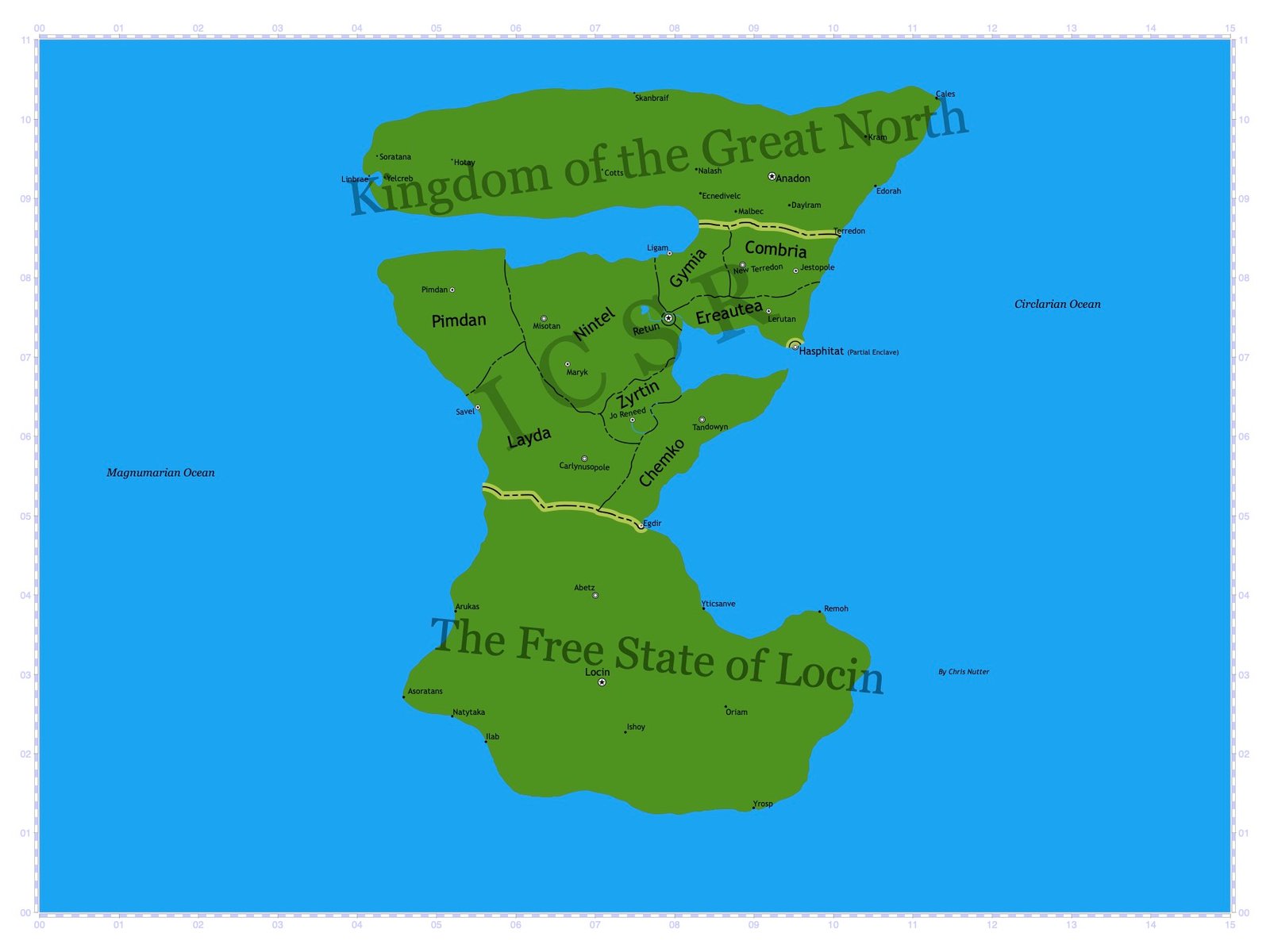
With an original agenda to expand the lightfire industry into the Ancondrian River States, it seemed that economic prosperity in the Commonwealth would continue under the administration of Prime Minister Kame. However, in February 1369, a logistical faux pas on behalf of the Commonwealth government gave way to the uncertain threat of sanctions to be carried out by Congress of Circlaria. This led tradestone brokers in the Diamond District of Hasphitat to panic and begin a mass sell-off, leading the tradestone market into a decline. By law, the Commonwealth government intervened and bought out the tradestones. In the wake of this and receiving little to no investment outside existing trade deals, the lightfire industry in the Commonwealth all but collapsed as its leading business, West Horizon, closed its doors the following year.
1370
On 12 November 1370, the final ruling by Congress of Circlaria led to the signing of the Treaty of Silba, which handed territorial jurisdiction to the defeated Esurchians to encompass the immediate vicinity of Esurchia proper, Onitalep, and Kilma. The remaining territory of the Havenlands region, which had been embroiled in civil conflict following the official end of the Esurchian War in January 1368, was divided between three established city-states: Barduuh, Krivaran, and Wielfren. This peace deal had a plethora of conditions, two of which being that travel restrictions were imposed on both Esurchian and Commonwealth citizens and officials, where one could not travel to the other's territory, nor were the Esurchians allowed to enter into any territory of the Remikran Union or vice versa. Similarly, communication restrictions were imposed as well. Furthermore, as an item of complicated logistics, the Isle of West Providence, situated just off the coast of the Commonwealth province of Pimdan, was placed under Esurchian jurisdiction while the surrounding waters remained under jurisdiction of the Remikran Union. Because of the traveling restrictions between the Remikran Union and the Esurchians, the Isle was legally made into a no-man's land, leading it to becoming a problematic haven for criminals. This agreement lasted until 12 November 1430, when, according to Congress of Circlaria, the Commonwealth was able to lay claim to the Isle as long as it was physically untouched by the Esurchians over the duration of 60 years.
However, local Ancondrians living in the established states of Barduuh, Krivaran, and Wielfren, were not satisfied with the Silba Treaty of 1370, for it mandated that the borders between the three states be closed and lined with guarded border walls. That December, Ancondrian residents and leaders rose up and declared the territory encompassing the three states to be the new nation of the United Confederation of Ancondria. Allied activists rose up in Ramport in 1371 as former District V declared independence. This led the Commonwealth and allied Ancondrian nations to amend the Silba Treaty to recognize the Confederation as a nation and to recognize the independence of Ramport.
1371-72
Economic decline continued into the 1370's, as the issue was compounded by emerging fallouts in the Malfua Trade Deal as well as Commonwealth Ancondrian Districts voting to join the Ancondrian Confederation. Toward the end of 1371, the Ancondrian state of Doriem attempted to establish a deep-trade arrangement with the Commonwealth, utilizing the Commonwealth Deep-Trade Administration's existing "para quota" policies to quickly establish a contract.
While this did little to alleviate pressing concerns, the Kame Administration settled uncertainties with the signing of the New Hobland Trade Deal in the summer of 1372, boosting trade in the Hasphitat Diamond District for the first time in three years, and providing extra benefits to South Masonia.
Toward the end of 1372, issues began to arise with Doriem, as a majority of the Commonwealth population began to recognize them for displaying similar charismatic and oppressive traits to the Esurchians. On 12 November, the Deep-Trade Administration voted to emancipate from them. Despite fears, however, no major conflict ever arose.
The Breakup of the RAD Party
In the wake of fallout with both Esurchian and Doriem, discord over the issue of deep-trade began to emerge between members of the RAD Party, with one faction supporting the continued pursuit of deep-trade and the other calling for an end to the practice, known as secularity. In June 1373, the RAD Party officially split into the Trader and Proculturalist Parties. Embraced by Prime Minister Kame and former Prime Minister Robinson, the Trader Party emerged as the more conservative of the two, consisting of champions of the effort to preserve and expand on deep-trade deals. Meanwhile, the more progressive Proculturalist Party valued domestic public infrastructure, and equality in public business investment, as well as opposed the idea of deep-trade for its tendency to benefit too much those considered to be the "owners." To the forefront of the Proculturalist Party emerged its most prominent figure and candidate, Meghan Wen.
The Election of 1374
Against incumbent Prime Minister Kame, Megan Wen campaigned on a platform that promised legislation to govern and solidly establish deep-trade protocol to guarantee important protections for Commonwealth citizens, policies to address emerging issues with housing, and policies to guarantee equal public funding for all trades. Aside from opposition within the Combrian sector of the population, where her Provan ethnicity was used against her, Wen and her platform gained strong popular support throughout the Commonwealth, leading Wen to winning the election on 24 September 1374.
Prime Minister Wen's First Term
On 7 January 1375, Prime Minister Wen signed into law legislation to establish the Occupational Priority and Equality National Forum, or the OPEN Forum. That week, she also signed the final decision to include the Commonwealth in the merger of the New Hobland Trade Deal into the South Coast Company Trade Deal.
Many other accomplishments were had in the year of 1375. However, a bill to establish a deeply-seated protocol for deep-trade failed to pass.
On 7 February, in reaction to a short-term crisis in the darkfire industry, Prime Minister Wen signed an order to establish the Darkfire Decision Committee. The Committee, seated in the Lake Maern Reserve, was comprised of five members, all of which were elected by the population of the Reserve, and included four Regular Members and a chief Committee Member. The Chief Committee Member was appointed by having the most votes from the electorate. In the case of an undetermined count from the population, the Committee would vote, with the decision power going to the Prime Minister if the Committee was also undecided. Each Member would serve one term of one year.
Since 1375, the role of the Darkfire Decision Committee has been to dictate all policies regarding darkfire, eliminating the bureaucratic complications of such policies having previously been dictated by the majority votes of Council. Critics have, over the years, claimed that this was too much of a concentration of power; however, supporter refutation that this gives more voice to the Darkfire Community has always been the more popular argument.
On 12 October 1376, a second attempt to establish a more secure deep-trade protocol finally succeeded in the official ratification of the Eighth Amendment, which contained the Five Clauses: the First Clause required that all deep-trade transactions must, in some way, benefit all involved parties; the Second Clause required that each party must recognize and respect the sovereignty and diplomatic ties of each of all of the other involved parties; the Third Clause required each involved party to carry its own economic policy that does not depend on the deep-trade agreement for its survival, and forbade any party from claiming the property and assets of any other party; the Fourth Clause forbade any party from carrying out an investigation or act of espionage against another with or without regard to any deep-trade agreement; and the Fifth Clause gave each and every party the right to peacefully exit an existing deep-trade agreement without the consent of the other parties.
Two important pieces of legislation were passed by the Commonwealth Council and enacted by Prime Minister Wen in 1377. The first, on 22 February, was the decision to merge the Commonwealth Aerospace program with that of the Canticulan Union.The second, on 7 April, was the Gyrovehicle Transit Infrastructure Act, or the GTIA. In the wake of the Esurchian War, the gyroplane industry had been succeeding in business competition between the vac train, auto, and aviation industries with a new prototype: the Personal Occupational Destination Vehicle, or the POD vehicle. The GTIA authorized the Commonwealth government to shift public transit funding to make POD vehicles widely available to the public, while also integrating the Commonwealth with the existing POD network throughout the Circlarian Realm. In March 1377, the GTIA was adamantly challenged by opponents backed by the existing traditional industries as well as opponents with passion for cultural nostalgia. However, proponents noting the convenience of the POD vehicle boosted support for the GTIA and facilitated its passage.
In 1372, Commonwealth Ancondrian Districts III and IV voted to gain autonomy from the Commonwealth and join the Ancondrian Confederation. And District II would follow in 1374. By the beginning of Meghan Wen's tenure in 1375, District I, holding the city of Kronoston, was the only remaining piece of Ancondrian territory under Commonwealth jurisdiction; and within that District was a growing number of people calling for the territory to join the Confederation. In the hope of calming local resentment, Prime Minister Wen signed a measure to discontinue an effort previously put forth by the Kame Administration to forward proposals for the former Commonwealth Districts now part of the Confederation to rejoin the Commonwealth, and proposed for the Commonwealth Council to pass a law giving every resident of Ancondrian District I a tax break for five years. The measure would also have the OPEN Forum grant an exception to the lightfire industry and establish a publicly-owned entity known as the District One Lightfire Foundation with the intent to re-establish lightfire trade between the Commonwealth and Ancondria. Federal Arbitrator Robert Marks in the Basin District concluded that the law would be fair and enforceable if funding for this measure came from either loans or grants discharged by allied nations. Both the Linbraean and Edoran Royal Treasuries refused to assist in this, while the Ancondrian state of Malfua provided only partial funding. As a result, the law failed to pass Commonwealth Council. Alex Tong, Chief Arbitrator for the Ancondrian Domain, in response to growing sentiment from the population, called for a popular referendum to take place on 16 September 1275 for the last remaining District to join the Confederation. This special election yielded to 56 percent of voters passing the referendum. On 23 January 1376, Prime Minister Wen signed the Termination of Jurisdiction of Kronoston and District I, thus officially handing over the last piece of Commonwealth Ancondrian territory to the Confederation.
Resentment to Prime Minister Wen among conservative voters began to grow in 1378, when sanctions issued by the Ancondrian State of Likatus against the Commonwealth on 4 December marked the end of a failed attempt by the Wen and previous Commonwealth Administrations to restore diplomacy between the two nations since the incident of 1331. Combrians decried the Wen Administration on the matter, citing diplomatic incompetence. For the first time since the 1330s, Combrian nationalism began to propagate, triggering concern throughout the Wen Administration and the remainder of the Commonwealth over a possible political movement for Combrian independence. Beginning in 1379, to soften Combrian resentment, Prime Minister Wen signed controversial counter-sanctions against the Likatus State.
In the summer of 1380, a minor paperwork mishap in the South Coast Company Trade Deal merger led to the false rumor of a fall-through, triggering economic panic and re-igniting Combrian resentment against the Wen Administration. The rumor, however, had been successfully traced back to a biased Combrian media source as the information was proven false.
The year 1380 was also election year for the Commonwealth, during which Prime Minister Wen faced her challenger, Anita Robinson, daughter of former Prime Minister Raoul Robinson. Robinson (Anita) campaigned for the restoration of deep-trade policy from before the Wen Administration as well as the implementation of another 100-Week Darkfire Enhancement Project. However, Wen's plan to construct a new educational institution to rival that of long-lost Cabotton University, an agenda to restore the environment and ecosystem in Chemko, and a plan to reform housing won the incumbent Prime Minister a re-election victory on 16 September.