A Quest for Power
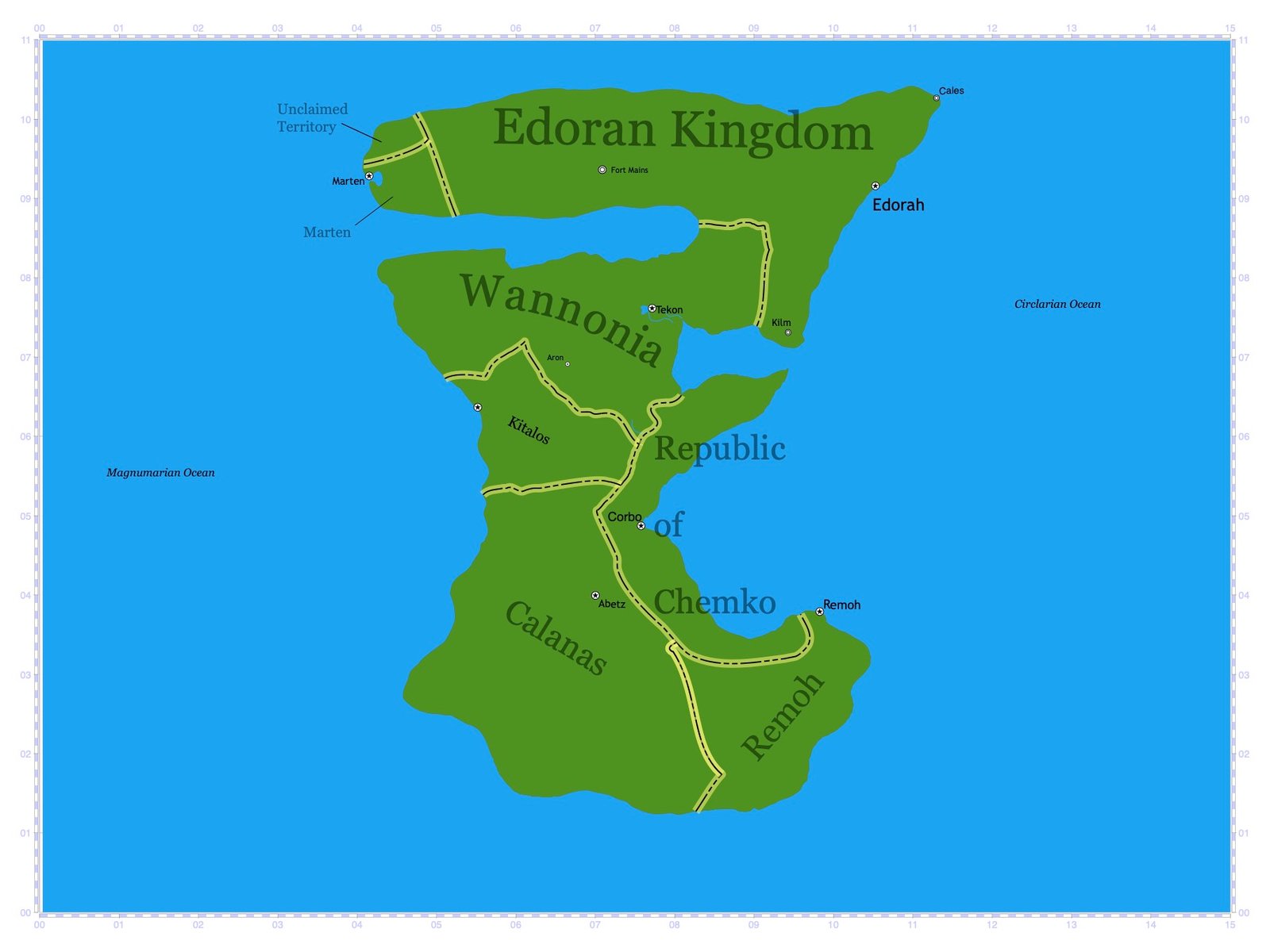
In November 130 CE, King Solon of the Remohans died, and was succeeded by his son, Solonmake. Solonmake, a young man of great ambition, made some observations. First, he realized that the Remohan people were mostly poor and starving, having barely any resources. In a moment of enlightenment, he discovered that whoever had dominance over Remikra had a surplus of food and resources at their disposal; and after further searching, King Solonmake discovered the dominating power to be the Empire of Wannonia. It was at this point that he experienced a divine vision, which charged him with the task of conquering Wannonia and reaping all of its spoils. Such a quest was difficult, though, as Wannonia proved to be very organized and powerful. Solonmake had to attack the weaker nations to attain their wealth and resources, which would be just enough to prepare for Wannonia.
To the North and West lay the Kingdom of Kitalos. With this nation, Solonmake realized his call to reclaim the former city of Calanas. The Kitalan Kingdom was organized and powerful as well, though not so much as Wannonia; so a victory over them was possible. Very soon, King Solonmake began recruiting and training his Remohan soldiers. He also attempted to recruit Calanasian people, who still lived in "pocket communities" throughout the Remohan lands, but they would not oblige except for a great amount of wealth.
The Fall of King Hemos
In June 133 CE, King Solonmake and his soldiers arrived in Kitalos, only to find that its defenses were not as robust as they were ten years previously, due to a recent plague. One night, the Remohans launched a sneak attack upon the city, overrunning it and killing King Hemos by sunrise. The raiding of Kitalos' homes, shops, and palaces did not generate the wealth needed to fund enough Calanasian soldiers to help Solonmake overcome Wannonia. So he looked next to the Republic of Chemko.
Desire for Chemkan Wealth
Just then, various sources brought news to King Solonmake regarding Chemko, especially its capital city, Corbos. Chemko was a republic, which King Solonmake viewed as unstable and anarchic in nature, and therefore, weak. Furthermore, most people there were poor while the few rich merchants resided in their palace-like residences in Corbos; and such places were unprotected aside from the walls and guards around the city. On such defenses, Solonmake sent spies to attain information, and was surprised to learn that no improvements were made on the style and type of such defenses since the sacking of Eskant by Totian Emperor Kestaven centuries before. The same defenses and guard post functions remained. In June 134 CE, after a great deal of planning, King Solonmake launched a Kestavian-style assault; and in a very short amount of time, Corbos was overrun by Remohans.
Chemkan Response
As the Remohans swept through Corban streets in a reign of terror, people were killed, properties were raided and set ablaze, and valuable items were taken. Those lucky enough to escape the ensuing chaos escaped the city and fled elsewhere. The Chemkan Senate, by protocol, fled to the location where stood Estrayon's Library, where they convened and voted to dispatch multiple Chemkan Legions. These Legions drove the Remohans out of Corbos, and mostly out of the Chemkan Republic. However, the enemy struck back, making numerous hit-and-flee raids against the Chemkan border villages. Attempts by the Chemkan Legions to target and eliminate Remohan encampments right across the border were met with high casualties and low levels of success. As peace and order was at least restored to Corbos, the Senate returned to their original meeting place, where they voted to dictate a letter to Wannonian Emperor Murstallar II for assistance.
Meanwhile, in the Wannonian capital of Tekon, Emperor Murstallar II was struggling to keep coffers afloat owing to the recent war and internal upsets in Wannonia, and was forced to levy taxes. In retaliation, some Wannonian people rebelled against the high taxes by protesting, or even by simply refusing to pay. With a seemingly pointless war in the West, as proposed by the Chemkan Senate, serving as a potential for additional financial burdens on the already-strained Imperial system, Murstallar II responded to Corbo with a letter of refusal.
Attack on Wannonia
Ironically, it was during the raid on Corbos that the residences of the rich guild owners were ransacked, yielding, as King Solonmake hoped, a large enough amount of wealth to finally acquire enough Calanasian soldiers to launch an attack on Wannonia. And in January 135 CE, Solonmake did just that, capturing the city of Aron. Such a victory was short-lived, however, as Emperor Murstallar II, having received news of this, dispatched multiple Wannonian Legions, who swiftly returned Aron to Wannonian control. With the emerging stories of terror, of Wannonian farmers slaughtered and homes and crops set ablaze, it was in September 135 CE that Murstallar II was determined to eliminate the Remohan terror once and for all. He promptly signed an alliance treaty with the Chemkan Senate, sending them a letter of apology for the previous statement of refusal and calling upon them to join Wannonia in an attack on the city of Remoh proper. The Remohan capital, however, was surprisingly well-defended; so they called upon the Calanasians for assistance.
The Rise of Queen Lifsona
The "pocket communities" of Calanasians left over from the fall of Calanas more than ten years previously were now being forced to make decisions between fighting for the Wannonians and Chemkans, or fighting for the Remohans. In September 135 CE, Lifsona, a female Calanasian warrior, initially answering to a call to fight for the Remohans. Her company, however, was captured by Wannonians early on, and she was taken prisoner. With strategy and wit, though, she escaped her captors before crossing the border into Wannonia, and, in March 136 CE, returned to her homeland. Upon her return, she listened to the anger and frustration of her fellow Calanasians, as they had no control over the lost Calanasian lands to the affairs of the warring foreign powers. Such powers were also fighting over the Calanasians, themselves, as if they were merely pawns in a board game. It was then that Lifsona formed her resolve: to unite the Calanasian people and re-establish the State of Calanas. Such a resolution appealed well to the Calanasians, who joined her.
Under Lifsona's command, the Calanasians carried out a strategy where they appeared to join the ranks of the opposing foreign armies. However, when the time came for the armies to attack each other, with the Calanasians on both sides, the Calanasian recruits turned inward and, in coordination, slaughtered their own military hosts. Such an assault was launched in September 136 CE; and by that November, the Wannonians, Chemkans, and Remohans were successfully driven away as the Calanasians carved out their own sovereign territory, taking up the Southwest portion of Remikra.
The Council of Abetz: 137 CE
Lifsona went to the city of Abetz, situated in the middle of the Interior Desert, where she called for a council with the previously warring nations. It was here that she signed a peace treaty mutually with Wannonia, Remoh, and Chemko, and furthermore re-established the Kingdom of Kitalos, which would be governed by her sister, Hanna, now a Queen. Shortly thereafter, Lifsona, herself, became the Queen of the Kingdom of Calanas.