Fall of the St. Thomas Foundation
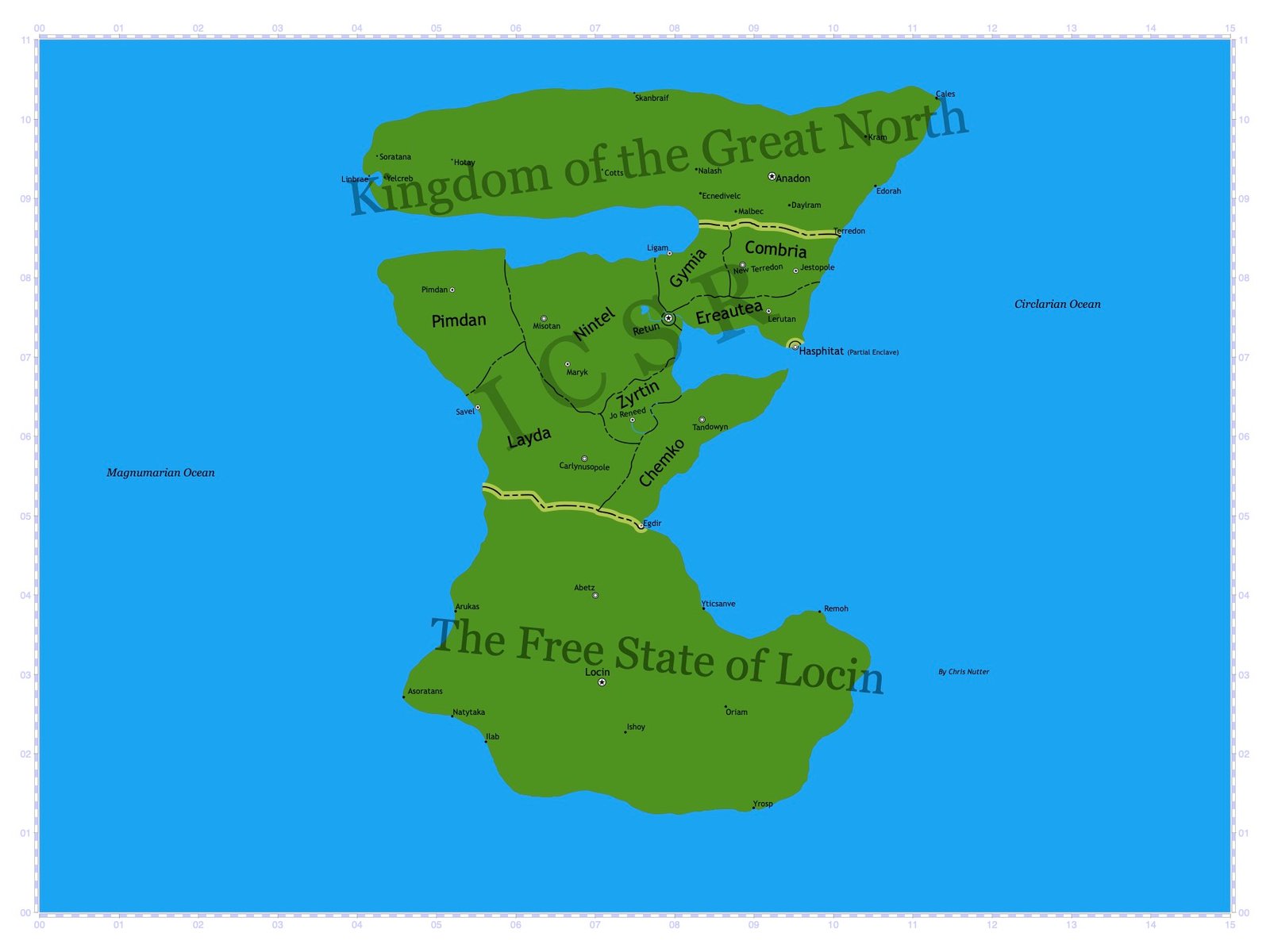
The geography of Uhlstead, Ereautea consists of three areas: Upper Uhlstead, located on the skymountain Laidi; Middle Uhlstead, located on a raised, round plateau 300 feet above the surrounding terrain; and Lower Uhlstead, located on the surrounding terrain.
The area began first being settled by Esarian followers following the 1187 Coup. In 1218, a child, believed by many to be the legitimate second-born daughter of one of the Councils of House Esary, was transported here to shelter from the ensuing political turmoil in Notulfa. Combrian President Jacob Henry, at the time, signed a treaty to keep this area restricted in order to protect the community protecting the child. Said treaty would be renewed by every successive Combrian President and every successive Retunian Prime Minister until the tenure of Prime Minister Arthur Cummings.
This community functioned since 1218 as a "democratic theocracy," run by a democratically-elected council taking advice from said daughter figure. When the daughter figure passed at age 70 years from health issues in 1283, her role posthumously was taken up by a three-Cleric tribune, who exercised slightly more power over the Council and the community. This mode of government stood until the year 1294 when, after photos taken by several passengers aboard an airship blown off-course by severe thunderstorms, the Retunian public began to take strong interest in the area. In 1295, David and Robert Thomas gained approval from the Retunian Council and Prime Minister Cummings to have the protective treaty annulled and to enable negotiations with the protected community leaders on having the area developed commercially.
Between 1297 and 1311 occurred mass construction and development to the area, as there now emerged a municipality established officially in 1299 as the town of Uhlstead. By 1311, Uhlstead was a significantly developed municipality on par with towns like North Kempton, and became home to the St. Thomas Foundation established that year. Upon said establishment in 1311, the St. Thomas Foundation included the St. Thomas Cathedral in Upper Uhlstead, the St. Thomas Courtyards in Middle Uhlstead, and the St. Thomas Academy in Lower Uhlstead.
The municipality of Uhlstead would hold local elections in 1312, which yielded the Mayorship and a near-unanimous Council majority to the Uhlstead Foundational Party. On paper, this was a typical, local political party. But in practice, the Foundational Party was a deeply religious party who ensured policies that would favor the St. Thomas Foundation. These included policies unofficial "pipelines" for donations to the St. Thomas Foundation, and local ballot adjustments to all but ensure that local elected positions were filled by Foundational Party members. The latter effort succeeded in giving the Party the Mayorship and Council majority consistently for around 130 years, prompting numerous forms of scrutiny from political critics within the Retunian Commonwealth and abroad in time to come.
Despite this, Uhlstead enjoyed economic success and technological achievements. The St. Thomas Academy carried a degree of excellence rivaling even that of Cabotton University, especially with its music and lightfire programs. The Academy also made significant contributions to engineering, most notably with the introduction of the Vacuum Train in the 1340s. Outside the Academy, the St. Thomas Foundation created economic incentive for increased trade abroad for Retunian investors, particularly those in lightfire and dymensional planecrafting. And of note, Uhlstead and the St. Thomas Foundation provided a major political sanctuary for those Retunians resisting the Esurchian Occupation.
Despite this, there were obvious underlying issues. Most notably, the St. Thomas Foundation collected a large revenue of donations with the promise that one day, there would be renewed diplomacy with House Esary, which would deliver economic prosperity giving returns toward donations made. The St. Thomas Foundation would predict specific dates when said promise would be delivered, making a future date accordingly when previous date passed with the promise unfulfilled. And over the years, it became increasingly clear that the Foundational Party had an iron grip on politics and the opposition, which the Party intentionally kept divided, while they continued to ensure that no opposition parties appeared on local ballots, other than space for write-in candidates, for local elections. Meanwhile, the St. Thomas Foundation gained increasing notoriety abroad as its propaganda was rejected largely due to its "scammy vibes." Furthermore, there was concern abroad that the failure of the Retunian Commonwealth to take action to address the political party rigging in Uhlstead would serve as a precedent for further political troubles in the future. And then there was also the obvious issue of the unproven speculation of oathcrafting.
A break in the Foundational Party "regime" came, finally, in the year 1437, when a former member, Godfrey Gins, became a whistleblower and exposed to the Retunian public many details of the St. Thomas Foundation's corrupt apparatus. The Supreme Court in the Basin District accepted these claims and called for a joint investigation against the St. Thomas Foundation, who, in turn, succeeded in being granted a two-year window to collect the information needed in order to cooperate with the upcoming inquiry. Said inquiry began in the early months of the year 1439, during which the allegations of corruption were proven true and the leaders of the St. Thomas Foundation promised to enact a motion to pay back on the donations it received over the last twenty-five years. Accordingly, said payback would be delivered by April 1441. The Inquiry Commission agreed to this. However, in January 1441, an anonymous observer appointed by the Committee reported that the St. Thomas Foundation had begun moving financial capital to offshore accounts in Tandeiyah. The Tandeiyan government, in response, froze the involved accounts and assets. And this further act by the St. Thomas Foundation led a final verdict of the inquiry to judge the St. Thomas Foundation guilty in its actions, while the Retunian Supreme Court authorized for a popular referendum to take place on 16 September 1441 on a decision whether or not to liquidate the St. Thomas Foundation, itself. Said referendum yielded ninety-five percent of the Retunian population calling for the liquidation.
Thus began what would be known as the Great Deconstruction of the St. Thomas Foundation.
Scholars, however, consider the second week of April 1441 to be the beginning of the Deconstruction, as many within Uhlstead municipal limits, along with many across the nation, gathered to begin taking apart the Cathedral, Courtyards, and Academy. The motion began, on paper, on 2 January 1442. Regardless, the Deconstruction continued, carried out by volunteers, until the second week of April 1442, when a demolition crew arrived and finished the job.
Numerous St. Thomas Foundation beneficiaries directly involved in the scandal were prosecuted while a few of them were sentenced up to five years in prison. Meanwhile, the Supreme Court ordered Uhlstead to print ballots listing the top three most popular parties along with the write-in spaces, just like every other Retunian ballot. As a result, ballots in Uhlstead for the 1444 Municipal Elections included candidates for the Uhlstead Foundational Party, RAD Party, and the Commonwealth Democratic Party.
Said elections were held on 24 September 1444, which saw the Uhlstead Foundational Party lose every elected seat. Kara Sindroh of the RAD Party won the Uhlstead Mayorship while the Commonwealth Democrats, opposed to the RAD Party on the national scale, gained a very thin majority over a RAD Party majority in Uhlstead Council. Both parties, locally, decided to form a coalition in the beginning of the new term in 1445. The legislative efforts that followed led to the establishment of the Uhlstead Community College, which worked with the National Institute of Research and Development, and the establishment of a significant branch of the Library of Circlaria.
Retunian Constitution: Amendment Thirteen
With memories fresh in the minds of many regarding the disastrous Marc Warren agenda of fifteen years past, as well as other deep-trade opportunity fallouts, came a call for a repeal to Constitutional Amendment Six, which had initially mandated the continuous existence of the Deep-Trade Administration. On 16 January 1443, Retunian Council approved such a repeal, through the addition of Amendment Thirteen, and, per constitutional protocol, scheduled for a popular referendum on this to occur on 16 September of that year. The referendum succeeded in having Amendment Thirteen ratified, giving the Deep-Trade Administration until 24 September 1444 to act on any standing deep-trade interests with formal Motions or to otherwise vote themselves out. The latter would occur on 24 September, thus making the last day of the Deep-Trade Administration's existence 24 December 1444.
Library of Circlaria Funding Prioritization
The Library of Circlaria, over the previous decade, had become the primary source of economic incentive. Numerous times, other interests had perceivably done nothing but cause disruption to this economic model. And so came forth a solution for the Retunian Council to mandate priority funding to the dymensional planecrafter industry through the OPEN forum, and that any counter-proposition could not move forward in the Forum without the backing of a popular referendum. This measure succeeded, passing the Retunian Council, in a measure known as the Dymensional Planecrafter Economic Security Act, on 16 September 1443 and signed by Prime Minister Heits on the same day. This initially generated controversy as an effort was made for a lawsuit. However, Arbitrator Curale Mallow rejected to send the suit to the courts; and no petition materialized against Mallow's decision.
1446: Trade Contract Changes and Federal Elections
Over the previous decades, the South Coast Trade Federation gained notoriety for exploiting its trading partners, especially the Retunian Commonwealth. By the 1440s, an overwhelming majority of the Retunian population called for a termination of the trade agreement. The issue, however, was that, in order for the Commonwealth to maintain economic stability, it would need to form a trade agreement with another entity. After a great deal of negotiation, the Commonwealth government, on 24 September 1446, signed a trade contract with the Dorican Trade Federation.
With all-partisan support, the improvements stemming from the Dorican Trade Federation arrangement left only two other debated issues: scriptfire policy and darkfire community policy. These came up in the 1446 General Elections during which Mary Ann Heits ran for re-election on behalf of the RAD Party and Orie Rickardson ran on behalf of the Commonwealth Democrats. Heits called for continued priority funding for Library of Circlaria and the dymensional planecrafter industry, and expanded efforts for diplomacy with the International Darkfire Community. Meanwhile, Rickardson called for the re-prioritization of funding for the scriptfire industry, with the hope that success here would float other Retunian markets.
With the population determining that Rickardson's proposals would incur too many costs and impose too many "conformist" adjustments, Heits won re-election, and the RAD Party maintained legislative majority, for the election on 24 September.
Dorican Trade Contract, Deep-Trade Transactions, and Library of Circlaria Restructuring
Taking effect in the summer of 1447, the contract with the Dorican Trade Federation provided numerous benefits to the Commonwealth, including less travel requirements for contractors and increased revenue toward Retunian markets.
Meanwhile, despite the absence of an official Deep-Trade Administration, private firms spear-headed efforts in helping the Commonwealth expand its diplomacy network among members of the International Darkfire Community. This took advocates on business trips increasingly to places further South and East across the Circlarian Ocean. A notable Deep-Trade Forum, as a result, was carried out in the West Ancondrian municipality of Cheritan between 2 and 15 November 1449.
On 7 October 1449, the Retunian Council passed the Dymensional Planecrafter Economic Restructuring Act, which aimed, mainly, to fund the effort by Library of Circlaria to restructure its platform on Planet Nephina. Operations on this began on 13 March 1450 and concluded its main agendas on 7 October 1450; though operations here are ongoing to this day.
1452 Elections and Lotumna Deep-Trade Arrangement
Leading up to the year 1452 arose contentious debate over whether the Retunian Commonwealth should prioritize funding toward diplomacy within the International Darkfire Community or prioritize funding toward conventional trade interests like scriptfire. The year 1452 was an election year, for which Mary Ann Heits endorsed the incumbent Provincial Domain Governor-General, Kara Mackwell, to run against the Commonwealth Democratic candidate, Ryon Kormish, for the Prime Minister position. Mackwell, during her 1452 campaign, stated that she supported funding diplomacy in the Darkfire International Community due to the abundance of darkfire resources in the Commonwealth providing incentive to do so. Meanwhile, Kormish campaigned for priority to be given to conventional trade due to the perceived higher economic payoff in the long-term future. However, the population, once again, favored the agendas of the RAD Party. As a result, Mackwell won the 1452 nomination while the RAD Party maintained legislative majorities.
On 23 December 1452, the Lotumna Maritime Trade Council launched an agenda during which they sent representatives to negotiate the prospect of deep-trade transactions with the Retunian Commonwealth, with the Retunian darkfire quarries serving as incentive to do so. Despite a majority hostile sentiment against deep-trade up to this point, Retunian business deep-trade representatives agreed to said transactions while a call was made to form a new Deep-Trade Administration to file through the official Motions.