Summary: The Edoran Line
From 103 to 133, King Richard II ruled over the Edoran Kingdom. He was then succeeded by King Richard III, who ruled until 169, King Richard IV, who ruled until 201, Queen Rebecca I, who ruled until 247, and Queen Rebecca II, who ruled until 289. Queen Rebecca II was succeeded by King Paul I.
Early 300s: The Situation with Fort Mains
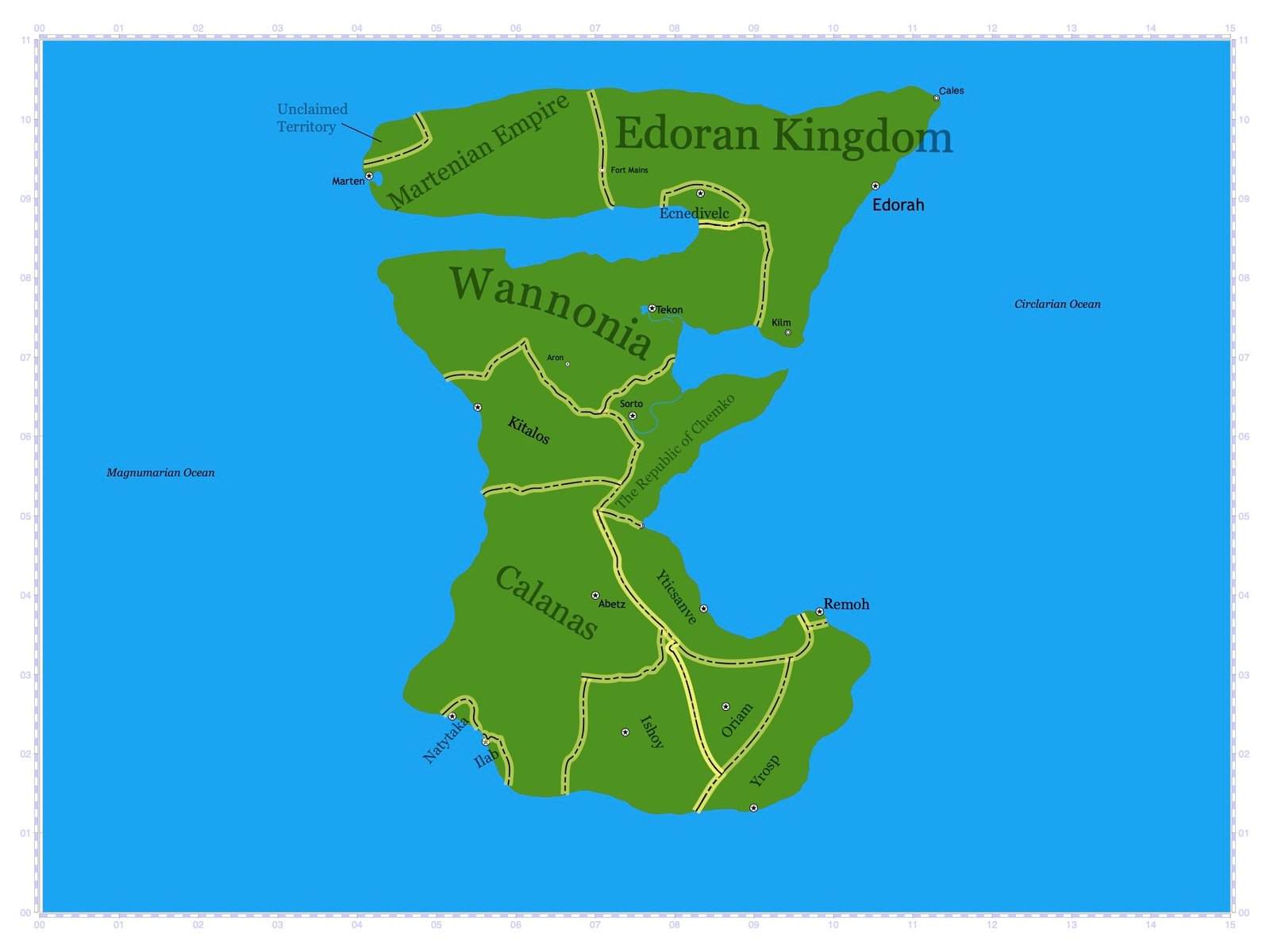
The situation concerning conflict with the Martenians to the West proved to be a seemingly impossible gridlock for the early Edorans, who fared well in holding Fort Mains, but were unable to make any effective gains in Martenian territories. Then, in April 304, the Martenians launched an assault, which captured the Fort from the Edorans. However, with the the two nations being nearly equally matched in power, the Martenians were unable to make gains of Edoran lands. In the city of Edora, King Paul I issued orders boosting funding and recruitment of soldiers in preparation for a counterassault.
Moorlandish Conformity and the Edoran System
By this point, the Moorlander population was divided into three separate factions: those who conformed to either the Edoran or Martenian establishments, those who resisted such conquering forces but were strategic enough to avoid capture or enslavement, and those who were captured and forced into the system. Within the Edoran system, Moorlander prisoners were subject to a program of Kestavian Redemption, implemented initially by Queen Rebecca I. Accordingly, each captive was given a choice: die or be redeemed. Redemption was achieved by committing to serfdom for a number of years determined by the ruling Edoran authority thereof before receiving a formal blessing from the Edoran Church. An official Certificate of Redemption was granted by a High Cleric after each said Moorlander accomplished a certain quest. After the blessing and Certificate, each Moorlander was presented with the opportunity to join the ranks of Edoran defenses in exchange for ascension to a high status within Edoran society.
Each soldier recruitee, Moorlandish or not, initially went through three weeks of training in a conditional camp for a weekly payment of 10 coppers. Graduates of conditional camps were then sent to three weeks of combat training in the training camps for a weekly payment of one silver. After that, one year of knighthood for a particular county had to be completed, with payment at 10 silvers per week. Then, pending need for service, each soldier was placed in waiting status of "reserve," being paid 100 silvers per week. In the event that a soldier was called, he would, if not needed immediately on the battlefield, undergo conditional maintenance training in a reserve fortress for a one-year term, being paid one gold piece (1000 silvers) per week. In the event that he was called, a soldier would fight on the front line, or within a fortress actively engaged in battle for a payment of 10 gold pieces per week.
Ecnediven Surley
Fort Terrance was a reserve fortress during the war against the Martenian Empire. Soldiers training in the Fort were each paid one gold piece per week, as small companies or larger divisions of them were each called to the front line. Under King Paul I, a return from battle would reward each soldier 100 gold pieces.
Ecnediven Surley was raised in a community of those who were either Edoran or Moorlandish ethnicities or a mixture of both. His father, Edward Surley, was an Edoran, while his mother, Divina, was a Moorlander. Divina ran the family's plot of farmland, worked upon by a few serfs, while Edward completed services in knighthood. Ecnediven was drawn to the successes of his father, who brought in a great deal of wealth. When he was sent to train in Fort Terrance, Ecnediven looked forward to the opportunity to draw in 100 gold pieces. However, there was an internal conflict within Ecnediven, as he was unhappy with his mother having originally been captured by his father in the past. As she was forced to conform to Edoran and religious convention, she gave in and eventually married who would become Ecnediven's father. Growing up, though inspired by his successes, Ecnediven at the same time resented his father for being too overbearing in personality, and wanted to take advantage of the 100 gold in compensation by rebelling against Edoran society and, in a sense, "rescuing" his mother.
Moorlander Uprising
The scattered population of Moorlanders near Fort Mains was under the leadership of a man named Temor, who resented both the Edoran Kingdom and the Martenian Empire. Within the previous two centuries, the Edorans occupied the lands, imposing high taxes and religious oppression. In the beginning of the fourth century, the Martenians presented themselves as being the "saviors" promising to cure the Moorlanders of their woes experienced under the Edorans. However, such promises were not fulfilled, as the Martenians were equally as oppressive. During the ongoing conflict, the Moorlanders were forcibly divided between the two ruling powers, having to help carry out either a Martenian or Edoran agenda. Under Temor, the Moorlanders came to a resolution: to reclaim their lands for themselves and rule over them as an independent sovereign Moorlander nation. In November 306, the Moorlanders, through the use of spellfire, dispatched an army of hidden archers, who captured Fort Mains, driving out the Martenians, and keeping the Edorans at bay. Alarmed, the Edorans held a royal counsel where they determined the large number of soldiers needed to overcome the Moorlanders, thus requiring larger expenditures of gold in payments.
From Fort Terrance were withdrawn more soldiers, including many of Ecnediven's friends. Meanwhile, to compensate for the pay increases, King Paul I ordered compensation for the remaining soldiers in the Fort to be reduced to 100 silvers per week.
Fort Terrance Uprising, The Formation of Ecnedivelc
In addition, the remaining soldiers in Fort Terrance, including Ecnediven, were forced to train harder, as they also faced food rations. It was during this time that Ecnediven felt a greater amount of contempt toward Edoran authorities, protesting the unfair conditions. Furthermore, he was unhappy with the agenda against the Moorlanders to the West, feeling that such was morally wrong. It was also at this point that he recognized that the leadership in the Fort was assigned from the higher ranks of Edoran authority to Edoran officials not familiar with the fortress. Ecnediven's resolution for this was to overthrow the Fort Terrance command posts.
In March 308, Ecnediven gathered followers who agreed with him and assassinated his immediate superiors. However, word of this spread quickly to the higher ranks of Edoran authority, who immediately dispatched forces to the overrun stronghold. By that May, archers killed most of Ecnediven's immediate recruits, while other followers were divided, and Ecnediven was sold as a slave to Wannonia through an unusual arrangement.
However, during this time, Ecnediven had become friends with a spy, an unknown figure by the name of Darkhand, who relayed information to other Moorlanders regarding Ecnediven's whereabouts. In June 308, they coordinated an escape plan, which succeeded. Upon his return, Ecnediven organized his even larger band of followers into teams of secret assassins, secret archers, and infantry divisions. In November, the assassins killed all occupants of Fort Terrance's command posts. Word of this, once again, reached the higher ranks of Edoran authorities, who dispatched soldiers. However, these reinforcements were killed by Ecnediven's team of hidden archers. Meanwhile, Ecnediven's secret infantry attacked from hidden places within the stronghold. And thus, Fort Terrance was captured and renamed Ecnedivelc. From this fortress, other units of infantry drove out local Edoran forces, as surrounding territory was placed under Ecnediven's direct control.
On 2 December 308, Ecnedivelc crowned himself King, establishing his territory as the Kingdom of Ecnedivelc.
309: Flight of the Moorlanders
Some of the Moorlanders originally loyal to Ecnediven's agenda were not happy with his self-coronation, as he had previously promised to establish the land as a democracy. In January 309, these opponents attempted a coup against King Ecnediven, but were dispelled as the King retaliated with brutal force. Surviving Moorlanders fled out to the Fort Mains region to join Temor.