The Building of Temor's Army
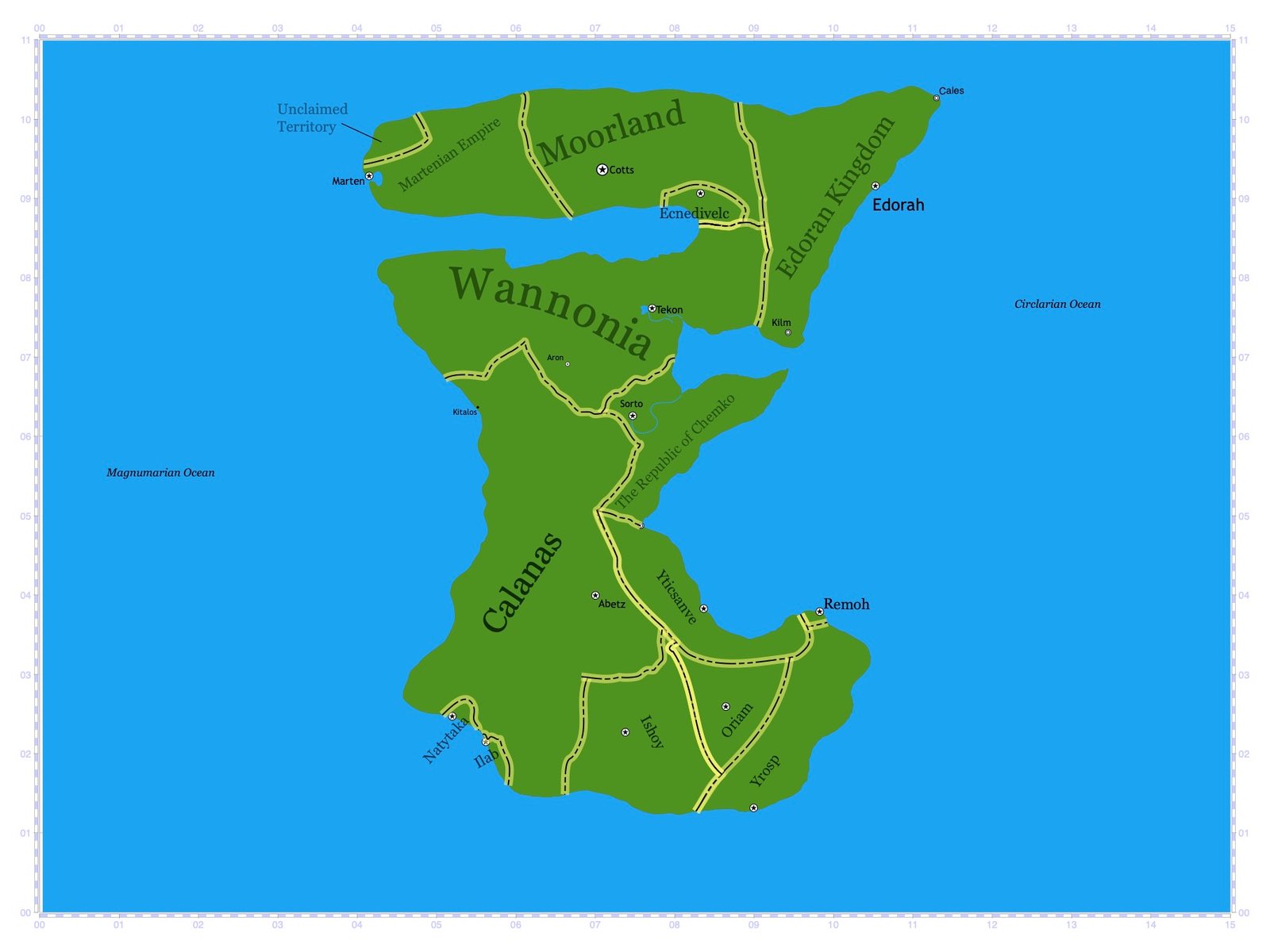
Between 308 and 309, as the Kingdom of Ecnedivelc formed while Edoran forces withdrew from Fort Mains, escapees from the tyranny of King Ecnediven joined the ranks of Temor's increasing army. Such an army served, initially, to defend the Fort, as less and less casualties were inflicted upon the Moorlanders and more were inflicted upon the Edorans. Eventually, the Edorans withdrew completely from the front; and, on 4 March 309, Temor crowned himself King of the Moorlanders.
The Flight of King Temor
It was during the summer of 309 that the Martenians from the West seemed to fall back as well, but only momentarily, as their move was that of strategy, mistook by King Temor for weakness. Unexpectedly, as civil society had begun to take root within its walls, the Martenians launched a surprise assault upon Fort Mains, attacking from above via spellfire "bombs" dropped by soldiers on eagles. Martenian archers mounted on eagles also launched hell and fury from above, as infantry scaled the walls with ladders and cavalry struck at weak spots. Before long, Fort Mains was under Martenian control, while King Temor and surviving Moorlanders fled in multiple directions throughout the surrounding territories.
Moorlandish Recapture of Fort Mains
Despite such setbacks, King Temor, through a well-coordinated system of communication, was able to organize additional recruits from Ecnedivelc into five underground encampments around the Fort, while a spy network relayed information concerning the inner functions of the Martenian forces. In May 312, news reached Temor of the Calanasian attack upon the Martenian capital, as well as information that only one division of a Martenian Legion was now manning the Fort. Seeing the opportunity, Temor dispatched all five encampment forces; and by September, Fort Mains was back under Moorlander control. Noting the faults that led to his initial defeat, Temor commanded the building of Edoran-style catapult-slingshots for the purpose of shooting down any future eagle riders. Furthermore, he utilized spellwork to create large "supertorches" which served two purposes: to spot eagle riders from afar, and to blind both the eagles and their riders. To prevent infantry and cavalry charges, King Temor ordered the construction of large water trenches, to be hidden by large grass covers. Such proved well in September 313, when the Martenians returned to reclaim the Fort, only to have large numbers of infantry fall into the hidden water trenches and drown.
The Two Fronts
Nevertheless, both Martenians and Edorans were strong within their respective territories. In May 314, King Temor launched an assault in an attempt to capture Martenian strongholds and lands, which ended only in heavy Moorlander casualties, as the Martenians held their ground. The Martenians, in return, attempted another attack on the Fort in that same month, but were met, once again with casualties inflicted by Temor's enhancements, prompting their immediate retreat. At this point, King Temor's plan was to conquer, instead, the territories of the seemingly weaker Edoran Kingdom, capturing Edorans as prisoner-mercenaries to use as additional forces against the Martenians. In September 314, the Moorlanders launched this plan; but the Edorans were better at using their slingshot-catapults, and had copied the Moorlander idea of using hidden water trenches around their strongholds. As a result, the Moorlanders were forced to retreat.
As part of a final resolution, King Temor decided to concentrate all of his forces to protect Fort Mains, where a large community, complete with a sophisticated infrastructure of agriculture and waterworks, would develop in the years and decades to come. It was here that underground passages began to be constructed, leading Fort Mains to bear a striking resemblance to ancient Totia. As early as the 310s, trade began to expand here as merchants were drawn in.
Kordera and the Soul Gem Deception
In September 315, Fort Mains saw the arrival of a notable merchant: Kordera, the daughter of a Wannonian noble and Tahnish warrior, who had, in her possession, a large collection of soul gems. King Temor, upon observance of this, conceived the idea of using the soul gems to generate images of dead Martenian and Edoran soldiers and fool both Edoran and Martenian forces into thinking that the other was planning an assault within the territory thereof. In the presence of such a distraction, the Moorlanders would attack and claim their territories. In November 315, a deal was struck with Kordera for the King to purchase 17'000 soul gems for only 100 gold pieces. Between March and June 316, Temor implemented his strategy by constructing each a large wooden perimeter in both Edoran and Martenian territories. As planned, he utilized the soul gems to generate images of large numbers of soldiers from the opposing country training inside each perimeter, while employing a small number of Moorlandish archers to make the deception seem genuine. Both Edoran and Martenian forces fell for this, as large numbers of Edoran and Martenian soldiers fell away from the lands surrounding Fort Mains.
The Moorlandish Reclamation
Between September and October of 316, King Temor took advantage of the massive withdrawal and captured large numbers of Martenian and Edoran fortresses, building his designed enhancements upon each. The Martenians were the first to realize the trick played by the Moorlanders and attempted to reclaim their strongholds and territories. However, the Moorlander enhancements kept the Martenians at bay, while the Martenians sustained heavy casualties. In December of that year, they approached King Temor with a peace treaty, to which the King agreed only on two conditions: that they would help the Moorlanders hold their ground against the Edorans, and that they would support the Moorlanders in forming a treaty with the Edorans. To this, the Martenians agreed.
Between January and April 317, the Edorans attacked. Like the Martenians, they endured heavy losses owing to the Moorlander fort enhancements. That May, King Paul I crafted a three-way treaty between the Edorans, the Moorlanders, and the Martenians. With this treaty, the three nations established negotiated boundaries.
The Kingdom of Moorland: Monarchy and Democracy
Ultimately, the Kingdom of Moorland was established as a system of both a monarchy and a semi-democracy. Temor was the King, ruling over a top-down distribution of power, while knights enforced the King's laws in a hierarchy of divisions down to the county level. However, such power was limited, with each county and town being free to form its own type of local government, under two conditions: that they did not challenge the King, and that they did not challenge each other (i.e. via tariffs). It is interesting to note that some counties and towns established local elected councils.