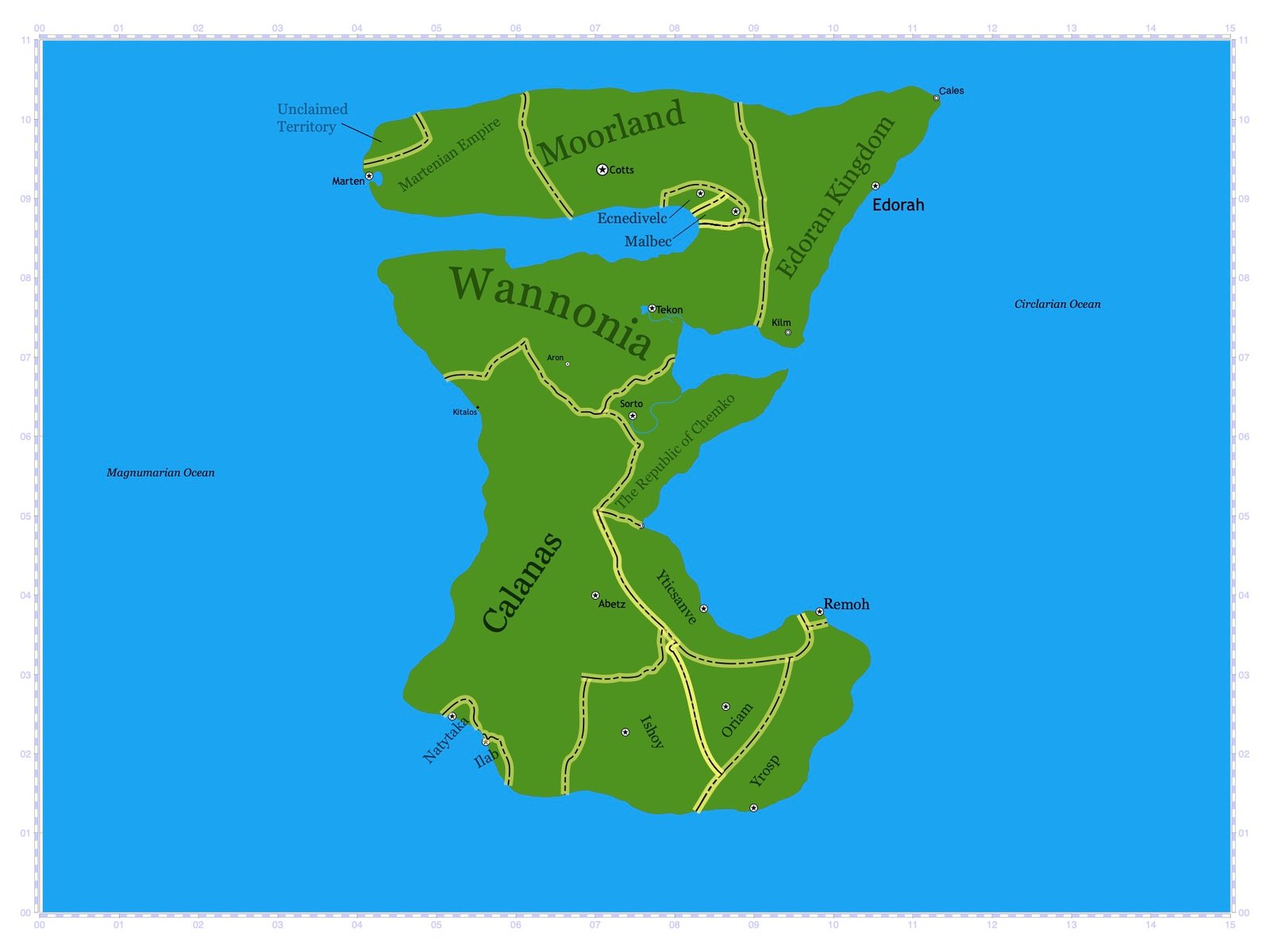
310s-320s: Moorland and Ecnedivelc
The Kingdom of Moorland covered mostly flat plains as well as coastline in the South and in the North. The vegetation was mostly grasslands while the climate alternated between mild summers and frigid winters. People of the Moorlander and Moorlander-Khap ethnicities comprised of most of the population while the Moorlander Vernacular and West Aerdn languages dominated written and spoken communication. King Temor was initially raised alongside Edoran norms. While holding true to the Alconist faith, Temor believed that the Edorans corrupted it, and, thus, began rebelling against Edoran society at the beginning of adulthood. Temor allowed the practice of the earlier Moorlander and Khappian religions but considered Alconism to be the official practice, building churches or chapels in each Moorlandish county. With the Crown and the Church of Moorland merged, education was taught in these chapels, as well as the convents. The King of Moorland was the ultimate government authority, exercising limited powers through the hierarchical system of knighthood; but counties were also allowed to establish their local governments, provided that they remained loyal to the Crown. Meanwhile, as the years progressed, there emerged a social class similar to the Edorans, with the King and nobility at the top, followed by the lords or local councils, knights, merchants, and finally the laborers. The laborers produced food for themselves and the cities, while traveling merchants circulated goods and wealth to the city guilds and guild owners. Such a Moorlandish economy traded wheat, silver pines, and spellfire items. Like other countries in Remikra at this time, the Kingdom of Moorland followed the gold, silver, and copper standard for their currency. The diet of this population consisted mostly of grains, deer, and bison, while freshwater was drawn from the lakes and the outflows from the Correns. Silver and copper quarries were present as well. While King Temor did not believe in forced serfdom, the guilds bought large amounts of farmland and paid laborers in copper and silver. Such a system created an incentive to labor, and, therefore, a large number of people willing to labor. During this time, the King established a uniform postal system consisting of horse and eagle riders, while communication was carried via letters, pamphlets, journals, and bulletins. While Moorlanders used the ancient brick roads built by the ruling powers of the past, they also constructed additional gravel roads to support the additional villages that came into existence. Such a system was patchy, with no standard for the type of road used for transit between specific types of destinations. Along these roads, most people traveled via walking. Those of the upper classes or working for the postal system used horses, while others used eagles. Being initially a roaming warrior power, the Kingdom of Moorland never experienced a shortage of infantry and cavalry. However, King Temor wasted no time paying laborers to construct large numbers of ships to build a Navy to patrol both the North and South coasts. Shortly thereafter, every county was supplied with at least ten eagle knights, while hundreds of these protected Fort Mains, now named Cotts, and the King's Fortress. While a three-way treaty of peace existed between Moorland and the two powers, Marten and Edora, King Temor was concerned about the aggressive sentiment carried out by Ecnedivelc. Meanwhile, throughout the entire Kingdom was discovered spellfire quarries; although, these were smaller than the ones present in Wannonia in ancient times. A key difference between the Edoran and Moorlandish Kingdoms was that while the Edorans limited spellfire practice to specific guilds, the Moorlanders allowed local encampments to teach and use spellfire. Later on, however, certain counties and cities would issue ordinances restricting spellfire to outside certain limits.
Meanwhile, in the Kingdom of Ecnedivelc, the terrain was more mountainous, with more pines than grasslands present. The climate here was, overall, colder and wetter, with consistent rain in the summer and heavy snows in the winter. Moorlandish and Edoran peoples resided here, but the Edoran language was the dominant tongue. Like Moorland, King Ecnediven established his own Alconist church, known as the Church of Ecnedivelc. And similar to Moorland, it was the clerics who initially provided educational instruction. However, once students grew older, they would be mandated to continue their education in military school. King Ecnediven exercised absolute power, enforcing all laws via a system of knighthood and not allowing local governments to develop except under appointed lords. Any defective lord against the King would be promptly executed. The social class structure was a simpler one, with the King and nobility at the top, followed by the knights, and then the serfs. The knights protected the lands, while the serfs produced food and goods. Fishing and grains were the two primary sources of trade, while the gold, silver, and copper standard was the dominant currency. However, all functions of economy were solely under the direct authority of the Crown. The knights, along with their military duties, controlled all systems of communication via eagles and horses, with all pamphlets, journals, and letters under the control and approval of the Crown. Only one library was allowed to exist, and was located in the fortified city of Ecnedivelc proper. The network of transportation consisted mostly of dirt and gravel roads, while commoners walked between places. Only nobility and the knights were allowed to use horses and eagles. Only one division of knights, usually consisting of up to ten people, protected each village. In adherence to military doctrine prescribed by the King, village serfs of age were expected to be armed and ready to protect themselves. The rest of the knights, as well as all of the eagle fighters, protected Ecnedivelc proper. Meanwhile a single spellfire guild was established under direct control of the King and his respective nobleman. Such a guild consisted of one location, inside Ecnedivelc proper; any spellfire acts outside of this place was punishable by death.
War on Ecnedivelc
Throughout the late 310s and early 320s, Ecnedivelcan refugees came to Moorland with stories of oppression and aggressive military doctrine, in which all pupils were made to train in the military, while defectors, regardless of age, were put to death. Those involved in spellfire, especially those exhibiting symptoms of what would be studied as Involuntary Darkfire Conjuration Syndrome centuries later, were hunted and killed. Upon hearing of these tales, King Temor came to the resolve that there was moral wrongness in Ecnedivelc. The King of that small territory had too much command and power, and thus the people there lacked certainn important freedoms. Certain people were oppressed based on how they were born, which King Temor determined to be wrong in the face of Alconism. Ultimately, Temor felt that it was his calling to bring an end to the "barbaric Kingdom."
In June 322, King Temor launched upon the Kingdom of Ecnedivelc an assault consisting of divisions of infantry, cavalry, and archery. Forts and villages were captured, with most taken prisoner, and the most aggressive warriors killed.
Preservation of Ecnedivelc
In September 322, King Temor placed Ecnedivelc proper under siege; however, such a strategy would be outsmarted by the Ecnedivelcans. Mallan, a member of Ecnedivelcan knighthood, demonstrated talent in combat, thus advancing to the highest command post. Meanwhile, King Ecnediven was dying and had no apparent heir, leading Mallan to believe that he was suitable for the Throne. However, he was not yet old enough to be King; so Ecnediven placed his nephew as a temporary occupant of the position until Mallan's sixteenth birthday, which would happen in October of that year. Furthermore, Ecnediven wanted for Mallan to be the one to defeat King Temor or effectively force the enemy into submission, as a test for leadership. During this time, King Ecnediven attempted but failed to break the Moorlandish siege; so Mallan conceived the idea of sneaking forces behind enemy lines via eagles at night. Ecnediven agreed to the approach and employed Mallan to lead the mission. As Mallan carried this out, King Ecnediven died, and Divenec, his nephew, assumed temporary power. At the end of September, Mallan's forces attacked, with infantry having been carried by the night eagles charging from behind, and wall archers attacking from Ecnedivelcan walls in the front. Soon, the besiegers were trapped and slaughtered. Hearing silence and instinctively knowing that something was awry, King Temor of Moorland sent reinforcements; but Mallan had also used his night eagle idea to plant additional infantry to charge from hidden locations around the city, catching King Temor's reinforcements by surprise. Thus, upon the Moorlanders, heavy casualties were inflicted, and the siege was broken. Amid rumors that King Temor was planning to strike again from the South, Divenec assigned Mallan, in October, to command a Fort in that region. In November 322, King Temor surrendered his agenda and approached Ecnedivelcan leadership with a proposal for a treaty, in which the original boundaries were respected, and an alliance was signed for each side to provide mercenaries as necessary in a time of need.
Internal Strife: Mallan Breaks Off
Later that month, while Mallan was stationed in his location to the South, Divenec officially crowned himself King of Ecnedivelc, breaking the will of the late Ecnediven. Unhappy with the broken promise, Mallan carried out a coup. In January 323, Mallan placed Ecnedivelc proper under siege, where both sides were gridlocked in a battle in the skies between eagle riders. Divenec, though, having expecting this, dispatched a division of hidden archers from the concealed strongholds built during the first siege; and by April, Mallan's forces were dispelled. As punishment, King Divenec ordered Mallan imprisoned inside the very post in which Mallan was originally assigned to command. However, as the imprisonment guards arrived in April 323, they were massacred by Mallan's forces, who had been expecting such an agenda of containment. In the months that followed, Mallan's forces built and commanded from encampments around the Southern region of Ecnedivelcan territories, as King Divenec sent wave after wave of reinforcements. In September 323, Mallan launched a coordinated mass assault, driving Divenec's forces back North. In October, Mallan crowned himself King, renaming his fortress and his new territory the Kingdom of Malbec.