Peace and Order
Between 551 and 524 BCE, Emperor Termis Korladi I ruled over Wannonia with peace and order. His Legions were well-funded and well-staffed, providing consistent protection across the Remikran and Canticulan territories. Roads, canals, and other forms of infrastructure were continually expanded and well-maintained. Under Korladi I's economic policies, guilds could trade freely and make independent business decisions. However, if they reached a certain height in wealth or ownership, they were assessed large taxes designed to eliminate or downsize their presence. Such tax funds would go to the second-rank guild members so that they would establish their own guilds or continue to operate existing ones. Also under this policy, with guilds growing and selling crops, land was zoned while guild ownership was limited by region. The purpose of these policies was to prevent the ancient guild equivalent of monopolies, as such would otherwise gain too much power and ultimately corrupt the Wannonian Imperial Court. During this time, Ulizion Sterrol, a prominent flaxweed guild owner approached the Emperor, proposing that through experiments and spellcrafting, he had developed a strain of flaxweed capable of withstanding disease, bad weather, and other misfortunes. An additional benefit was that it produced a bountiful harvest. Appeased by such testimony, Korladi I granted Sterrol permission to try his experiment on large tracks of land in Canticula, temporarily exempting him from the guild tax policy. The outcome of this was that bountiful flaxweed returned to Tekon and the Wannonian homeland, impressing Korladi I. However, the Emperor then received news that farmers were forced to pay for certain "soil rocks" in order to help grow this strain; and such minerals were extremely expensive. Furthermore, the crop severely sapped soil nutrients so that other flaxweed crops were unable to grow there, forcing farmers to continue buying Sterrol's resources. Korladi I discontinued Sterrol's expansion, limiting him to the land he had thus far. The Imperial Court also tried to force Sterrol to reduce his soil rock prices, but with Sterrol proving his expenses, prices stayed high. However, Korladi I also restored the guild tax policy upon him. And thus, the Wannonian economy remained stable until Korladi I's death in 524 BCE.
Ignorance and Complacency
In accordance tradition and Korladi I's will, his son, Termis Korladi II, peacefully succeeded the throne in 524 BCE. Sterrol approached him with the exact same request. Except Sterrol also had a deal: in exchange for getting as much land as he wanted as well as a complete tax exemption, Sterrol would also promise his daughter for marriage to Korladi II's son. Despite dire warnings from his closest advisors, Korladi II agreed to the deal. Promptly, Sterrol's daughter and Korladi II's son married. And within a few short years, Sterrol's flaxweed crop became the dominant and eventually the sole flaxweed crop throughout the Circlarian realm. Sterrol lowered flaxweed prices for Korladi II and his family, as well as the families of other guild owners. For everyone else, however, he raised his flaxweed prices, resulting in growing popular contempt. Later on, other merchant guild owners approached Korladi II asking him for similar tax exemptions and deals. To every single one of these, Korladi II obliged. Before long, Imperial coffers ran dry from the tax exemptions, leading to an inevitable halt in basic infrastructure. To resolve the crisis, Korladi II instilled high property taxes on the working and farming classes. In protest, the population staged a mass stoppage of tax payments; and Korladi II sent Legions to the rebelling counties to collect taxes by force, and, when necessary, to put down rebellions.
Promise and Restoration
In October 495 BCE, popular uprisings manifested into two rebelling figures: Nikon Eustus from Aron, and Korlus Maen from Combria. In that month, they met, where Maen presented his ideas: to give land back to crops other than Sterrol's destructive flaxweed strain, to exempt his region from property taxes, and to establish a legislative body among the farmers and inhabitants for representation in Tekon. Eustus then presented his ideas: to overthrow Korladi II and the Imperial Court, to instill a system of leadership similar to the Head Consul Commander system, to abolish property taxes altogether and bring back Korladi I's guild taxes, to break up the large guilds while bringing back the old flaxweed market, to directly appoint one person, Maen, to govern Combria and Ereautea temporarily until an election was called, and to call for an election of a Senate. Furthermore, in retaliation to past discriminations, Eustus also vowed to freely allow Chemkan settlers to establish their properties in Wannonian territories.
The End of Korladi II
Eustus and Maen organized a coup. At this point, Wannonian Legions were underfunded so that Tekon, the Imperial capital, effectively had no protection. In September 493 BCE, the group launched an assault similar to one carried out by the Totian Emperor Kylan. Such an attack upon Tekon succeeded, as Emperor Korladi II and Sterrol as well as their families were put to death. Eustus then made himself the third Emperor of Wannonia, assuring that such a duty was only temporary and vowing to act on his promises.
Broken Promises
Emperor Nikon Eustus implemented major changes within the first few years. He restored Korladi I's tax code against the large guilds and broke many of them up. New flaxweed guilds came into existence, but all used the strain and system of Sterrol. Nevertheless, prices were lowered on Sterrol's flaxweed and minerals. However, Eustus did not act on all of his promises. He handed Senate formation responsibilities to a man named Locolan Dorrus, who stalled in his duties. Eustus lowered property taxes but not by much, backing from a subsequent promise to lower them incrementally; and he certainly was not going to follow through on his vow to abolish them. He also signed tax exemption deals with guilds expanding their businesses into the Free State of Calanas. To compensate for this, he instilled a sales tax on flaxweed and other crops grown in Combria and Ereautea. Furthermore, he later mentioned that he would torch the Chemkan capital of Corbos if even one settler set foot in Wannonian territory.
Resentment in Combria and Ereautea
Between March and May 480 BCE, Maen, feeling betrayed by Eustus, organized a rebellion. He secretly built underground fortifications where rebel fighters could station themselves. He then had tax collectors captured and issued a ransom letter to Eustus, refusing to let the captives go until he lifted both the property and sales taxes. Eustus dispatched two Legions stationed in Combria, who massacred the rebelling farmers and rescued the tax collectors. Eustus then punished Maen by levying extremely high property taxes, levying extremely high crop sales taxes, and, furthermore, forcing farmers to surrender half of their yields for Tekon. In June 479 BCE, Maen organized yet another army of rebelling farmers, who slaughtered every Legion soldier throughout their region and beheaded their Legion Generals. These severed heads were sent to Emperor Eustus in Tekon, along with a letter signed by Maen that the region was now an independent sovereign nation: the Nation of Karlin.
A Likely Defeat
Eustus responded by sending more Legions of Wannonian soldiers who pushed into Karlin between September and October 479 BCE. Maen was killed; rebelling farmers were forced to retreat into their strongholds; and Wannonians dominated the landscape. Nevertheless, the Karlinians refused to surrender. Meanwhile, in Tekon, Eustus assumed that the seemingly short-lived conflict was over.
Hidden Preparations
Between November and December 479 BCE, Dusteros, a merchant from Chemko, arrived in Karlin where he examined the situation with the rebelling farmers and noted another leading Karlinian figure: Tevonian Likon. Promptly, Dusteros and Likon met in private council, where they planned to recruit social outcasts from both Chemko and the Totian Empire, promising to reward them if they fought for Karlin. They smuggled these recruits into Karlin, where they hid in the strongholds as reserves ready to fight.
A Facade of Hostility
In March 478 BCE, Dusteros returned to Chemko, where he convinced a Chemkan Legion General to go against the Chemkan Senate's wishes and invade Wannonia. In the following month, Likon voiced surrender to the Wannonians, even though such a statement was not genuine. In September 478 BCE, the Chemkan Legion invaded Wannonia; and between January and February 477 BCE, Emperor Eustus drew troops from Karlin to combat the Chemkans. Before summer, these troops were at the gates of Corbos. In March 477 BCE, Likon and his soldiers, noting the departure of the Wannonian Legion troops, retook Karlin and pushed toward Tekon, with the stretch of land in between unprotected from the Karlinian invaders. Emperor Eustus, having received news of this, promptly sent a message to Corbo, demanding their assistance. Before long, however, the Karlinians placed Tekon under siege.
Wannonian Defeat
In October 477 BCE, the Wannonian Legions from Corbo arrived and broke the siege around Tekon, but were struggling to keep the Karlinians at bay. Eustus tapped into the Canticulan territories for more Legion soldiers, giving the Northern half of the Canticulan territory to an independent protectorate government. When these troops arrived in Remikra, they succeeded in pushing the Karlinians back to their main stronghold, a city named Kilm. In 476 BCE, a usurper protectorate government overtook the remainder of Canticulan colonies. Eustus sent Legion soldiers back to Canticula in an attempt to hold onto them. But such efforts were futile, and Wannonia effectively lost all Canticulan lands. Meanwhile, such a departure of Legion soldiers led the Karlinians to gain land back to the original Karlinian border, where they and Wannonia would remain in a gridlock in the years to come. In 450 BCE, Eustus died, as the Imperial throne was succeeded by his son, Nikon Eustus II, who spent the remainder of the war attempting in vain to launch assaults against the Karlinian border. In 432 BCE, as Imperial coffers were drained to pay for this long war, Eustus II was overthrown and put to death by the Wannonian people. Servan Maen, son of Korlus Maen, was placed on the throne, where he immediately ended the war and signed a peace treaty with Karlin.
The Republic of Karlin
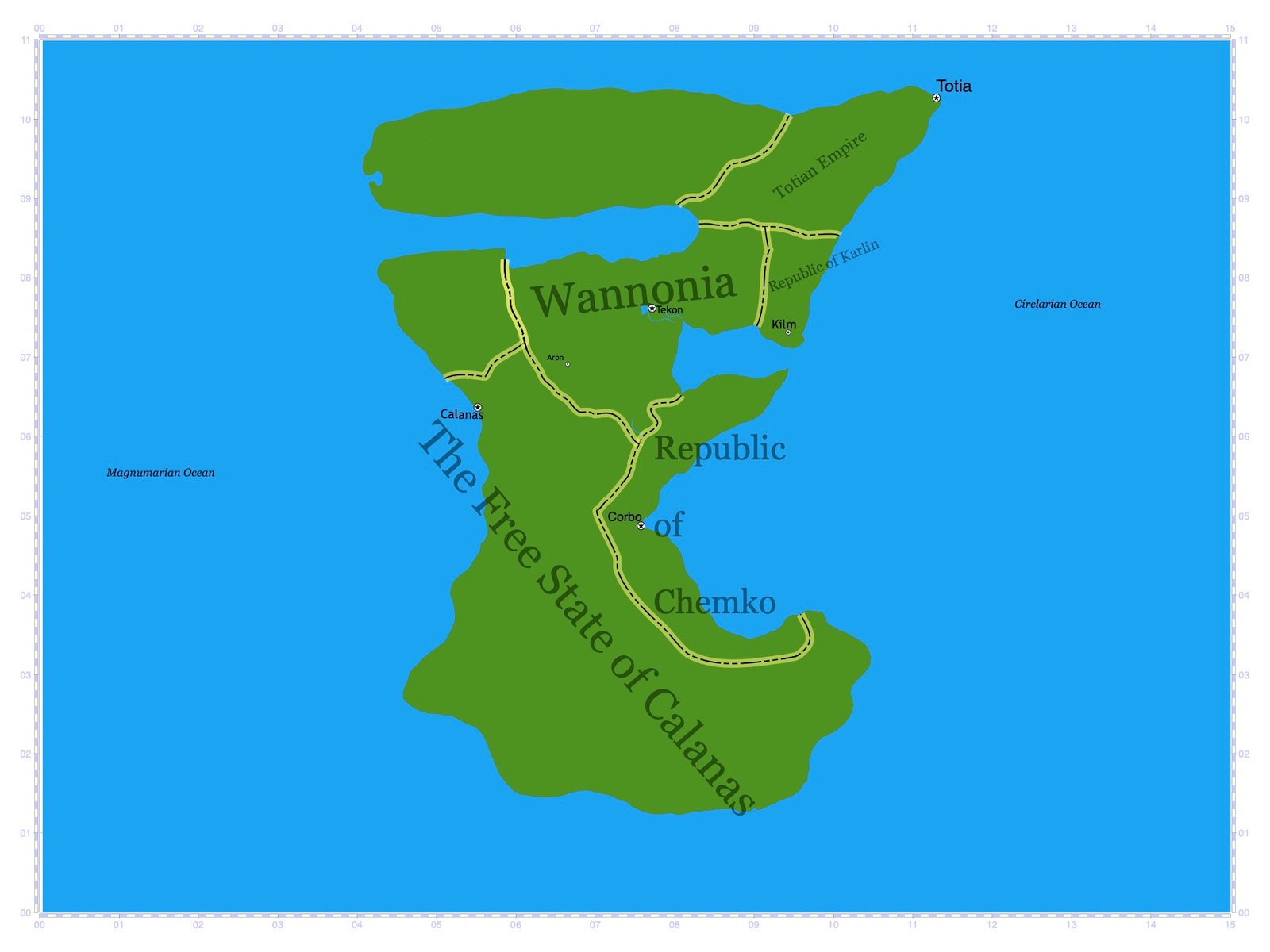
The nation of Karlin established itself as a republic which covered the Eastern portions of present-day Combria and Ereautea. Most people here were Wannonian, Totian, and Chemkan, while the language spoke was the same form of Aerdyn as it was in Wannonia except with a distinct regional dialect. Local religions were practiced, while the Republic instilled a policy of complete religious freedom. Culture was simplistic in the farmlands, but a prominent arts center developed in Kilm, Karlin's capital. A public library-based academy system served to educate the Karlinians in the centuries to come. The government in Kilm consisted of an elected Senate with elected Consuls, one Chief Commander over Legions and Generals, and a system of Mediators in a court of justice. In fact, it is believed that the Republic of Karlin was the first in the Circlarian realm to have three distinct branches of government. Taxes were placed against large guilds, while the Senate voted to instill more freedom in trade and choice over guild commitment, preventing the formation of guild family lines present in Wannonia. Karlin had plenty of arable land for crops, many rivers and lakes for freshwater, and still plenty of wood from the trees. Meanwhile, they placed an embargo on flaxweed. Karlin was allied to the Republic of Chemko and the Totian Empire to the North, while they were neutral with Wannonia and Calanas. In 421 BCE, the Karlinian Senate voted to establish the Free Library of Kilm, which stored a great collection of scrolls and spellbooks.