Kilm: The Five Lords and Houses
Bisected by the Deepnarrow River, which ran Northwest to Southeast through the city in an S-shape, the center of Kilm, in the fifth century, consisted of a large multi-tiered Palace built over the River, underneath which existed docks to serve passing merchants. South of the River lay the West and South Cantons of the growing city, while the North and East Cantons lay to its North. Medieval Kilm under the Edoran Kingdom was governed mutually by five Lords, each from their respective House in their Canton. The Town Square in the center was, in the early 400s, governed by Lord Sir Alexander Thomwell; the North Canton was governed by Lord Sir Robert Kayndon; the South Canton was governed by Sir Paul Teemor; the West Canton was governed by Sir John Borwell; and the East Canton was under the Lordship of Sir William Benson. The official roles prescribed to these Lords was to each employ a division of knights to defend his respective Canton, and to each collect taxes from the serfs, who were employed by wealthy guild owners.
Lord Donmar's Agenda
Initially, the Lordship establishment was disliked by the serfs, who stated grievances of family separation for labor purposes, as well as lack of rights, lack of free choice, high taxes, and long work days.
In the autumn months of 399, Lord Benson, who was on his deathbed, appointed Sir Kenneth Donmar, from Fort Norm, to be his successor. This appointment was approved unanimously by the other four Lords; and a letter from King Samuel I also expressed approval. In January 400, upon taking his new role, Sir Kenneth Donmar publicly insulted and dehumanized the working serfs, drawing contempt from the masses. However, such contempt was unheard. And with large amounts of gold rewarded to him by King Samuel I for the defeat of the Kilmian city-state, Lord Donmar vowed to convert each of the Canton Lord's Houses, including his own, into large Palaces similar to that in the Town Square District; and around each, he would construct a large courtyard. The issue was that the space required for such expansions was already occupied by many of the living serfs. Donmar addressed this by forcing the serfs to live in smaller spaces along the margin of each Canton. With no opportunity for input from the serfs, themselves, the Lords unanimously approved of this project in March. And very soon, the plan went into action.
Instan's Uprising
In September 401, Instan, a serf from the West Canton, began to realize the end agenda of their labor, and wasted no time rallying the other serfs in his and other Cantons to protest. Street riots ensued, but in December 401, the ruling Lords had all of them arrested; and Instan was jailed for five years. In March 407, after his release, Instan was sent to labor in the surrounding farmlands as part of a parole for "redemption." In September, he fled his post and arranged secret meetings with serfs in and around Kilm for a coup. In March 408, Instan and his forces attacked from within the Town Square with blades, arrows, and spellfire. The Lords retaliated, massacring the rebelling serfs and executing Instan.
The Restructuring of Kilm
Other serfs not directly involved in the coup began to protest in the streets, as the Lords wrote to the King for help. King Samuel II, who was now the incumbent King, ordered all serfs currently living in Kilm to be divided and sent into different counties in exchange for the inflow of serfs from those respective counties. Upon the incoming new serfs, Lord Donmar imposed a doctrine, as they were sorted into their Cantons. According to the doctrine, and relative to the Lord of the assigned Canton of each serf, the "other Houses" and "other Lords" were conspiring to exclude their Lord and House, and that the said Lord was the only one in Kilm who was not corrupt. Part of the role of each serf was to prepare for the ultimate battle, which the presiding Lord feared would be initiated by the "other Houses," and that their House was to win and restore peace to Kilm.
Meanwhile, Donmar's policies continued; and the successful completion of all the large Palaces and Courtyards warranted the promised feasts in the Great Halls of these Palaces in the autumn months of 426.
The Gang War Games
In each Canton, some serfs were made to construct 100-foot tall stone walls around their respective district, while others trained in combat to fight the "other Houses." Another sector of serfs reported to the central Town Square to work for some of the guilds, where they encountered serfs from other Cantons.
Meanwhile, in the decades that followed, the presiding Lords' on settling minor disputes, most commonly the acquisition of surrounding farmland, involved setting up serfs' duties to spark conflicts. Individual serfs or factions of them would ultimately challenge each other to duels or battles, provided that the conflicting parties were from different Cantons. When such conflicts arose, the Lords would secretly meet to establish announced times and places for these conflicts to happen. Such venues were turned into arenas as spectators would watch the events unfold. The Lord and Canton of the winning party would get the favorable upper hand in the minor dispute, while the losing party in the aristocracy would receive some gift of consolation; thus, diplomacy would be maintained between the Lords.
George Manning, Upbringing
By the 480s, leadership in the Houses and Cantons had changed considerably. The Town Square was now governed by Lord Sir Dennis Fillhorn; the North Canton was governed by Sir John Kayndon; the South Canton was governed by Sir Robert Teemor; the West Canton was run by Lord Sir James Borwell; and the East Canton was under the Lordship of Sir William Benson III.
A son of the owner of a ship building guild, George Manning was initially friends with Lord Dennis Fillhorn of the Town Square district. He had access to the Lords' meeting quarters and was educated on such matters. Furthermore, he had access to their Library. Early on, Manning was indoctrinated with the belief that there was friction between the Lords, which was manifesting into the serf conflicts within the city. Worried about the loss of stability in the city's political landscape and a man of the Alconist faith, George Manning consistently prayed for peace. In his early adulthood, Manning began attending the Royal College of Town Square to study further material in ship building.
Library and Enlightenment
In September 484, an especially brutal rivalry arose between families of the East and West Cantons; and a ship battle in the River was announced to take place at the Southwest Edge of the city on 15 November. It was during such announcements that Manning observed with question how the upper establishment would regulate the logistics for these battles to happen, and further questioned the rules governing the number of ships used, as well as the type and amount of weapons. On the evening of 15 November 484, as scheduled, the conflict began. Ships from the South Canton attacked and overcame the ships from the East Canton. A signal was given by the Mediator for the archers on the East Wall to shoot flaming arrows on the Southern ships, thus destroying them. The Mediator declared victory for the East Canton. While observing this, Manning also took note of the Lords sitting together on a high balcony along the South wall. After the conflict, Manning spied on a secret meeting between the Lords, where he discovered the cause of the conflict to be a dispute between the respective Lords over farmland Southeast of the city. Sir William Benson III, in accordance to the conflict outcome, gained the land, but offered consolation to Lord Teemor through his daughter's hand in marriage. Thus, the two Lords came to a diplomatic consensus.
Not long after this, George Manning went to the Library and crossed into a restricted section, where he discovered manuscript detailing the uprising of Instan. Further research taught him of the fall of the ancient Republic of Karlin.
The Crossing of Boundaries
In January 485, Manning emerged out of his deep Library studies and relayed what he found to a group of close friends. That March, they began a secret distribution of pamphlets to serfs in all of the Cantons and Town Square. However, before anything could materialize, an unknown defector tipped the Lordship of Manning's secret agenda. Manning and his followers were arrested, divided, and sent to work on surrounding farmlands outside the city.
The First Attack
While in his assigned farmland, between January and June of 486, George Manning gathered followers, and set up an underground system that united his original followers on the other farmlands. One night, they met and planned a coup, where they would retake Kilm and re-establish it as a democratic city-state. They would then move to overthrow the Edoran Kingdom and re-establish the Republic of Karlin.
In September 486, recruited forces under Manning's leadership commandeered merchant ships and snuck into the dock ports under the Town Square Palace. From these sprung infantry and archers, who pushed out into the Town Square as the Palace fell under Manning's control. They aimed to attack and capture the surrounding Cantons; but the Lords struck back, attacking them with eagle-riders who shot arrows and spellfire discharges. Furthermore, infantry dispatched by the Lords pushed Manning's forces back toward the docks. Having lost this battle, Manning attempted to escape, but was found and arrested.
The Second Attack
George Manning was thrown into a dungeon in the South Canton, where he was set to be executed. His remaining forces were either imprisoned or divided and sent to farmlands near Norm and Daylram. In March 487, however, Terrance and Maen, spellcrafters and Manning's closest followers, who managed to escape being captured or killed, helped Manning escape to freedom. Between June and October of that year, the three figures established a secret Kingdom-wide underground system with hidden posts in every county. With this, they recruited large numbers of rebelling serf-warriors, especially from Daylram and Norm. In November 487, they attacked, overthrowing the two cities, as they were brought quickly under Manning's control. In December, they attacked Kilm. This time, Manning's agenda succeeded, as all five Lords were executed, and Kilm was brought under Manning's control. Soon, they pushed Edoran reinforcements to the Circlarian Coast and up toward Edora proper.
War: Establishment of the Reformed Republic of Karlin
King Samuel V readied thousands of knights and soldiers. In February 489, he launched them in a sweep that captured Daylram and Norm, and placed Kilm under siege. In March 489, Manning, Terrance, and Maen snuck past the siege lines and traveled to Wannonia, where they spoke to Empress Alexia VI for help. The Empress obliged and sent Wannonian mercenaries, who, in April 490, attacked from the West, breaking the siege and joining with Manning's forces. Together, they swept Northward, re-capturing Daylram and Norm, and placing Edora proper under siege. King Samuel V dispatched night-eagle riders to the Maurangans, a fleet of pirates in the Circlarian Ocean, to ask its leader, Torchae, for help. Torchae agreed, and, in June 490, dispatched his entire fleet as reinforcements. By September, they arrived in Edora proper, where they broke the siege and swept toward Daylram and Norm. In May 491, however, after struggling in vain to re-capture the two cities, reinforcements from Alexia VI slaughtered Edoran and pirate forces. One year later, the King approached Manning with a message of surrender, calling for a treaty.
September 492: The Treaty
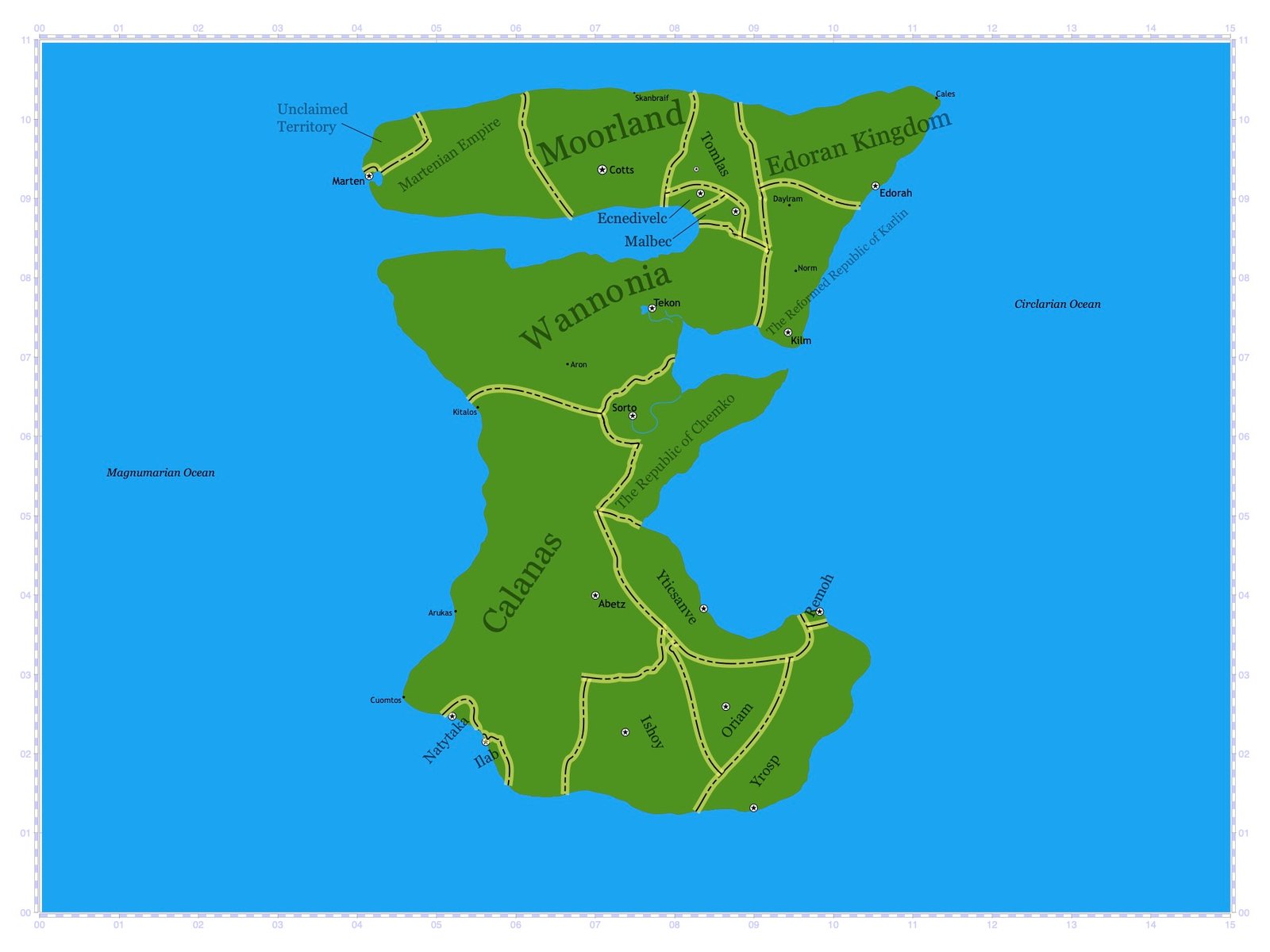
Signed in September 492 between the parties involved, the treaty recognized the Reformed Republic of Karlin as a sovereign nation. A boundary was drawn North of Daylram. All land to its South, including Daylram, belonged to the new Republic; and all land to its North belonged to the Kingdom.
Another Change in Wannonian Leadership
In October 492, Alexia VI died peacefully. However, with no daughter to succeed the Throne, the dynasty of the Alexias was brought to an end. Instead, Alexia's son, Justorran, would take her place.