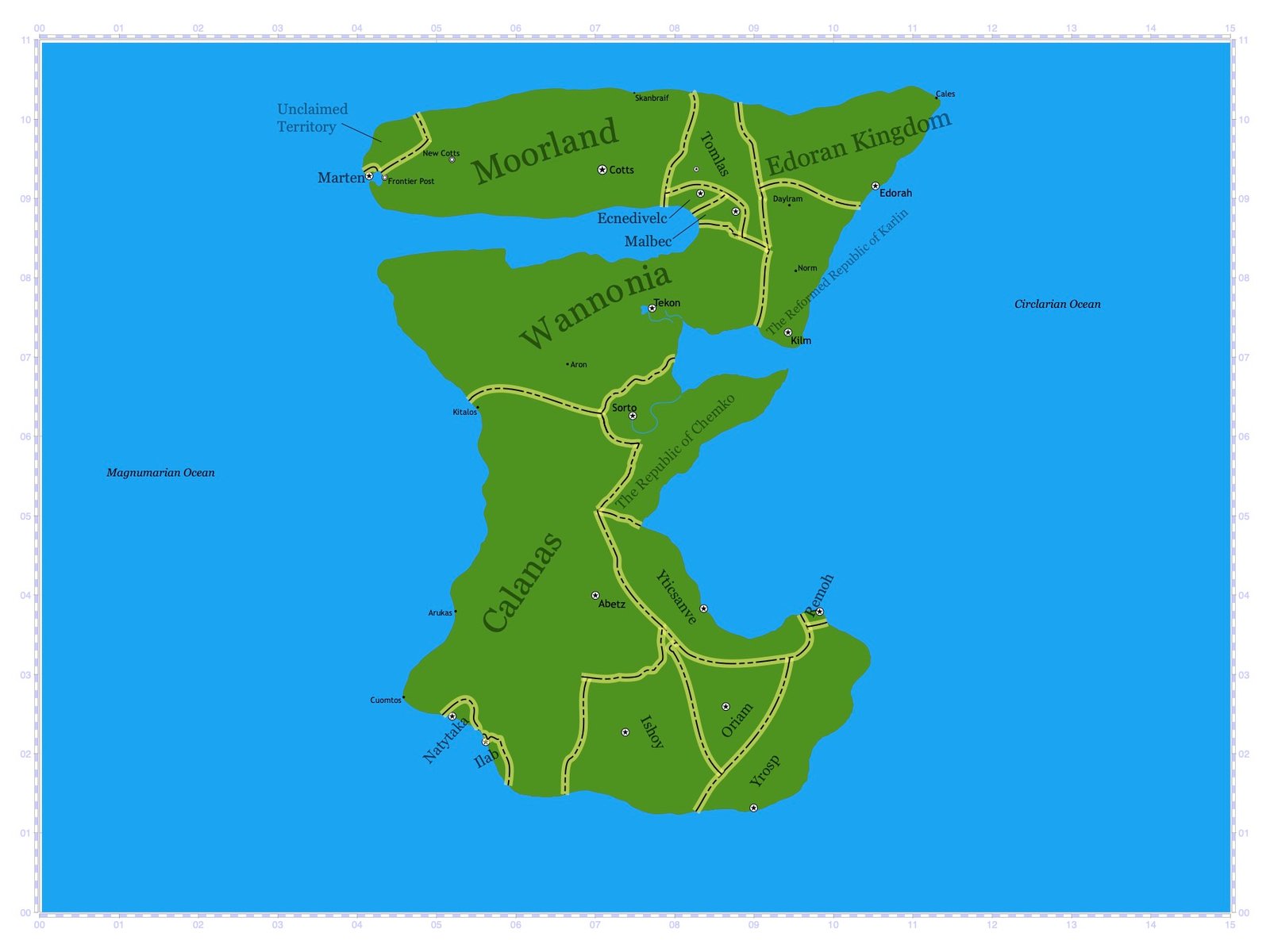
Isle of Truth: Wannonian Deal
For centuries, the inhabitants traded "pine-gold" a material made of brown pine wood. Accordingly, taps were drilled into each brown pine tree to drain the sap, while special file tools ground wood shavings. The sap and shavings were then mixed into pots and cooked over the fire. After that, such a mixture was either poured onto a cool stone surface for crafting of floor or wall decor, or poured into cooling molds to create pottery or statues. The Isle natives, in the end, made gold profit in selling cut trees, while it was the Wannonian guilds who produced the makes. In Wannonia, guild merchants bought and sold "pine-gold" products, circulating them with neighboring nations like Chemko and Calanas.
In the latter half of the fifth century, a deal was made where the Isle natives sold harvested pines to the Wannonians for tariffs lower than sold to other countries. The Wannonians would then produce such items and sell them via only merchant guilds from the Isle. Also part of the deal, to further compensate for the reduced tariffs, the Isle guilds raised such charges toward other countries, particularly the Martenian Empire.
Effects on the Martenian Empire
In the past, guilds from other countries, including the Martenian Empire would be involved in the "pine-gold" trade on the Isle. However, by the 460s, only Wannonian guilds and Isle guilds sympathetic to the Wannonians dominated the Isle; and the tariff deal played unfavorably toward the Martenians. In 469, the disadvantaged Martenian guilds went to Costellus VII, the incumbent Martenian Emperor, and proposed for him to attempt to join the trade deal with the Wannonians. However, instead of this, Costellus VII responded with a tariff of his own on a dominant Martenian export: silver pines. In 470, the Wannonians responded to this by ceasing all trade with the Martenians, impoverishing Martenian markets. In early 471, the Martenian guilds and its people banded together, forming an army under a significant opposition figure: Kytan. Kytan promised to establish a council consisting of the Martenian guild owners as well as another council consisting of the lower guild members, with both bodies each electing a leader to run Martenian affairs democratically. In April 471, Kytan's forces launched a surprise attack within the city walls of Marten, as the Palace was stormed and overrun. Costellus VII was executed.
Rise of Kytan to Power, Martenian Invasion of the Isle
In May 471, both council bodies were established. However, internal strife arose when the lower guild members' council believed that Kytan was gaining too much political power, and voted to remove him from office. Kytan, having been elected the leader of the higher guild owners' council, dispatched soldiers who slaughtered all members of the lower council body and imposed martial law over city and the country. During this time, Kytan propagated the mentality that the lower council was attempting a coup to reduce Marten into a state of anarchy. Over the ensuing chaos, in the end of that month, Kytan crowned himself the next Emperor.
In June 471, Emperor Kytan turned his interests toward the Isle and the Wannonians, blaming them for the poverty in Marten. He readied numerous ships of infantry, cavalry, spellcrafters, and archers. He then invaded the Isle of Truth, bringing it under Martenian control in a very short period of time.
Wannonian Recapture of the Isle
In September 472, word reached Empress Alexia VI of the Martenian invasion; and she immediately began preparing hundreds of ships, which were equipped with similar forces but were professionally trained. These armed vessels arrived to the Isle of Truth by September 473. The Martenians were no match, as most were slaughtered while the remaining survivors were forced to return to Marten. When they arrived in October, Emperor Kytan ordered the other surviving forces to retreat but to do so while setting the brown pines ablaze. Such a move destroyed ninety percent of the brown pine industry; and the Wannonian guilds suffered financially as a result. Justorran, son of Alexia VI and friends with the guild leaders involved, wanted Alexia VI to strike back at Marten. However, Alexia VI refused, on the grounds that the surrender of the Martenians meant the end of the conflict, according to Wannonian code; and that the only way to re-enter conflict was via provocation on behalf of the Martenians.
The Second Wannonian-Martenian War
In October 492, Empress Alexia VI died peacefully; and, with no daughter to continue the Alexia line, Justorran succeeded the Throne.
Throughout the 480s, Tormae, leader of a sea merchant guild known as the Lobars, was promised gold and special trade deals by the Wannonians in exchange for keeping at bay the Moorlanders, with whom the Wannonians had a brief period of friction. Such favors were carried out by Tormae, but, as the conflicts with the Moorlanders subsided, the trade deals proved not as fruitful as promised. Later on, the Lobars would become marginalized by the Wannonians, as land merchants associated with them were made to leave Wannonia. As a result, Tormae held a grudge.
On an evening in September 493, as Emperor Justorran was still adjusting to his new role, Tormae, having sent recruits to hide in various locations within the city walls of Tekon and Aron, launched such forces, mostly spellcrafters, to set many Wannonian civilian structures ablaze. Subsequently, Lobarran archers and infantry launched an armegaddon from the inside out, inflicting heavy Wannonian civilian casualties. Crisis ensued in the Wannonian Imperial Court, as Emperor Justorran imposed heavy measures of martial law, which included having every function in every major city being regulated by soldiers, not just city watches, having village functions regulated in a similar manner, and having Legion soldiers set up checkpoints along roads and canals. Furthermore, Wannonian civilians suspected of having connections to the Lobars were arrested, interrogated, and tortured. From these arrests arose the false rumor that a large army, preparing to attack Wannonia, was being assembled in Marten. Despite the lack of truth, Emperor Justorran readied massive Wannonian Legions while those voicing opposition to the measure were either imprisoned or executed. In late March 495, hundreds of Wannonian ships began launching divisions from the North Coast, bound for Marten.
The last of these ships arrived by June 495, where the Wannonian Legions stormed Martenian territories, forcing Martenian troops to retreat to the city proper. In Marten proper, Martenian forces were slaughtered, as the streets were overrun by Wannonians and the Martenian Imperial Palace was overtaken. Emperor Kytan was found and promptly executed.
In his place, the Wannonians devised a new system of government, where five co-Emperors, all of them Wannonian Legion Generals, were placed in office. The city of Marten was divided into five Cantons similar to the city of Kilm before the rise of the Reformed Karlinian Republic. Meanwhile, the remaining Wannonian Legion Generals equally divided the surrounding Martenian territories, as Wannonian code was imposed.
The Fall of Justorran
The maintenance of Martenian territories inevitably raised taxes on the Wannonian people, who began to rise up against Emperor Justorran. Among the opposition was Bilgondon, a member of the Legion force policing Tekon, and a rival to the Legion General, Doerman. In June 497, Bilgondon had Doerman assassinated. He then assassinated Emperor Justorran and crowned himself the Emperor. As Emperor, Bilgondon withdrew Wannonian forces from Marten. In Marten, four of the co-Emperors had begun to look favorably to the remaining fifth: Petrician, who Emperor Bildondon appointed to be the sole Emperor of Marten. Meanwhile, the remaining four former co-Emperors were assigned as Legion Generals to each command a Legion over a share of Martenian territory, while, by November 498, all of the other Legion forces returned to Wannonia.
The Moorlandish Invasion
King of Moorland since the year 478, Fotoram had always desired of the most valuable commodity of the Martenian Empire: silver pines. For this, King Fotoram, many years previously, carried out a failed invasion against the West, which ended in a peace treaty.
However, the recent Wannonian invasion and withdrawal created an opportunity. In May 499, with the King in command, Moorlandish infantry and cavalry swept across Martenian territories, capturing the city proper. However, Emperor Petrician escaped and returned to Marten in secret, where he secretly gathered assassins, archers, infantry, and spellcrafters. In September 499, Petrician's forces attacked Marten from within, overcoming the occupying Moorlandish forces. In October, they continued their agenda, attempting to retake Martenian lands, but were met with heavy casualties. In December, both Petrician and Fotoram ended the conflict with a treaty, establishing nearly all of the Martenian lands as part of the Kingdom of Moorland, while a small region of land surrounding Marten proper was given to Petrician.