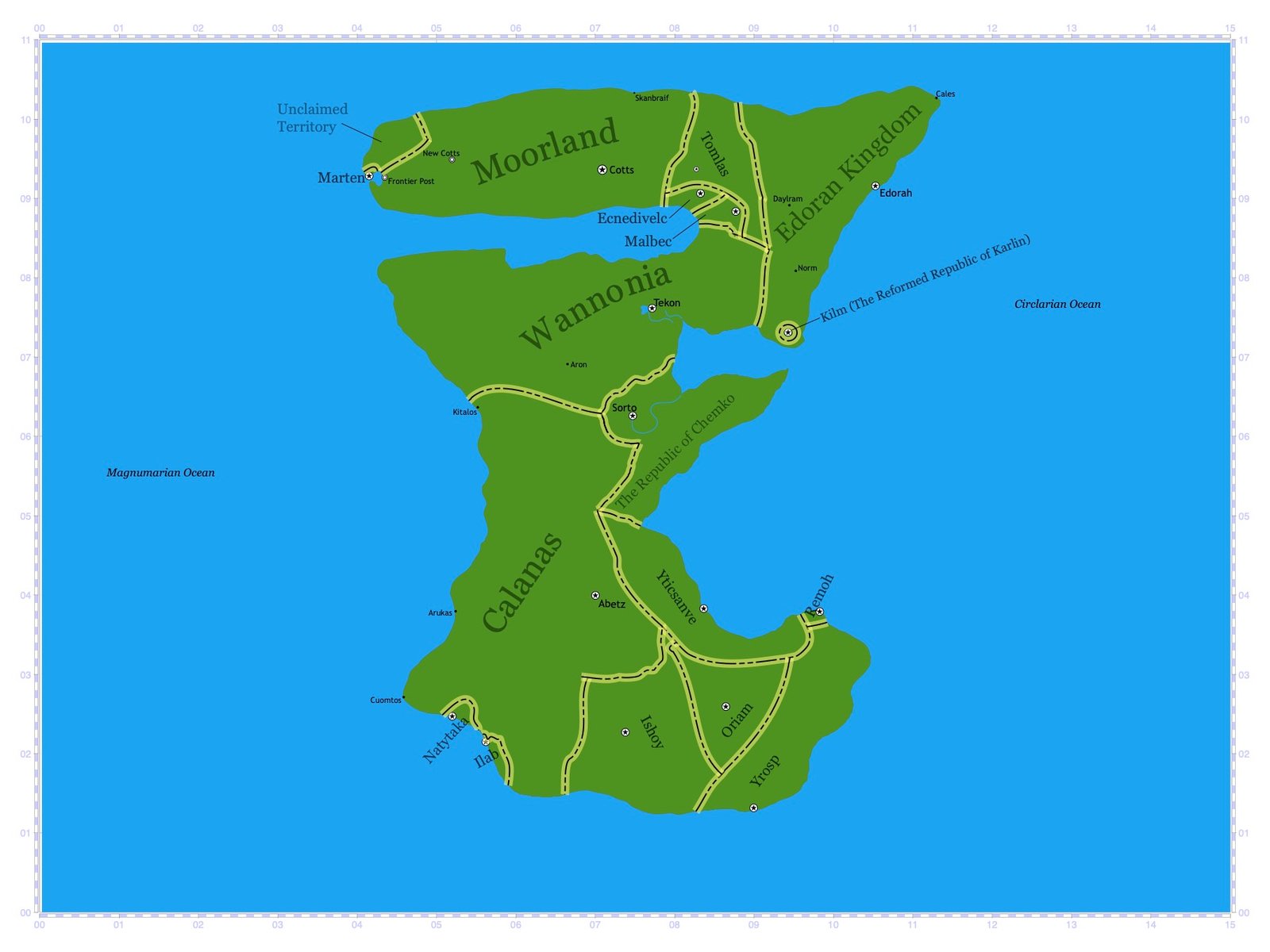
The Reformed Republic of Karlin: 493-517
In the Northern regions of this new country lay the Corren Mountains, where there were mostly pines and small patches of grassland. Cool, mild summers alternated with frigid winters. In Combria, the Combrian Mountains did not reach such great heights. And pines mixed more commonly with deciduous trees, as milder summers and winters dominated the climate. South of the St. Eschel River, mountains turned into rolling hills, as there were deciduous trees and evermore grasslands. The summers here were warmer; and so were the winters. However, both were accompanied by larger amounts of precipitation from Inland Sea storm systems.
In equal standing, those of Edoran and local indigenous ethnicities dominated the Karlinian population, which now spoke the language of Middle Edoran. Most here practiced Alconism, but the Council voted, early on, not to enforce it as law, respecting religious freedoms. The government of the Reformed Republic of Karlin consisted of an elected Council presided over by a Head Consul, a Council of Mediators, and a Commandship of seventeen Legions. The elected Council voted on and passed laws, while the Council of Mediators settled disputes between two parties, serving as an early model for a judicial branch. Meanwhile, the Legion Commandship enforced all decisions and laws. It is important to note that county governments within the Reformed Republic had similar structures and functions, and that all members of such were elected directly by the people every seven years, starting in the year 493.
The Reformed Karlinian economy consisted of an upper class, composed presumably of guild owners and politicians, a middle class, consisting of farmers and independent merchants, and a working class, consisting of paid and unpaid laborers. The Republic traded mostly grains from the Southern and Combrian regions, wood from all three regions, and minerals from the Correns. Like the Edorans, the Karlinians employed the gold, silver, and copper standard for their currency. Around 500, the Council voted to establish a formal Office of Post, responsible for delivering private and public messages, mostly in the form of pamphlets, letters, and journals. There were also independent guilds who legally functioned as message carriers. These people, as well as other journeyers, utilized a uniform system of roads regulated by directional signs, like in earlier times. Along with this, however, the government of the Reformed Republic became the first to establish official eagle posts for those who traveled by air. Meanwhile, seventeen Karlinian Legions were funded and staffed, with each Legion governing a certain region of land. Counties had their own Legions as well to keep law and order within the villages. On both levels, each division had sufficient land, sea (when necessary), and eagle-rider forces.
Division in the Republic
Initially, the Council established a law requiring all paying merchants to compensate paid laborers with a minimum of one silver per day. As the years went on, however, desire grew among the wealthier of employers for more revenue on their behalf; and they began implementing methods to reduce labor costs. One of the most infamous practices was involved rotating laborers as necessary based on age and ethnicity. This was soon challenged and brought before the Council of Mediators, who ruled such practices to be illegal. In response to this, merchants began to draw on the population of criminals legally subject to mandatory labor as a form of punishment, bribing county councils to pass radical laws so that more people would be subject to prosecution. Early on, though, this proved limited, as these criminals were, under Karlinian law, given limited sentences.
But then, in September 505, pirates attacked the coastlines; and also under Karlinian law, prisoners of war could be held indefinitely until it was determined by the Mediator Council that such captives no longer posed a threat to the Republic. The merchants exploited this system by expanding the clause determining the threat to include the families of the attacking pirates, and by spreading fear of further pirate attacks, which convinced incumbent Mediators not to implement orders to release them. Farmers in the South began taking advantage of the growing pool of unpaid laborers. But very soon, strong advocates in the North filed a petition alleging that such acts constituted slavery, which was illegal in the Republic.
Nevertheless, the farmers in the South counties persisted, convincing the Mediators that such actions did not constitute slavery because of how the threat of piracy was a mitigating factor. In the election of 507, those in support of the farmers took a majority in Council, giving counties more power over local enforcement of laws. The counties in the South limited the power of the presiding Legions, rendering them incapable of enforcing anti-slavery laws. Very soon, controversy arose among the Karlinians, as those in the North began accusing the farmers of the South of conspiring with the Wannonians, a false rumor, while those in the South accused Northern advocates of conspiring with Edoran Kingdom in an attempt to bring the Republic under indirect control of the presiding King, Samuel VI.
In the election of 514, though, the Council majority swung in favor of the North, as Karl Broman, a leading Northern advocate, passed laws preventing the enforcement of local county powers and established the training of special Legion forces to keep his laws in place. Very soon, the counties in the South began resisting, and began drawing assistance from willing Edoran mercenaries. Meanwhile, these same advocates for the South spread rumors throughout the Republic that it was the North-led Council majority who was employing Edoran forces.
The Employement of Edoran Mercenaries
Initially, the Edoran Kingdom had a policy against providing mercenaries for unrelated affairs concerning the Karlinian Republic. However, Edoran counties bordering the Republic had begun sending over such forces to the counties in the South. Messengers loyal to the original policy were alarmed and immediately brought this to the attention of King Samuel VI, who had been on the Throne since 504. To the surprise of everyone, Samuel VI allowed for the counties to continue providing mercenaries.
Edoran Commander Paul Esten was especially opposed to King Samuel VI's allowance for this, and was determined to put a stop to it. Esten did so by, himself, sending mercenaries to the forces in the North, serving secretly, in the hopes of challenging the Edoran mercenaries serving the South. In 516, however, word of this counter-agenda reached King Samuel VI, who immediately had Paul Esten assassinated. He then separated Esten's forces and re-educated them, promising them a great deal of land and bounty; for Samuel VI's plan was to utilize the division in the Republic as an opportunity to supply mercenaries secretly to both sides and overtake the Republic when a conflict started.
War: The Edoran Capture of Daylram, Norm, and Kilm
Such a conflict began in March 517, when Timan Yates, an advocate against slavery, led a group of thousands of escaped pirate-prisoners across the St. Eschel River. During this crossing, they were attacked by a Legion from a Southern county, which was countered by a waiting Legion from the North. Very soon, Northern and Southern forces began battling each other, as the country plunged into civil war.
But then, in September 517, under the orders of Samuel VI, the Edoran mercenaries turned on their Karlinian employers and struck, capturing Daylram and Norm. They united with numerous divisions who had crossed over from the Edoran Kingdom and captured Kilm, where the elected Council was toppled, Head Consul Broman was executed, and five Edoran Lords were instilled to govern the city, like what happened the previous century.
The Recapture of Kilm and the Two Walls
Timan Yates was presumed dead in the initial assault carried out by the Southern Karlinian forces. However, he had miraculously survived, and, in secret, came to the Edoran-run city of Kilm. Here, in a concealed fashion, Yates recruited pirate forces and concentrated them in hidden places within Kilm's streets. On May 520, with spellcrafters and infantry, they attacked, successfully driving out the Edorans. In the month that followed, they pushed out, capturing farmland and freeing prisoners, for about 10 to 20 miles around the city. In March 521, Yates lost a few miles of his advancement owing to a counterattack by the Edorans, but afterward, held his ground. Under Yates' orders, resisting forces constructed a wooden wall around Kilm and their held land, with the wall being completed by October. The wall was effective in holding back Edoran forces. One year later, under King Samuel VI's orders, the Edorans built a similar wall surrounding Yates perimeter two to three miles out.
And thus, a gridlock ensued. Each wall was armed with archers and spellcrafters, while a layer of defensive forces behind this consisted of catapults. Behind this, both the Edorans and Karlinians had eagle posts. In the next ten years that followed, each side attempted an assault on the other. Infantry and cavalry would attempt to carry out an assault, marching through the land between the two walls. But every time, these divisions were slaughtered by either archers from the wall, hiding spellcrafters or archers in the conflicted ring of land, eagle-riders wielding either arrows or spells, or debris from catapults.