Father James and the Great Schism of the Early Edoran Church
In 534, a Great Schism emerged in the Early Edoran Church, as bands of clerics and ordinary people gathered, expressing grievances, including the selling of blessings and prayers, politics and bureaucracy within the ranks of clergy, and corruption and scandals not being addressed. The leader of this movement, Father James Smith, gathered a petition and presented it to the Clergy. When this was ignored, Father James led a peaceful rebellion, which was dispersed by the King and the Edoran Church authority. Shortly thereafter, in an effort to stifle any further disturbances, King John sent Father James to Fort Norm.
Wannonia and the Edoran Kingdom: The Standoff
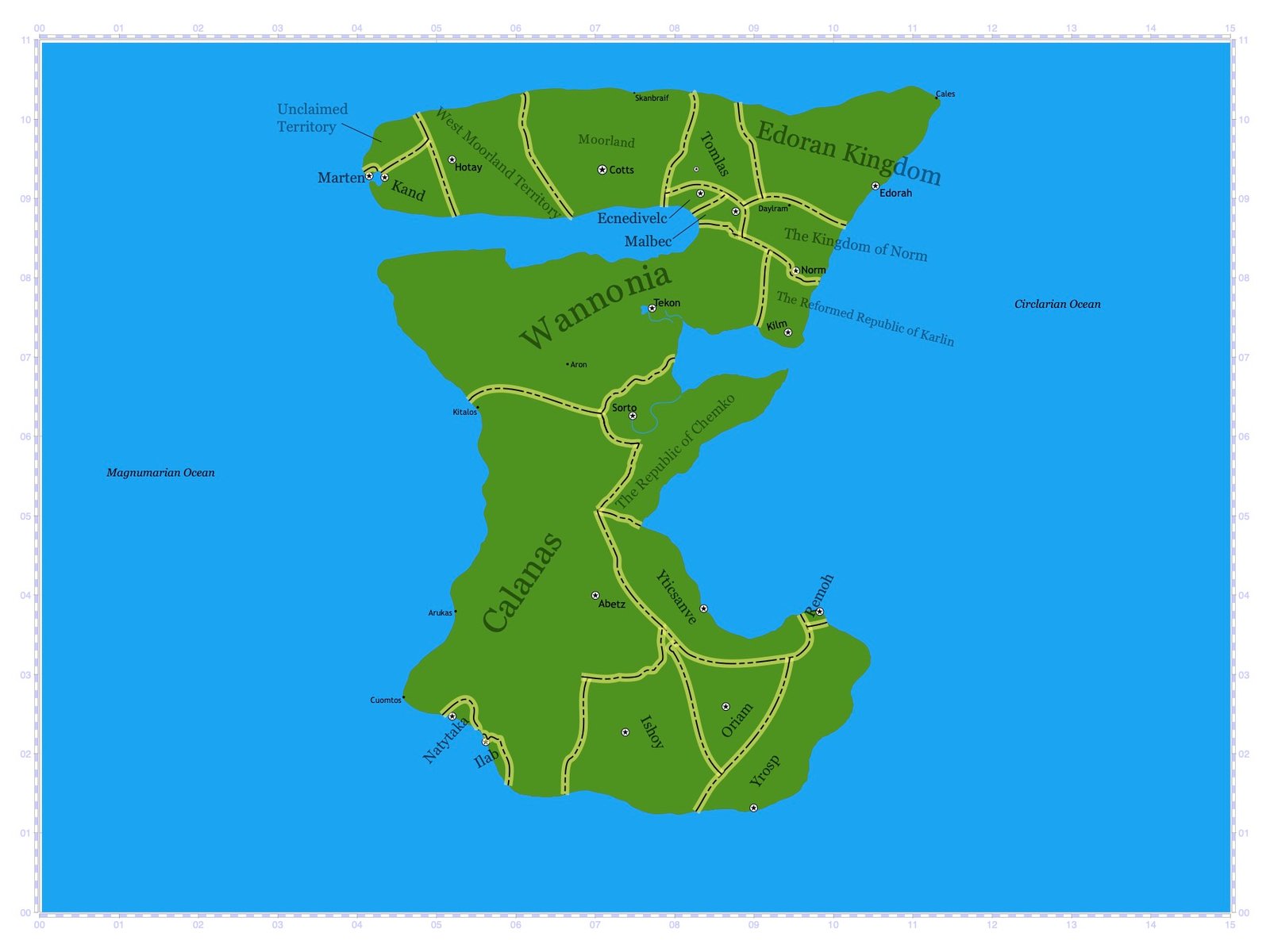
Meanwhile, Bilgondon, Emperor of Wannonia since 497, had focused his interests upon the land containing a newly discovered gold quarry Southeast of Tomlas. During the spring and summer of 533, Wannonians began construction on a fortress within their territory but very close to the site; although the initial motive for this is unknown. In October of that year, shortly before the Malbeccan invasion, word of the fortress had reached King John, thus providing reason to keep the land after the conflict. Such an agenda was followed through in the wake of the defeat of the Malbeccans in April 535, as an equally-sized and equally-armed Edoran fortress was constructed just across the border. From Norm to this fortress, King John sent the incumbent Father Ramsen, assigning Father James to serve as a temporary replacement back in Norm.
Via a spy network, the Wannonians discovered the Edoran fortress across the border and enhanced their own, adding spellfire torches, additional turrets, and catapults. To man these expansions, Emperor Bilgondon dispatched more Wannonian soldiers and sent over more weapons. Such a build-up was discovered by the Edoran spies, who informed King John. Under King John's orders, the Edoran fortress saw the construction of similar expansions but which, by intent, exceeded those of the Wannonians. Furthermore, Edoran soldiers were stationed in a makeshift encampment "over the hill" from the Wannonian border.
Close Call, the Treaty of 535
In October 535, Wannonian soldiers secretly crossed the border and stationed themselves in a hidden encampment just to the Northeast of the Edoran fortress. Such a Wannonian stronghold served as a secret reserve in the event of conflict, and as a base for Wannonian spies. However, Edoran night-eagle riders discovered such a settlement and urgently sent a message to King John, who promptly ordered numerous divisions of soldiers, including the ones at Fort Norm and the border fortress to ready themselves for imminent battle. He then penned a personal letter to the Wannonian Emperor, threatening an attack if the Wannonians did not withdraw from Edoran territory by the Eve of Stellacrux (December 14). To this, Bilgondon responded with a call for a treaty and compromise.
In November 535, between Wannonia and Edora was signed such a treaty, which called for both nations to withdraw their forces a certain distance from the border, and deconstruct their fortresses and encampments. Furthermore, the Edorans actually allowed for limited trade of gold from the quarry with the Wannonians for a tariff.
The Norman Rebellion, 536
During the Edoran-Wannonian standoff, the soldiers in Fort Norm prayed for peace, as was Edoran custom in anticipation of a major conflict. However, these praying soldiers also voiced grievances against the Edoran Church Establishment, complaining of high fees charged by clerics for sacred deeds such as blessings and prayers, pressuring ordinary Edorans to partake in such paid acts of sacrament while condemning "unofficial prayers" as not religiously legitimate, and, of course, clerical privilege, where inside business was kept from the public and said clerics were supposedly closer than ordinary people to the Alconist God.
Father James, originally of the Edoran Church Establishment, initially encountered hostility from the soldiers. However, he listened to their grievances and made amends to address them by presenting a doctrine of inclusiveness, that "all under God are equal." Among the soldiers, he began to establish Alconist practice that eliminated the "class of clerics" and "fees of sacrament." In March 536, King John heard of this, and terminated Father James' clerical tenure, ordering him to vacate his post. Instead of obliging to the King's mandate, Father James, on 24 March 536, officially declared the establishment of the Church of Norm, of which he was the head. Such a Church would follow Father James' doctrine.
In May 536, King John retaliated with Edoran soldiers, mostly infantry, who placed Fort Norm under siege. However, in June, Father James launched a division of eagle-riders, who attacked King John's besiegers from the rear and got into a gridlock conflict with enemy eagle-riders. Meanwhile, an infantry division charged at the remainder of King John's forces, driving them into retreat.
Father James made himself King of the territory gained; and very soon, he began to acquire a lot of followers.
In September, King John recruited more Edoran knights and attempted to re-capture Fort Norm. However, King James' forces, expecting this, confronted those of King John, matching them equally, and carrying out one of the bloodiest battles of this time period. In October, King James of Norm dispatched a secret division to attack the Edoran stronghold, Daylram, from the Northwest. Some of King John's soldiers from the Norman battlefront broke off and attempted to serve as reinforcements to the overwhelmed defenses in Daylram, but King James' forces here were stronger yet. With both battlefronts weakened, resulting in high numbers of casualties and loss of territory, King John of Edora finally surrendered and called for a treaty.
The two Kings met in Daylram in November 536, where King John recognized the Kingdom of Norm, encompassing both Fort Norm and Daylram, as sovereign territory under King James. Compromise ensued, though, as open guild trade was established with reasonable tariffs while no walls or additional fortresses were to be built along the border.