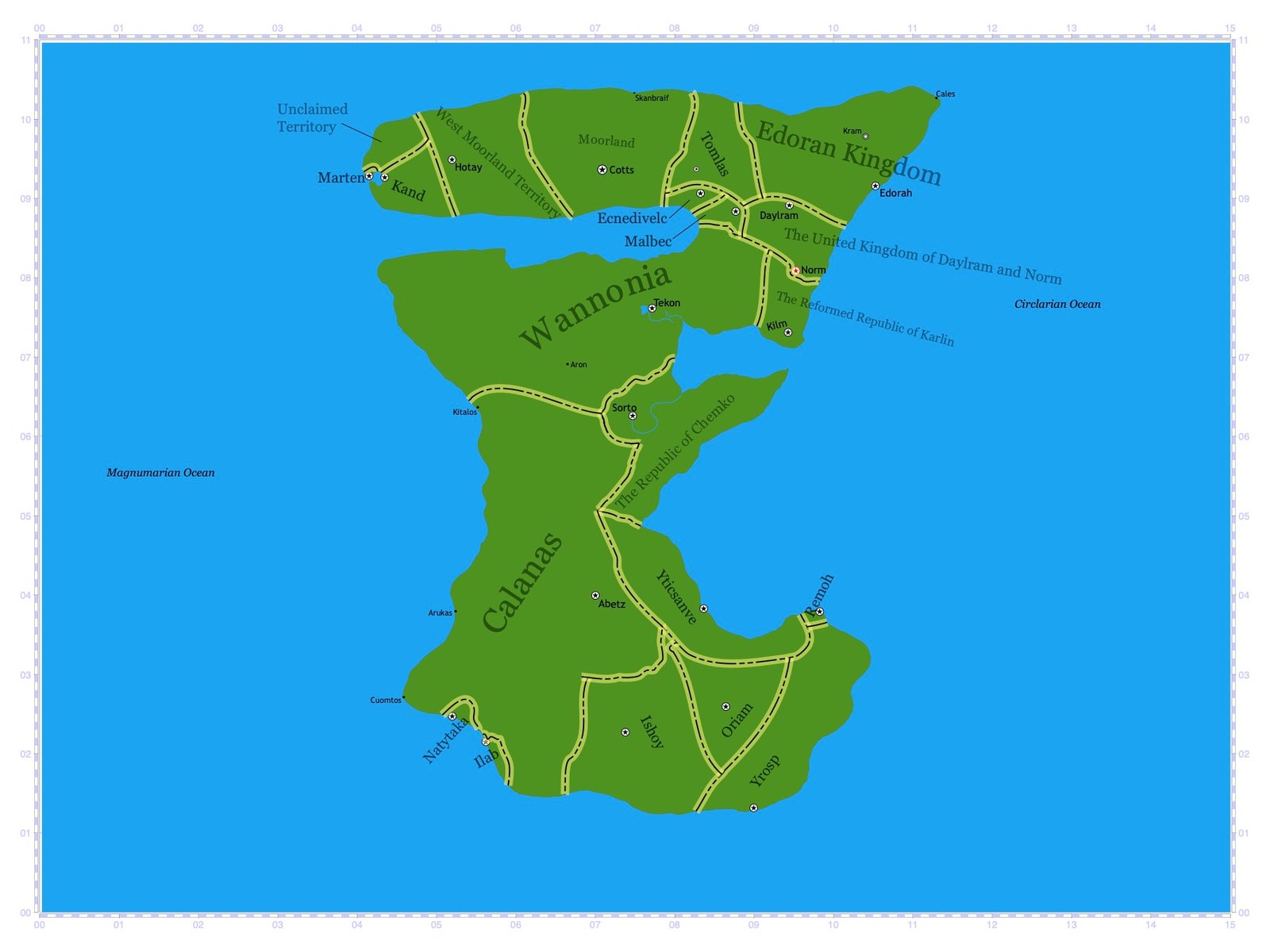
550s: The Norman Reformation in the Edoran Kingdom
Under the Church of Norm, there was no clerical class or money paid for prayers and blessings; all liturgy and scripture was translated to Edoran from Karlinian Aerdn; and "illegal spellcrafting" was condemned as witchcraft, although those indirectly involved received an opportunity for redemption. Any Norman could join the Clergy, as, in fact, every Norman was encouraged to do so; those voted in became preachers and leaders; church services were held once per week: on Sundays; and money was collected only from those who donated voluntarily. In fact, Kings would occasionally present tithes. Such money was provided by the Church, along with shelter and resources, to those in need. The Church of Norm followed a Doctrine of Recruitment, where missionaries chosen were charged with the duty to ensure the joining of the Church by as many Normans as possible. Some of those missionaries established posts and recruited from outside the Kingdom.
Of those missionaries who travelled abroad was John Morris, who, between 552 and 553, went to villages in the Edoran Kingdom. With such appealing doctrine and philosophies, Morris gained a lot of Edoran converts. But in June 553, King John II, the Edoran ruler since 537, had Morris arrested and put on trial. While the trial was proceeding, Norman-loyal villagers rebelled, as local Edoran forces were overthrown, and traditional Edoran Churches were burned to the ground, as Norman Churches were erected in their places. John Morris was eventually convicted, and, in June 554, one year after his arrest, executed. Such a death further angered the Edoran people, as Morris' story spread all over the Kingdom. In October 556, Edoran commoners rebelled, as traditional Edoran Churches were destroyed and replaced with Norman ones. In May 557, King John II was overthrown and executed, and was replaced by Queen Mary. Meanwhile, the Clergy of the Early Edoran Church were driven out, executed or forced to flee, while the Royal Church, itself, had its interior torched, and then rebuilt as it was converted to the Reformed Edoran Church.
In 557, the doctrine of the Church of Norm began its wide spread of influence over all of Remikra. In 557, Tomlas, Ecnedivelc, and Malbec had their Churches and rulers overthrown, as the Norman Churches relative to each of these countries was established.
560s: The Norman Reformation in Moorland and Surrounding Territories
In 561, the incumbent King of Moorland was overthrown and replaced by a King who established the Norman Church of Moorland. In 564, the Guilds' Council of West Moorland was seen as corrupt, influencing Alconist teachings to cater to their desires. Menora, a woman employed, initially, by the Fighters' Guild, led a rebellion, which overthrew the Guilds' Council and established the Norman Church of West Moorland. The leaders of that Church established themselves as the new government of West Moorland, having power over the guilds.
In 566, numerous figures united and overthrew the Guilds' Council of Kand in a similar fashion. Here, however, the system of guild leadership was preserved. But each Guild Councillor was now required to pass a test determining him or her to be right with the Church leaders in order to take office.
By the 560s, the monarch figure of Marten had become the head of the traditional Martenian Alconist Church. In 567, rebels inspired by the Reformation Movement underway to the East rose up and overthrew the Martenian establishment, as a Martenian Norman Church was founded as the new government. However, in that same year, a coup led by supporters of the traditional monarchy restored the old Martenian system, as a man named Mantellus was made the King. King Mantellus, though, despite proclaiming himself the head of the official government, preserved the system of the Norman Church by having it serve as a test of morality in government decisions.
571-578: The Reformation Movement in Calanas
Territories to the South and East, including Chemko, experienced similar changes, with Norman Churches being established respectively. And before long, Norman sentiment was growing in the rural villages of Calanas. However, the Calanasian Clergy, having studied and become aware of the Reformation sweeping Remikra, recruited large numbers of clergy-warriors known as Braesianites. In March 571, Norman rebels rose up and nearly overthrew the Calanasian monarchy. But in September, the Braesianites struck back with brutal force, wiping out Norman forces. Upon each village defeated, the Braesianites imposed what became known as the Calanasian Inquisition, where they executed known opposing figures and witch-hunted suspected conspirators, subjecting them to disturbing methods of torture and interrogation.
As a result, many Norman-Calanasians fled to other countries, especially Wannonia, which began recruiting soldiers domestically and abroad. These forces became known as the Normanites. In September 577, the Normanites launched a mass assault upon the Calanasian capital of Abetz, placing the city under siege and forcing the Queen to surrender. She called for a treaty.
The Treaty of Calanas, March 578
A great deal of effort was expended in the crafting of this treaty, owing to the division between the Norman-loyals in the rural villages and the tradition-loyals, many of whom included commoners, in the cities. Eventually, the Norman of Church of West Remikra, of which there was no center, was established in rural Calanas, while a Papal Palace, heading the traditional Calanasian Church, was established in Abetz. Major metropolitan areas were designated as places for traditional religious doctrine; and neither the Calanasian Church could venture out of these boundaries, nor could the Norman church venture into them.
The Middle Peace: 580s-650s
In 581, Wannonia, Calanas, and the Southern Remikran nations, including Chemko, entered into a trade agreement, where guild merchants could travel freely between these countries. Wannonia then signed an additional agreement with Edora, where independent guild merchants could cross that border despite any political skirmishes between the two nations, provided that these merchants were not directly involved in any way. In 587, an Exchange Council was held between all Remikran leaders in Tekon, where an agreement determined which countries could best produce particular trades, and mandating them to focus on their respective trades. Every country was involved in this, as import-export arrangements were made. For the next seven decades, Remikran society, as a whole, would enjoy ensuing prosperity, the expansion of sea merchant trade, and the opening of trade with Canticula. During this time, very little conflict occurred, as only small rebellions and skirmishes emerged, most of which were sparked by inside political scandals.
The Great Plague: 665-666
Between 650 and 651, another change in the climate brought about crop failure, resulting in widespread famine. As a result, war, starvation, and death became commonplace, as quests were born to go elsewhere in search for food and resources.
The desire for such expansion led to the Wannonian Crusades of the 650s and 660s, where Wannonian Legions boarded ships and raided the Meredythian Islands, as well as Canticulan coastline. They recruited mercenaries from other countries to join them in exchange for shared wealth. Of the other countries who joined included the Kingdom of Norm, leading the Normans to later import the first firearms.
The nations in Canticula proved too strong for the Wannonian Crusaders to defeat, but such conquests resulted in the imported of a great deal of many goods, boosting trade. It is important, however, to note the entry of another unintended import: the Great Plague.
Originating from near present-day Prove, the Great Plague swept Canticula in 650s, wiping out a great deal of the population. Such a disease produced painful skin lesions, swollen lymph nodes, and high fever. For most of those infected, death would follow swiftly. To add to the fear, the disease spread rather quickly and easily. In 665, the Plague arrived on the docks of Wannonian Inland Sea ports, and spread quickly to the cities of Aron and Tekon. As millions fell dead, those who fled infected local villages in neighboring countries. In 666, the infected local villages in surrounding countries contributed greatly to the spread of the Great Plague over most of the entire continent of Remikra, resulting in the death of more than half of the Remikran population. Rulers saw this as "divine punishment" for the abusive misinterpretation of Scripture by Normans and traditional Clergy alike. Such actions would later be condemned as "the Great Sin." And thus, mass heresy accusations were brought against many people, as ridiculous laws were passed and Remikrans faced punishment.
By November of that year, the Plague died out.
A Brief History of the Early Firearm
In the early 500s, supertorches from Remikra were imported into civilizations along the West Coast of Canticula. In the Chokian Republic, such torches were narrowed so that they shot up "jets" of fire, carrying out a failed attempt to dispel hailstorms. Further East, these "jets" were enhanced, yet again, to shoot horizontally as flamethrowers in war, a more successful invention. When it reached the Red Desert and present-day Prove, the device was converted into fireworks and "debris-projectors," both of which were eventually imported back to Wannonia and Norm.
667: The Daylram Insurgency, Formation of Parliament
Upon sentiment regarding the "Great Sin" infiltrated even the Norman government. Though they still upheld beliefs of the Norman Church established 100 years previously, they nonetheless enacted moral laws governing lifestyle behaviors such as sex, drinking, and gambling. Years of serfdom and increasing taxes on the lower classes drew contempt from Normans, as quarantines imposed on them during the Plague were poorly managed, providing them with no food, while the government looted possessions of the dead.
In May 667, John Wilson of Daylram presented a list of grievances to King Robert of Norm, who ignored them. Very soon, Wilson and his followers staged a coup, which overtook Daylram and instilled Wilson as its leader. To this, King Robert responded with soldiers, sparking civil conflict. In June, Commander Wilson gained more recruits from surrounding villages, who enhanced "debris-projectors" imported from the East into the first cannons. Upon the walls of Norm, Wilson's forces engaged these, destroying the walls and allowing Wilson's forces to storm the capital. King Robert surrendered and called for a compromise.
In October 667, the compromise signed allowed for King Robert and his nobles to stay in power. However, although Robert still had the power to enforce laws, such laws would only be made by an elected body in Daylram. Such an elected body became known as a Parliament, which voted in John Wilson as its first leader.