War: The Formation of Wannonia
In the first three years, conflict between new nation of Wannonia and the West Totian Empire remained in a gridlock. But in 709 BCE, Tisdero sent a large wave of Legion troops to burn crops throughout the farmlands. Such an assault proved successful, bringing them near the gates of both Tecere (renamed Aron) and Tekon. The Order of Tekon, however, formed in 706 BCE; and they implemented a strategy of sending Wannonians, disguised as West Totians, to slaughter West Totian troops within their ranks, proving effective enough to drive Tisdero's men back to the Magnumarian Shield. In March 703 BCE, Tisdero overcame such a strategy and captured the city of Aron, before finally reaching Tekon and placing it under siege. Regor, however, had an underground method of communication well-established, and sent eagle-riders to travel by night to the Pimdanian Mountains, where they made a bargain with the Lynds to coordinate an attack against Layda, which was left open by the abandonment of Legion soldiers who were presently fighting in the Plains. In exchange for such a service, the Lynds would receive farmland in Wannonia. Furthermore, arrangements would be made over land ownership in the newly-gained territory of the West Empire. To carry out such an agenda, the Lynds quietly entered the West Empire, where they coordinated with the poor and oppressed, who were unhappy with Tisdero's further squandering of wealth and resources to fund the war, to assassinate Tisdero and overthrow the West Totian Imperial regime. Such an agenda succeeded when Tisdero was beheaded in October 702 BCE. The city of Layda was renamed Calanas, where a council met to establish a new government. This new government was a democratically elected one as the former West Totian Empire was renamed the Free State of Calanas. Promptly, the war was ended; and an alliance treaty was signed with Wannonia.
Despite the end of the war, troubles still remained in Wannonia. Between 702 and 699 BCE, the new nation was governed by two entities: the Order of Aron, comprised of about fifty councilmen representing the South and West, and the Order of Tekon, comprised of the same number of people representing the North. While the Order of Tekon wanted to govern the entire nation of Wannonia, the Order of Aron wanted to govern its region as a separate country. However, a conflict brewed within the Order of Aron, as an opposing faction wanted control of the Order to govern in mutual compromise with Tekon. Tensions mounted as the Tekonian and Aronian factions began preparing for conflict. But then, a political figure named Jystus called upon the House of Aron to vote on a compromise. In October, 699 BCE, such a measure succeeded, as a provincial government seat was established in Aron, while the original Order of Aron relocated to Tekon to merge with the Order of Tekon, forming the Wannonian Senate.
Wannonia: The Early Days
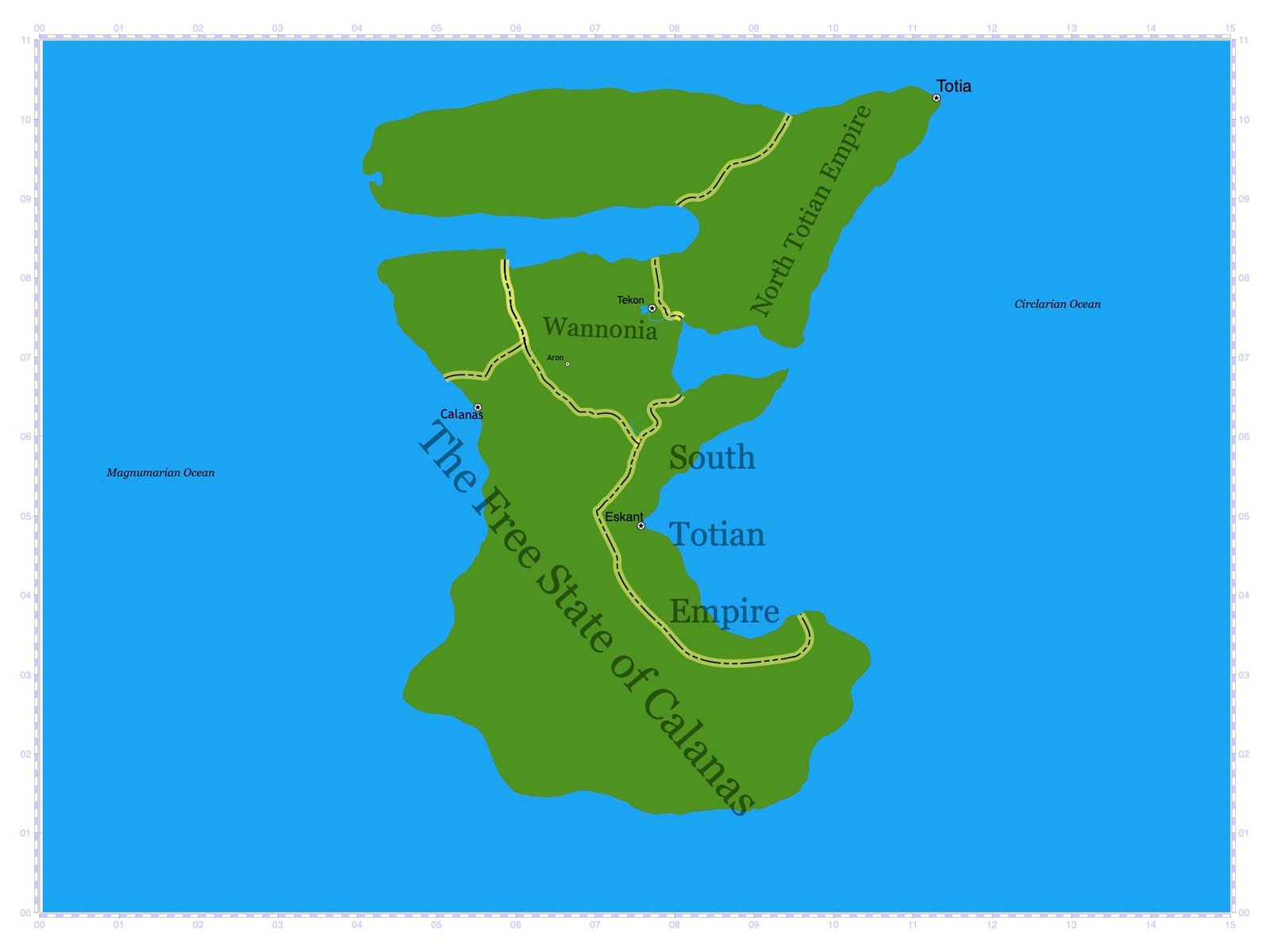
It was during this time that the area surrounding Tekon became officially recognized as the Wilderlands. The new nation extended to the North Coast, the Plains, and the borderlands with the Magnumarian Shield and Pimdanian Mountains. Wannonia also extended South and East to the coast of the Inland Sea, where various sea ports sprung up for trade with the North and South Totian Empires as well as the growing number of sea merchants. Totians and Lynds resided throughout the Wannonian farmlands and two urban areas, as Aerdn with Lyndan vocabulary emerged as the superior tongue. A hierarchy of Totian Divinity, where farmers looked more to community figures while cities looked more to elemental gods and sea merchants looked more to the Chief God, became established religion, despite there not being a specific policy ordering freedom of religion. Most Wannonians resided on farmland and followed a simplistic way of life, studying mostly written literature while receiving an education either with families learning the ways of farming life or from established academies in Aron or Tekon. The Wannonian Senate in Tekon, elected by the Wannonian population, governed a hierarchy over similarly elected Provincial Senates, County Councils, and Village/Canton Commissions. Laws and decisions made by this government model were carried out by five Head Legion Generals, Provincial Legion Generals, County Guard Commanders, and Village Watch Captains. Elections were carried out every September, as Wannonia became the first official democratic republic to exist on Remikra in the Post-Ashen Era.
The Wannonian economy began with a large middle class originating from an evenly dispersed population, with each of most members owning a large portion of farmland. Traveling merchants and shop owners owned plentiful amounts of wealth and resources between cities. A fairly large upper class also existed, consisting mostly of government office holders and guild owners. Farmers produced food mostly for themselves, but sold some portions of it to city-dwellers and to other lands via the docks along the Inland Sea coast. They produced a very important resource to Wannonia: flaxweed. Flaxweed was a versatile fuel, via grass, wick, and oil, as well as a food and building material source. In exchange for flaxweed and livestock products, cities produced tools and other goods. Wannonia, in 699 BCE, established an official gold, silver, and copper standard for currency in trade. Wannonians drew freshwater from Lake Maern, various rivers throughout the Plains, ice melt from the Pimdanians, and the sea via a flaxweed salt filter, invented by a man named Physellon. Wannonians also took the liberty to trade quartz for extra profit. The year 699 BCE was also the year that the Wannonian Senate voted to bring back forced labor without the Totian pardons. They also expanded on the mandatory labor sentences imposed upon enemies and wrongdoers. As a result, paid labor was not so prominent in the farmlands, as family members also farmed their own properties if they did not have laborers.
Runners, horse-riders, eagle-carriers, and coded light signalers carried messages through the vast Wannonian territories. A free press consisting of independent journals and pamphlets, as well as town bulletins similar to the Totians spread news messages in an efficient manner. Large underground vaults in Tekon and Aron, which still exist to this day, stored tax records and archived documents. Also storing archives was the Library of the High Lake, now renamed the Library of Tekon. A paved roadway was constructed between Tekon and Aron, while paved road networks connected lesser cities as well as villages and canton centers. Such a network extended to the Inland Sea ports. Bricked roadways extended into the North and South Totian Empires; and a gravel road ran West to Calanas. Caravans and horses traveled along these; but the main source of transportation was walking.
Wannonia established five major infantry Legions as well as seventeen Provincial Legions as its main source of defense against enemies. Each of the five major Legions had five fleets of boats each along the North and Inland Sea coastlines, while both the main and Provincial Legions had a fleet of eagle fighters. Wannonia was friends with the North and South Totian Empires, as well as Calanas. They were also friendly to the main factions of the Mundae and Fundae sea merchants. However, some hostile factions of the Tahnish and Quitzdodalan merchants presented a concern.
Meanwhile, the Library of High Lake, in 699 BCE, was renamed the Citadel Library of Tekon. The Citadel Library of Aron was also established that year, under the Librarianship of Persephone, who, in 682 BCE, bound scrolls together to invent the world's first spellbook.
The Free State of Calanas
Covering the Interior Desert, the South Coast, and present-day Layda, the Free State of Calanas boasted a population of Lyndan, Tahnish, and Quitzdodalan ethnicities. Following a principle of religious freedom, the old Laydan temples of the past fell into disrepair, while only local religions were practiced. Lyndan, Tahnish, Quitzdodalan, and Totian vocabulary blended to form a new language: Taendal. This time period brought about another age of poetry while the Library education system continued. Calanas was headed by an elected council similar to that of Wannonia, while they adopted the gold, silver, and copper standard of currency. Wealth here was effectively redistributed among all popular factions in the form of negative taxes, a measure voted by the presiding council in 698 BCE. Calanas imported grains and livestock from Wannonia while they drew water from Pimdanian lakes. They burned wood and olive oil as fuel sources, while many sought additional wealth from the Quartz Trail. Calanas also established a new postal system paid for by their council at no cost to those who took advantage of it. Roads were rebuilt in subsequent projects, while eagles were bred and more frequently used for a variety of civil purposes.
South Totian Empire
Covering the Chemkan Ridges, part of the Interior Desert, and the regions South of Eskant, the South Totian Empire saw a boom in the Chemkan population in the 680s BCE. In 687 BCE, Emperor Estrayon died and was succeeded by his son, Tomeus, who initially continued Estrayon's policies. The economy had been in decline since the loss of the Canticulan territories. However, Tomeus made deals with sea merchants from the Meredythian Islands, which restored trade to that of the recent past.
North Totian Empire
Covering the Northeast, Combria, and present-day Ereautea, the North Totian Empire saw a similar turn of events. In 699 BCE, Emperor Certhys died unexpectedly of an unknown health condition, and was replaced by his nephew, Terryn. The economy here was also in decline in the wake of the loss of the colonies; and Terryn attempted to form a deal with the sea merchants as well. However, many of these factions had sided with the South Totian Empire in the previous conflict, and had formed grudges against the North. So Terryn sought another trade: mining in the Correns. With this, valuable minerals, such as shale, heralded another period of economic prosperity.