Preface
Estrayon had been sent by Emperor Kestaven in 762 BCE to govern the Southern portion of the East Totian Empire from the city of Eskant. Upon arrival in Eskant, Estrayon discovered that a spellcrafter named Manys had been arrested and put on trial for copying inscriptions from scrolls smuggled from the Citadel Library in Totia, and was set to be punished. Estrayon examined the situation and observed that Manys had done so to supplement education to prospective spellcrafters who could not afford either the journey to the North or the costly tuition. And so Estrayon ordered the release of Manys and named him the Head Librarian of the Library of Eskant, the construction of which Estrayon had set in motion. Lescan, a Legion general jealous of Estrayon's appointment to Governor of Eskant, reported Estrayon's decisions to Kestaven; and later that year, Estrayon received a letter from Kestaven threatening an arrest if the Library was not closed. In November 762 BCE, instead of closing the Library Estrayon simply moved its scrolls to numerous underground cellars still accessible to Manys' students. In January 761 BCE, Estrayon turned the original Library building to a "museum" dedicated to Emperor Kestaven and had contemporaries write admirable letters to the North. Meanwhile, between March and September 761 BCE, Estrayon made a deal with Emperor Armstus to the West and paid public servants from West Totia to constuct a venue for the Library in a remote location in the Chemkan Ridges. By December of that year, Estrayon had moved all of the spellfire scrolls to that location and established secret networks and communication methods to direct pupils to the new site.
Circumstances
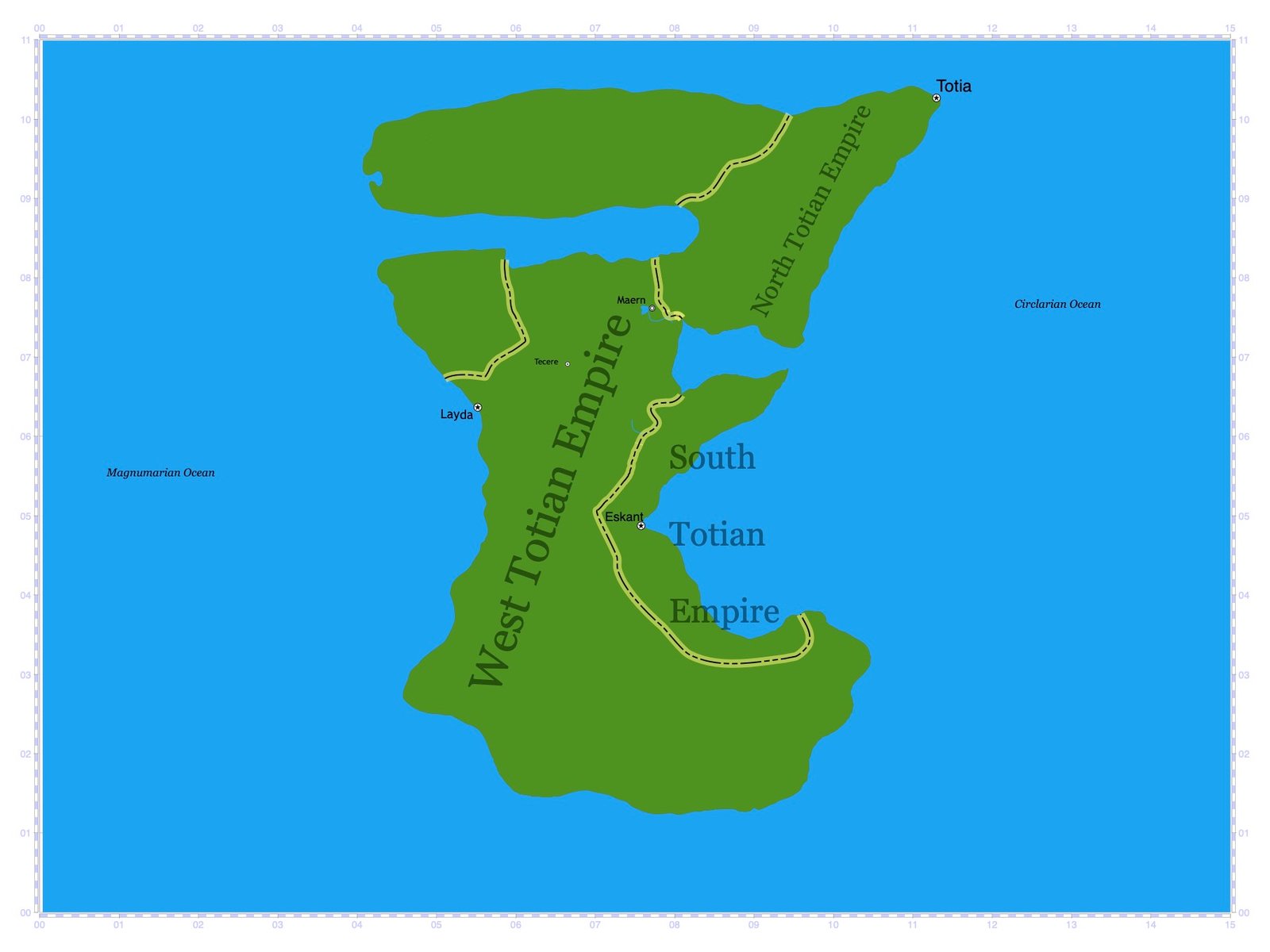
Around this time, the city of Eskant had been facing trouble. Beginning in January 762 BCE, pirates, led by a man named Ornan, began sneaking into the harbor past Eskant's defenses, disguised as ordinary merchants. Around the end of that month, they launched a coordinated attack from the docks and invaded the market square. By April, Estrayon's forces fended them off, but were expecting more to come. In May, the Ornan's pirates attacked again; and while Estrayon held them off, he realized that he needed reinforcements from the North. He sent a letter for help to Emperor Kestaven, who responded by sending a Northern sea Legion, which arrived in Eskant by October 762 BCE. Such an arrangement proved successful until Ornan approached Emperor Kestaven with a trade deal: that they would be allowed to freely exploit the valuable resources of the Chemkan region in exchange for service as mercenaries to an island inhabited by another band of pirates hostile to both Ornan and Kestaven. Giving in to greedy temptation, Kestaven agreed to the deal in January 761 BCE; and by June, the withdrawal of Kestaven's Legion reinforcements from the South left the region open to pirate attacks. Betrayed, Estrayon no longer felt compelled to honor the treaty compromises between the East and West, and called on Armstus in the West to send Legion reinforcements for protection. Armstus honored the call, and the troops arrived by December. In the following month, Lescan, now serving as a spy for Ornan, discovered this and the secret Library in the Chemkan Ridges, and travelled to Totia to inform Emperor Kestaven, reaching him by March 760 BCE. Infuriated by this, Emperor Kestaven sent a man named Torthys down to Eskant to assassinate Estrayon. The assassin arrived to Eskant by June, but Estrayon foiled the man and killed him. He then immediately declared Eskant and the Southern region surrounding the Chemkan Ridges to be the South Totian Empire.
War and Redemption
News of this reached Kestaven in November 760 BCE; and in the following month, he sent two Legions, along with pirate mercenaries to invade. However, Estrayon had established hard defenses along the coastline, as well as in the Inland Sea, which Kestaven's forces could not pass. In March 759 BCE, Emperor Kestaven was assassinated by Certhys, who felt betrayed by Kestaven's deceptive deal that killed his brother, Torthys. As the new Emperor, Certhys ended the war and, in November, signed a peace treaty with the South and West Totian Empires, proclaiming his Empire to be the North Totian Empire.
North Totian Empire
Covering Combria, present-day Ereautea, and the Northeast regions near Totia proper, the North Totian Empire consisted of a population of Fundae, Mundae, Emoran, Kusaye, Camaran, and North Circlarian ethnicities. Emperor Certhys instilled a doctrine of complete religious freedom and imposed no taxes to fund any clerical establishment, allowing Kestaven's temples to fall into disrepair. Education continued to follow a traditional Totian model with the exception that the curriculum was centered around the Citadel Library, which also began containing non-spellfire material. For the next few years, no taxes at all were collected from the people; in fact, gold was paid back to the poorer sectors of the population. Copper was established as a second official currency to ease the financial constraints on the lower classes. Meanwhile, forced labor on families and generations was abolished while temporary involuntary servitude serving as punishment for crimes still remained. The government continued to follow a top-down command system, although Legion Generals were given more freedoms while more governor posts were established. Furthermore, Legion Generals received increases in pay while recruitment standards were relaxed, leading to a stronger military. Not long after the end of the war, Certhys helped to form a three-way military mercenary obligation between the two other Totian Empires.
South Totian Empire
With jurisdiction over the Chemkan region as well as the lands South of Eskant, the South Totian Empire had a population consisting of Camaran, Quitzdodalan, and Tahnish ethnicities as well as a small number of North Circlarians. Although he carried the same religious policy as Certhys in the North, Emperor Estrayon abolished the traditional education system and replaced it with one based solely on research within the Library of Eskant. Similar to the West Totian Empire, Emperor Estrayon established representative assemblies for the populations in different regions of the Empire. He also imposed fair taxes to fund Legions, whose members experienced pay increases and requirement relaxations similar to the North, and public infrastructure while implementing his "resource flow" agendas, leading his economy to prospering beginning in the late 750s BCE. Meanwhile, indentured servitude as punishment for crimes existed only as a voluntary option.
West Totian Empire
Covering the Interior Desert, South Coast, and Layda regions, the West Totian Empire consisted mostly of Tahnish and Quitzdodalan populations. The cultural and economic hub of Layda continued to prosper, although gold was still declining in value. In 759 BCE, Emperor Armstus opened his Library to all people, not just graduates. Meanwhile, throughout the Empire, more towns came into existence, as others already in existence grew in size, leading to expansions in aqueduct and paved road networks. Alongside this and the notion of Legions and public servants continuing to be well-paid, a growing concern for the Imperial capital was public debt.
Astrolagus, Tandus, and Kestella
The time period between 759 and the 720s BCE was one of relative peace for Remikra. And such an era ushered in the desire to explore lands abroad. Three notable explorers from this time period were Astrolagus, Tandus, and Kestella.
Astrolagus
One of two contemporaries of Manys, Astrolagus was initially known for his contributions to the study of astronomy. In fact, it was his name from which originated the terms "astrology" and "astronomy" in the Circlarian Realm. In June 757 BCE, Astrolagus noted the nightly movement of the stars, which followed a circular-like pattern, owing to the rotation of the earth. He discovered that a single star was situated in the center of this pattern, and, thus, established the concept of cardinal directions, with the center star pointing to the North. As much as he was a scientist, Astrolagus was also a firm believer in the original Divine religion, viewing each star to represent a Divine being, and the center star to represent the Alpha Divine being. Wanting to reach the Divine, Astrolagus decided to travel as far North as he could. Between March 756 BCE and May 755 BCE, he set forth on a journey that took him through the Moorlands and across the sea into Hobland. He reached the top of the cliffs lining the edge of the Polar Basin, where he noted the Northern lights, interpreting them as being part of "divine intervention," before returning home.
Tandus
Throughout his years of adolescence and young adulthood, Tandus studied with Saerdys, the other contemporary of Manys, and was one generation younger than Astrolagus. In May 742 BCE, inspired by Astrolagus, Tandus set sail in the hopes of reaching the Polar Basin to witness the Divine. However, he misread Astrolagus' star chart and, instead, travelled East. Upon accident, Tandus discovered the land of Tandeiyah (which is named after him). In October, he returned to his home in Totia, reporting his observation of Tandeiyah to Saerdys. About one year later, in September 741 BCE, he and Saerdys travelled to Eskant, where Saerdys was sent to preside as the Head Librarian in the wake of Manys' death.
Kestella
Following a religious path like that of Astrolagus, Kestella studied both the spellfire and non-spellfire materials of the Library of Eskant and believed that many of the pieces of evidence pointed to the location of the fabled holy city of Edom, from which was believed to be the origin of humans and the Divine. In April 741 BCE, pirates attacked the docks of Eskant once again. By bad luck, Kestella was in a vulnerable location and was abducted by the attackers, who saw her as a valuable asset to their base on one of the Meredythian Islands to the East. It was to this location that she was transported, and here that she heard talk of "fruitful land to the further East," or the continent of Canticula. Kestella was cunning, observant, and quite witty. Such skills paid off in June 741 BCE, when she escaped her imprisonment and returned to Eskant. Upon return to the Library, she hypothesized that Canticula was the land home to the city of Edom, or at least was a host to clues of the location of the rumored city of the Divine.
The Council
In December 741 BCE, Kestella and Tandus met, as fellow scholars in the Library of Eskant, where they shared with each other their findings. Tandus' discovery of Tandeiyah served as confirmation to Kestella that there was, in fact, other lands to the East aside from the Meredythian Islands. Three months later, they set forth to the city of Maern, where they hoped to meet with Astrolagus. After a lengthy discussion, Astrolagus agreed with the two youths to sail across the Circlarian Ocean to explore the new lands.
The Journey Across Circlaria
In April 740 BCE, Kestella, Tandus, and Astrolagus set sail from the Inner East Coast of the Inland Sea. In June, they landed in Tandeiyah, and then, at the end of the month, continued further East along the trade winds. In September, 740 BCE, they landed on the West Peninsula of Canticula, where Tandus ventured into the mainland North, Astrolagus stayed within the Peninsula, and Kestella ventured South and East to the Midland River. In September 738 BCE, they met in Kartatia, the very Southern tip of the West Peninsula of Canticula, where they discussed their travels and observations before beginning their return voyage to Remikra. In December 738 BCE, they arrived back in Eskant, where Astrolagus began his journey back to Maern while Tandus and Kestella remained with Saerdys. Stories of their saga spread throughout the three Totian Empires, inspiring numerous explorers to journey to the lands explored. By the end of the decade, the first Totian settlements were established in Canticula.