Edoran Prosperity and the Desire for Tomlas
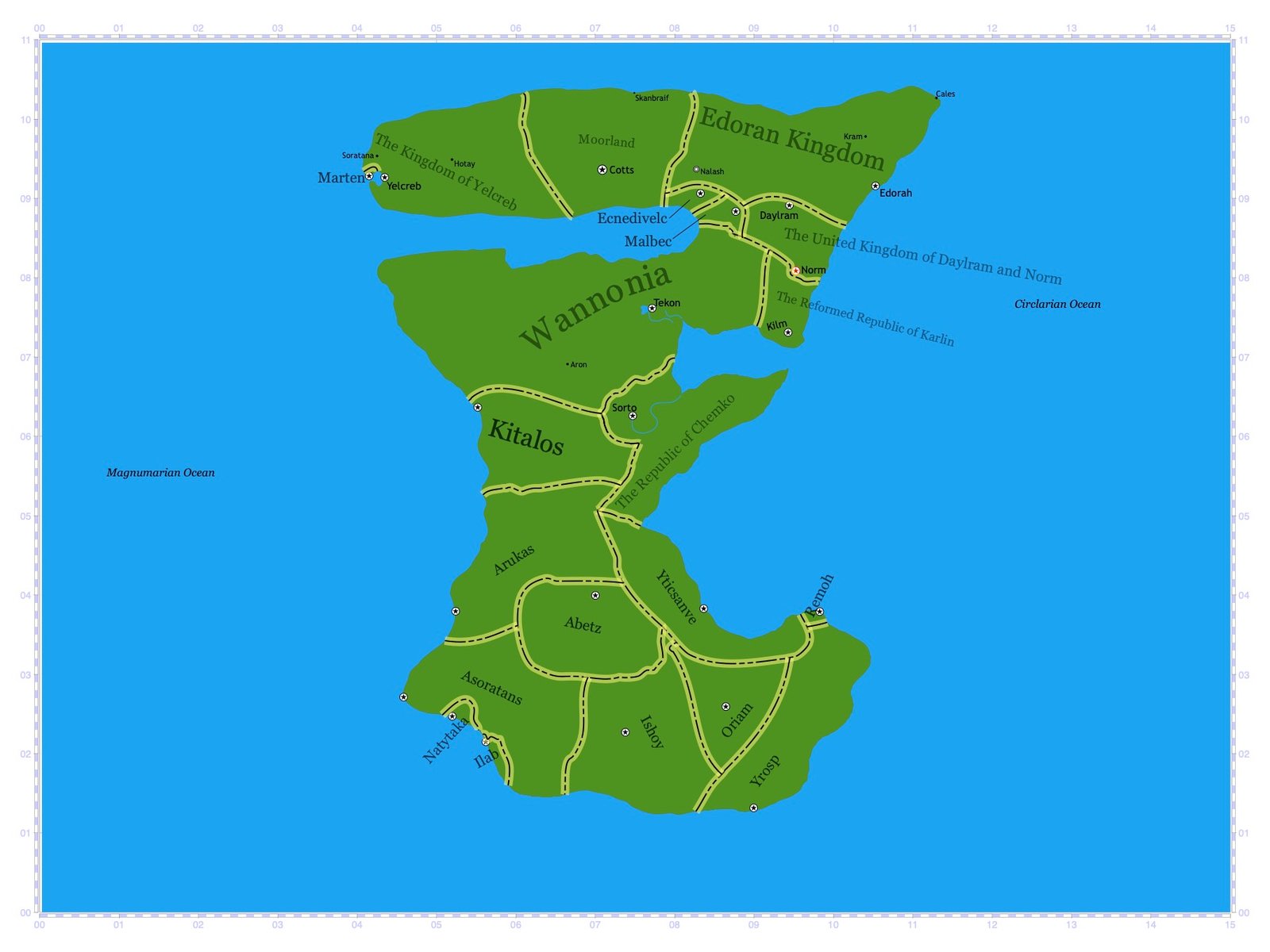
As the 700s continued, the Edoran economy grew. Trade with the sea guilds increased tremendously along the coastlines, while land merchants traded with the Kingdom of Daylram and Norm, as well as Wannonia, Tomlas, and even Ecnedivelc and Malbec. The Crown slowly but steadily increased taxes on goods as the Edoran Kingdom continued to prosper.
Between 741 and 742, three gold quarries were discovered in Tomlas. Local Edoran merchants near the border began traveling to and from these locations to barter for such a precious material. Also a desirable commodity present in the nation of Tomlas was its expansive fields of grain. As the Edoran population continued to grow, it could barely sustain itself on its domestic farmland, which was not so yielding because only small bits of it existed between the Corren summits. Therefore, food was expensive. In 743, after Edoran merchants seeking gold returned with word on such plentiful fields, a trade deal was signed between the two nations, where the Edoran Kingdom would export minerals and wood in exchange for Tomlassan exports of grains and furs.
Tension Between the Two Kingdoms
However, a change in Tomlassan leadership would bring a difference in the relationship between the two Kingdoms. In 755, after a two-year coup that ensued in the wake of Queen Ura III's unexpected death, King Mendon IV ascended the throne. As King of Tomlas, Mendon IV was jealous of Edoran prosperity, and instilled a high tariff on the grain trade. In the following year, King Peter III of the Edoran Kingdom responded with high tariffs on wood and minerals. In 757, Tomlas retaliated with yearly limits on gold traded from its three quarries, to which the Edorans responded in 758 with a steep increase in their existing tariffs. It was in 760, a year after, and a response to, the nation of Tomlas setting limits on its grain exports, that King Peter III verbally threatened war.
The Edorans began following through with their threats by commencing target practice with their muskets. In 762, the Tomlassans discovered this and built fortresses dedicated to the infantry training of muskets as well. King Mendon IV also drafted all young and able-bodied Tomlassans to join. In the year that followed, in response to this, the Edorans built even stronger fortresses and instituted their own military draft.
Nalesh was born in 745 to a family of independent Tomlassan farmers who grew large amounts of grains. With this, they fed themselves, but also traded large portions. They were hurt financially when the tariffs began taking effect. When tension began to increase between Tomlas and Edora, Nalesh was made to join the Tomlassan Army, where he encountered a rival named Demor, who won an unfair draw to obtain additional lands of grain, given away by the family of a deceased owner. In May 765, in retaliation to this, Nalesh and a company of his followers deserted the Tomlassan Army, and subsequently attacked and captured one of the three gold quarries. In October, he made a deal with the Edorans, offering them ownership of the quarry in exchange for an entire county and its mineral reserves in the Correns. Nalesh and King Peter III agreed to the deal; and King Peter III sent a caravan of merchants to make the Edoran claim.
However, Demor had a network of spies, including spellcrafters and eagle-riders, observing Nalesh and his activities. Upon hearing news of the deal with the Edorans, Demor sent a message to King Mendon IV, who, in March 767, dispathed a division of the Tomlassan Army, who fired muskets at and killed most members of the merchant group. Survivors of the massacre fled back to the Edoran Kingdom and sent a message to King Peter III, who declared war.
The Edoran-Tomlassan War
In September 767, the Edorans launched their first major offense across the Tomlassan border, attacking the nation with infantry and calvary, carrying muskets and swords, as well as archers and spellcrafters, serving as eagle-riders. The Tomlassans were engineered in a similar fashion, though; and there were three of them for every two Edorans. The Edorans were pushed back to only five miles into Tomlassan territory as a result.
Sir Paul Venn of Cales, during this time, invented the spellfire-trigger, meaning that muskets build with such no longer required gunpowder. The King recruited a division of his forces to train with these, and supplied such weapons to the battlefront. In October 769, Edoran forces launched another major offensive, during which the Tomlassans were outmatched, enduring heavy casualties. They were forced to retreat to Tomlas proper, as the Edorans closed in around its walls, placing it under siege.
Nalesh, having survived the conflict thus far, and making his way into the city for protection, employed spellfire skills gained in earlier years, and managed to sneak into Tomlas proper the idea for the spellfire-trigger invention made by Paul Venn. Within the city walls sat an eagle aviary, owned by eagle-breeder, Zin Midan. Midan created a wartime invention which involved a large basket that could carry two soldiers, which was tied on each of its four corners by a long rope. Each of the four ropes was each tied to a separate eagle manned by a rider, as the four of them trained to fly in coordination. Midan, during this time, replicated his invention for five-hundred units. In May 770, utilizing this strategy, the Tomlassans launched a surprise attack upon the weakest part of the siege. The Edorans were unprepared for this, as each basket was manned by two soldiers armed with muskets, and they endured high casualties. As a result, the siege was broken while the Tomlassans reclaimed nearly all sovereign land previously taken.
Meanwhile, in Edora proper, Sir John Motters was well-informed on matters concerning the war with Tomlas. He noted a problem with the musket, claiming that its open bell made it difficult to hit targets accurately. The mitigating factor was that such a designed was originally intended on facilitating the loading of ammunition. Motters' solution was to narrow the open end so that it was the same length as the base of the gun, and to provide each soldier with a special funnel tube separate from the gun to facilitate the loading of ammunition. The result of this was improved accuracy and increased range. Before long, the King approved of these enhancements, and recruited a division to train with them while adapting the new gun to the battlefield. This invention became known as the closed musket.
In September 771, armed now with closed muskets, the Edorans launched a third major offensive against the Tomlassans. They now could hit the eagles carrying the baskets and inflict higher Tomlassan casualties. Furthermore, since the Tomlassans had not yet adapted closed muskets, themselves, the Edorans copied the eagle-basket idea and fly over the walls of Tomlas proper, striking forces inside. With this method, they shot dead the gatekeepers and forced open the gates. As the Edorans poured in, Tomlas fell, during which King Mendon IV was shot dead. Tomlas was now part of the Edoran Kingdom.
772-773: Tension Between Edora and Moorland
In 772, King Castol VI, ruling over Moorland since 753, saw the fall of Tomlas as cause for concern. In a method of drafting similar to the Edorans and Tomlassans, he recruited able-bodied candidates in large numbers, training all of them with closed muskets, while building numerous fortresses along the border. Meanwhile, King Peter III saw the Moorlandish fortification as a threat, and, throughout 773, also boosted soldier recruitment while constructing even stronger fortresses. The conquered city of Tomlas proper was enhanced with extra lines of defense, and was renamed Fort Nalesh, after their Tomlassan contributor.
The Truce of 774
In September 774, King Peter III died and was succeeded by Queen Elaina, who called for a truce with Moorland. In a compromise, both nations promised to reduced staffing of their fortresses with only enough to protect passerby from bandits, while a deal of open trade allowed for the trade of certain goods like gold and wheat with no tariffs. In January 775, King Castol VI of Moorland agreed to the terms; and the deal was signed.