Although information is rather sketchy on the matter, it is known that Estrayon spent most of his early life in a Totian village situated along the East Coast of the Inland Sea a couple hundred miles from present-day Retun. Despite growing up with a lower-class farming family, Estrayon learned through unknown sources to be a spellcrafter and mathematician. This, combined with his frequency in mingling with the nomadic Lyndan nationality who lived further inland, made Estrayon an outcast among his peers, who embraced tradition and convention and alienated his practices as well as the Lyndan community.
Settlement
Throughout the 790s and 780s BCE, the Totians established various farming and fishing villages along the East Coast of the Inland Sea. Further inland, the Lyndan population lived in encampments, which moved based on the availability of their food sources: buffalo, grains, and flaxweed. They were mostly on peaceful terms with the Totians as they regularly met for trade. The Totians were mostly respectful of the Lynds but were otherwise removed from Lyndan society, as both groups did not agree on cultural norms. It was the Totian spellcrafters who mingled with the Lynds, however; and it was Estrayon who traveled with them and first made note of the vast fields and spellfire quarries to the West. Such claims were met, however, with little to no interest from the ordinary Totian villagers, who were worried mostly about their own crops.
Discovery and Influence
In 788 BCE, Estrayon befriended Tor, a member of the Lyndan community, who showed him to their camp near a rather large spellfire quarry. It was here that Estrayon identified an issue: the clan was not the first to have arrived to the area, and although sources of food existed, they were rather depleted. They were considering the idea of moving to another region; but that was when Estrayon intervened with an idea. Using the spellfire skills he acquired in his education, he shaped a large amount of earth to create a mound, and created a depression at the top of this to collect rainwater, with a spillway controlled by a large rock that Estrayon would move with spellfire. Meanwhile, he built a small canal to direct the rainwater toward a field, where it would divide into a system of smaller canals. He then drew fertile soil from around the region and concentrated it into the field with this system.
Hence, he created a system of irrigation.
In the following year, Estrayon's invention produced a bountiful harvest, some of which Estrayon brought to the Totian villages. The villagers were attracted to the prospect and began moving West. This created division within the Lyndan community, however. Tor and many other clans were friends with the Totians, and worked together to develop agricultural systems that provided a reliable food source. However, others were not open to the change. Vari, another Lynd, disliked the Totian newcomers, and very soon became Tor's greatest rival. Vari's companies, by the late 780s BCE, began attacking the settlements.
Crisis
In April 778 BCE, a band of Totian farmers seeking new land came under attack by a band of Vari's warriors, where very few caravaners survived. Upon receiving news of the incident, General Lamen dispatched a company of his Totian Legion, to be commanded by Rytan, whose mission was to accompany another large traveling caravan while setting forth to address the hostile Lyndan presence. Rytan did so by sending a flank of his company to travel ahead of the caravan while he and the rest stayed with the caravan for immediate defense. Vari and his Lyndan warriors proved quite cunning, however, and attacked the caravan from behind. With Rytan being the first casuality, the entire caravan was slaughtered, with exception to a man named Alan, the sole survivor. Alan fled as the caravan and delivered the news to General Lamen, who sent the remainder of his Legion to confront the enemy. As the war with the Vari's forces began, Lamen sent a message to Emperor Kestaven. Determined to protect the Totian settlers, Kestaven ordered a faction each from multiple Legions to assemble and form a Legion of its own to confront the new enemy.
The Lyndan-Totian War, 778-775 BCE
Despite the recruitment of Tor and his fellow Lyndan warriors to serve as mercenaries alongside the Totians, Vari's warriors had the advantage with surprisingly effective weaponry. The most frequent tool used was the impressionable dagger, crafted with spellfire from the quarries to "learn" the spellfire skills of the enemies it killed. Vari's warriors also were the first known people to utilize spellfire pitchers, three-pronged forks which could hurl spellfire discharges for considerable distances. They also used collective spell shields, which surrounded Vari's fighters from the ground and above to protect them from the Totian spears and arrows. In April 777 BCE, Tor was killed; and Vari managed to retain control over the Plains until November. In the following December, however, Kestaven's multi-factioned Legion finally arrived, replicating Lyndan weaponry, and pushed the Vari's forces to the South and West. By February 776 BCE, Vari's impressionable daggers helped his warriors to regain territorial advantage, as he predicted Totian strategies and attacked Legion troops from behind. In March of the following year, the remainder of each Legion, from which the Legion factions came, arrived on the battlefield, following an order delivered by Emperor Kestaven; and Vari's forces were simply overwhelmed by the large number of enemies. In May 775 BCE, the Vari's forces surrendered. Most fighters, including Vari, were killed, while the remaining survivors fled to the Pimdanian Mountains. The Totians claimed the Plains extending all the way up to the North Coast.
Continuation of Totian Society
It was after the Lyndan-Totian War that the Totian Empire was at its peak.
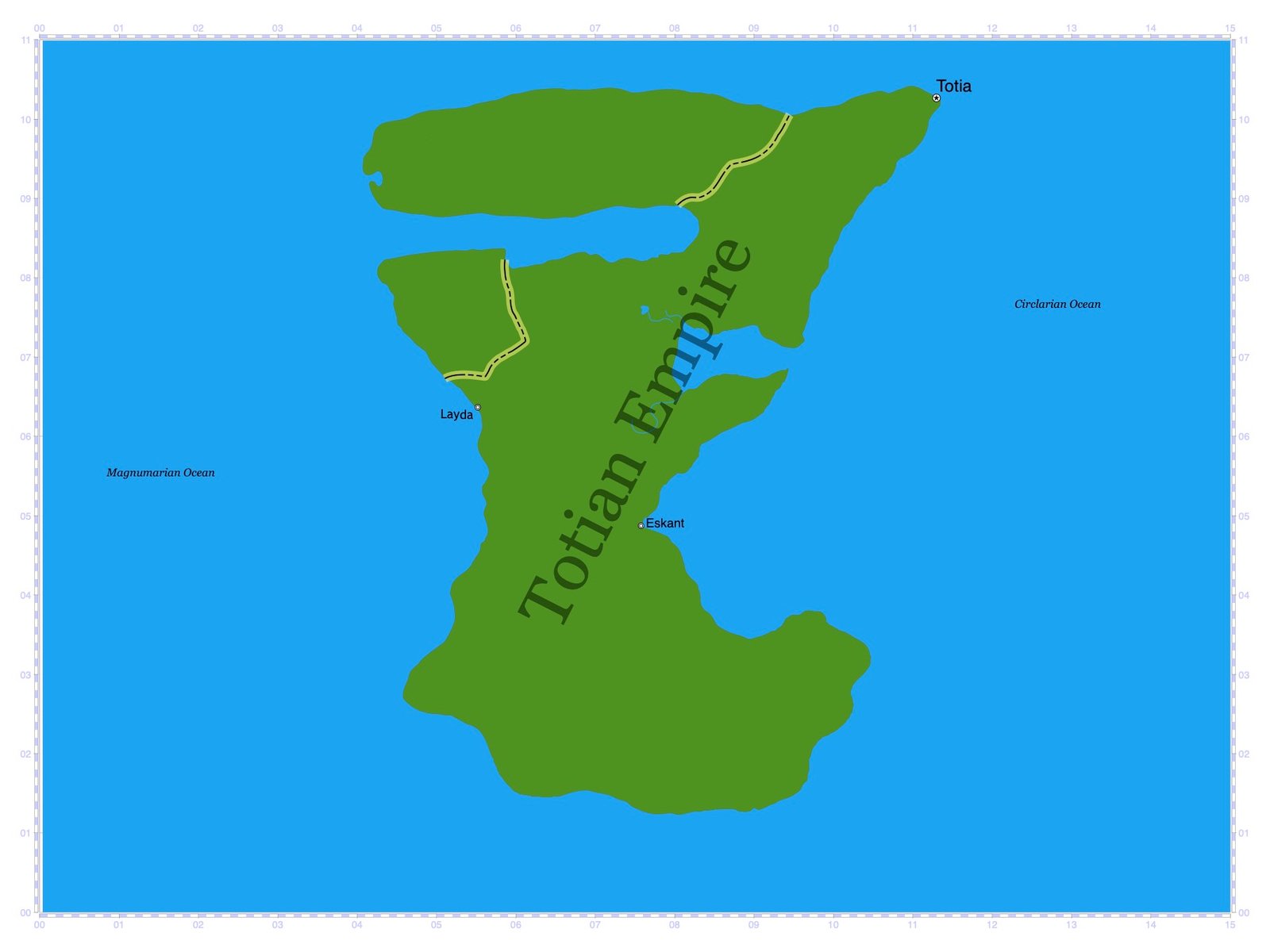
Covering most of Remikra, the Totian Empire had quite a variety in its geography. In the Northeast, near Totia proper, the terrain was mountainous and covered in mostly pine trees. The weather here was cold, wintry, and stormy. To the immediate South lay the land of present-day Combria, where the harsh Corren peaks turned into milder hills accompanied by lakes, a mix of pine and deciduous trees, and a slightly milder temperate climate. Bordering the Inland Sea further South, the hills were even gentler. The deciduous trees here outnumbered the pines and bore fruit from the fertile lands, while the weather here was warmer but occasionally stormy. To the West lay the Plains, covered with grain and flaxweed fields. The cold winters and warm summers in this region were accompanied by extreme weather. To the Southeast lay the Chemkan region, where the tall range of the Chemkan Ridges yielded mostly grasslands accompanied by a few deciduous trees. The climate here was subtropical, where it was warm year-round with seasonal storm systems occasionally lashing the coastline. Past the city of Eskant lay the Interior Desert which occupied most of Southern Remikra. Here, the milder ridges yielded little to no vegetation, while an arid climate gave way to little or no precipitation. Past the Escarpments, the Southernmost Coast presented low-lying land with thick, tropical vegetation, and extremely warm tropical weather with a distinct wet-and-dry season. Along the West Coast, near the city of Layda, the hills and low mountains surrounded a semi-arid area of flat plains, all of which were covered by grasses and a few local tree species. The Pimdanian Mountains, on the other hand, bore countless pines and unpredictable weather patterns, with most of the warmer weather in the lower altitudes and the colder patterns in the higher elevations; although no significant Totian expeditions ventured into this region. Also mysterious and uncharted were the Moorlands and regions Westward in Northern Remikra.
Totian society, at this point, included people from a variety of ethnic groups, including the Fundaes, Mundaes, Kusayes, Emorans, Camarans, Lynds, Tahns, and the Quitzdodalans. Of these, the allied and defeated factions subverted to Totian norms and intermingled. To the Southeast, North of the city of Eskant, the Chemkan ethnicity continued to develop. Vocabulary from these ethnic groups continued to be added to the Totian Vernacular, further removing it from its original Aerdn roots. Regional dialects developed with the Camarans to the South and East, as well as the Quitzdodalans to the West and further South. The population of the Totian Empire adhered to the monotheistic beliefs of Emperor Kestaven, who established such a doctrine as official religious practice. He tolerated local religious practices but only upon the condition that they viewed the official religious practice as a higher moral obligation. The city of Totia proper emerged as a cultural center during this time, where musical consorts of winds and drums became commonplace, as well as the emergence of tile paintings. Comedy and tragedy theatrical production practices were absorbed from the Kitalans, but the chariot races and death arenas were genuinely Totian. It was also in Totia that the traditional classroom, where the instructor was the ultimate authority, began to dominate the education system. An Imperial government structure dominated this society, where Emperor Kestaven served at the top of the chain of power, followed by the Imperial Court, the Legion Generals, and the lower Watch Officers. Such a system functioned with each Officer and General having ultimate power over his jurisdiction; although Emperor Kestaven had power over any jurisdiction whenever necessary.
Aside from the Emperor, himself, members of the Imperial Court were the wealthiest, followed by an aristocratic landowner class, a middle trading class, and the bottom class of workers and beggars. The Northeast, near Totia proper, was known for its production of gold and wood. Present-day Combria produced wood and grains; and present-day Ereautea delivered on wood, grains, fruit, and quartz from the St. Eschel River. The Plains harvested grains, flaxweed, and spellfire, while the Chemkan region farmed cotton and flaxweed. The Interior Desert traded glass and sandstone, while the Southern coast past the Escarpments traded tropical plants and animals. Layda boasted grains and white marble. In general, the agricultural regions traded food with other regions for valuable resources. And, in 775 BCE, to favor the resources in the region, Emperor Kestaven set the gold coin as the standard currency.
Totian society boasted a large supply of food, consisting primarily of grains and buffalo from the Plains. Water from the lakes and mountain glaciers was also in abundant supply. Wood was the common source of heat and fuel, while precious materials such as gold, quartz, and white marble dominated trade routes. Criminals and war enemies, along with their families, were subject to varying degrees of forced labor. Such a labor force competed with the class of workers and hard-laborers who did so for compensation.
A well-established postal service paid solely by taxes served people of all classes. Taxes also paid for announcers who delivered news verbally to local town squares and posted information on town bulletins. Throughout this period, record scrolls were kept in large houses dedicated to archives. In terms of road layout, the Totians imitated the Kitalans, but still retained the notion of making wooden directional signs. Only soldiers and the very wealthy owned and used horses, so walking was the most common mean of transportation. Treewalkers served the Combrian and Chemkan regions while tethros were convenient in the South. Not to mention, eagles in the Layda region served for travel as well.
The Totian Empire boasted over 100 Legions by land and about seventeen by sea. Nomadic groups submitted to Totian society or were allowed to function independently but adhered to Totian law. So enemies were generally weak, and uprisings contained. By the 770s BCE, factions of sea Mundaes, Kusayes, and Emorans had become friends with the Totians and had formed alliances against hostile factions.
Spellcrafters were still largely independent of Totian society. However, large quarries still existing in the Plains were of high value; and scrolls were still being discovered throughout the lands and being added to the College in Totia.