The Upbringing
Born in 821 BCE, Morstaris Kestaven was raised by a lower-class farming family in a region of the Totian Empire lining the boundary with the Moorlands in the North, under the tight leadership of Bryan. It was when he disobeyed orders at the age of six that Kestaven was subjected by Bryan to be whipped and forced to carry a favor to Zacharias, a fellow Watch officer. Zacharias, in contrast, was a much more tolerant person and won Kestaven's admiration in very little time. In fact, they formed a close bond. As a mentor, Zacharias taught Kestaven to use a sword in battle, as well as to engage in civil tasks like hunting and fishing. Zacharias' overall philosophy was about personal freedoms, leading him to agree with Kestaven that Bryan was too controlling.
Loyalty and Commitment
Around 809 BCE, Bryan handed Kestaven and his family to another Watch jurisdiction, located this time in the Chemkan Range region; and thus, the family was forced to move. Over the next few years, they worked on part of a large crop, while Kestaven, in his spare time, joined a "youth legion," which carried out mock battles. This organization was led by Zuk, a said friend of Zacharias, leading Kestaven to believe that he had found his place here. In 804 BCE, the war had begun with the Tahns; and Kestaven received news that Zuk, a target of the initial assault, was killed. Kestaven, upset by this, wished to seek revenge. His opportunity came when Zacharias arrived from the North; and promptly, Kestaven enlisted. Throughout his first time fighting, Kestaven survived many battles. Upon meeting him on the battlefield, Zacharias brought concern to Kestaven that Bryan had bargained to gain the Imperial Throne in the event of Alec's death. Feeling that this was a threat, Kestaven and Zacharias pledged to each other that they would both fight to protect the legitimate heir: Alec II.
The Capture
In March 799 BCE, Kestaven, now twenty-two years old, was dispatched again to the battlefield, although this time, he never met with Zacharias directly. He joined one of Zacharias' small scouting/fighting companies, who promptly made for the Southernmost tip of Totian territory. Here, the Tahns had recaptured a small piece of land; and the Totians were determined to regain it. Kestaven's company attacked and defeated the invading Tahns, slaughtering many of them and forcing others to scatter and retreat. With the land seemingly clear of enemies and other companies afoot to keep potential enemy reinforcements at bay, Kestaven's band set up camp one night while awaiting further orders from Zacharias. Unexpectedly, a band of Tahns launched a surprise-attack on the encampment, where they killed most of the Totian soldiers. Kestaven's life was spared, but he was made a prisoner to be transported to Kitalos.
Redemption
It was in September 799 BCE that Kestaven arrived to a land immediately North of Kitalos proper, under a local Council. Here, he was held prisoner while awaiting a final decision for his future. In the following month, he escaped but was recaptured in a short amount of time. In November, Kestaven was made to learn Kitalan Moral Code, while learning from fellow prisoners informal codes of conduct, as he was made to commit to involuntary labor in the crop fields. A few weeks later, he and a band of prisoners, having determined that the Kitalan establishment was corrupt and oppressive, attempted to flee while out in the field. Within three days, the group was captured and divided. In January 798 BCE, Kestaven was brought before a Cleric, who advised him that he had an opportunity to rehabilitate himself and become a free Kitalan by moral standing. Seeing no other options, Kestaven obliged. Over the course of two years, in the manner prescribed by the Cleric and approved by the local Council, Kestaven completed the required time of involuntary labor in the fields, and began doing so for compensation. He then pursued another opportunity he was presented to train with the Kitalan Army, where he ascended the ranks to a significant commander position. After leading his company to put down a rebellious band of Tahns in November 797 BCE, Kestaven was given extended leave with honors. In January 796 BCE, he was considered "redeemed" and awarded additional honors by the Kitalan Head Council. His story of redemption became well-known throughout Kitalan society, as many looked to him as a "model Kitalan." Kestaven then received a popular petition to run for a seat in the Head Council.
A Turning Point
Initially, Kestaven had received support from the Kitalan establishment. But then he appealed to the lower and working classes of Kitalan society, promising to redeem them economically. As a result, he grew extremely popular, and was poised to win a seat in Council. However, a story emerged that he was friends with Zacharias, who had just made himself Emperor of South Totia and was determined to seize the Throne in the North. This caused Kestaven to lose popularity, and, ultimately, the election. Kestaven, feeling betrayed by Zacharias backing down on his promise from ten years previously to defend Alec II, kept a low profile following the loss. In October 794 BCE, Kestaven was called for compulsory military service in the Interior Desert, where he was assigned to help Zacharias' forces. Unhappy with Zacharias and the mandate, Kestaven felt helpless, knowing that he still had to adhere to Kitalan Moral Code. It was then that Kestaven was said to have been intervened divinely by a deceased member of his family, who called on him to defeat Bryan and seize the Imperial Throne in the North.
Pursuit
In January 793 BCE, Kestaven appeared to obey the call by the Kitalan Council and made his way toward the Interior Desert, recruiting fighters along the way. He marched his company toward the East, along the Southern Coast, where he announced a plan to scout more of the coastline by ship for the company's safety. When on the ship, Kestaven deserted his Kitalan company and made his way for Totia. Three months later, he secretly landed on the coastline near present-day Edora proper.
Acquisition of Power
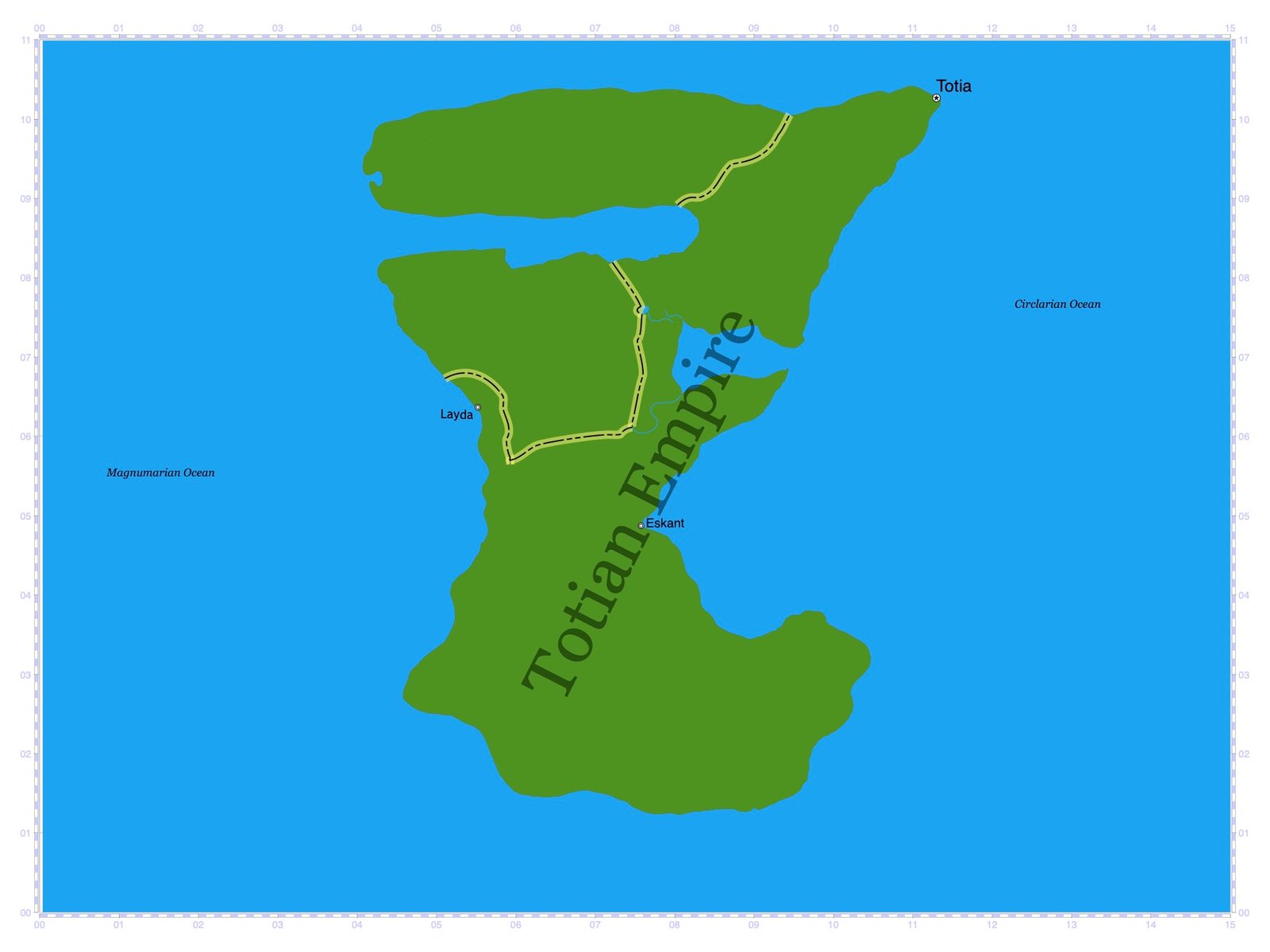
Kestaven continued the rest of the way on foot and arrived in Totia proper to find a lower class, as well as the Imperial Court, itself, deeply resenting Bryan's authoritarian policies. Throughout the year of 793 BCE, Kestaven put into motion an underground movement to eliminate Bryan. Such a plan came to fruition, in January 792 BCE, when Emperor Bryan received an invitation from Kestaven to attend a feast in a great hall ten miles West of Totia. Thinking that Kestaven was making a motion to join him in his attempt to defeat Zacharias, Bryan obliged and met with him at this location. However, upon arrival, two dark figures descended on Bryan and slit his throat. Kestaven then sent a message to the Imperial Court, claiming that Emperor Bryan had died of a fever and that, with no heirs, Kestaven himself was to be made the next Emperor. Whether or not the message seemed believable, Kestaven was warmly received as the next Emperor, as he promised that he was a savior to the Totians and instilled his monotheistic beliefs as standard religious practice. Kestaven's ascent to power came as unwelcome news to Zacharias, who considered him a usurper and vowed to defeat him. Kestaven launched his forces upon those of Zacharias and captured a small company of them. Kestaven subjected these prisoners to underground dungeons, where they were isolated and given little food. However, drawing from his experience in Kitalan captivity, he used "redemption psychology." Throughout the underground confines were statues and images of an Almighty Deity, giving an unrelenting feeling of Divine presence to the prisoners. Upon these prisoners, Kestaven delivered the indoctrination that they sinned against this Almighty God and that they were subject to divine punishment. However, these prisoners had an opportunity to regain moral standing with this God by committing extended time periods of involuntary labor in the crop fields and subsequently joining the ranks of Kestaven's Army. In doing so, Kestaven's Almighty God would forgive each prisoner of his original sins and promise him a place among the other Divine beings after death. Furthermore, Totian society would offer a life of privilege for each recruit who survived the war. Such an opportunity, though, was solely the choice of the prisoner. This approach, known as "recruitment by redemption", proved very successful for Kestaven, as those who were considered "redeemed" would participate in the redemption process of other captured enemies. Over a short period of time, Kestaven's forces grew in strength; and, in March 790 BCE, they pushed to the gates of Maurus, the capital of the South Totian Empire. As he attempted to escape, Emperor Zacharias was killed by an assassin's fly-dagger. In the weeks that followed, Kestaven made it clear to his people that he wanted Zacharias to be forgotten; so he ordered the city of Maurus to be renamed Eskant.
Unification
Shocked by Kestaven's acts of betrayal, the Kitalan Council saw Zacharia's death as an unforgiveable offense, and voted to wager war against Kestaven. However, Kitalan forces proved no match against those of Kestaven, as his forces continued to grow in strength with "recuitment-by-redemption" converting Tahnish and Quitzdodalan fighters. In October 789 BCE, Kestaven's Army launched a surprise assault against Kitalos proper, defeating it within two days. As a result, the Kitalan Head Council disbanded permanently while the Totians seized Kitalan property. As the city was renamed Layda, all claimed territories were now under Kestaven's direct control and thus part of the Totian Empire.