Totia
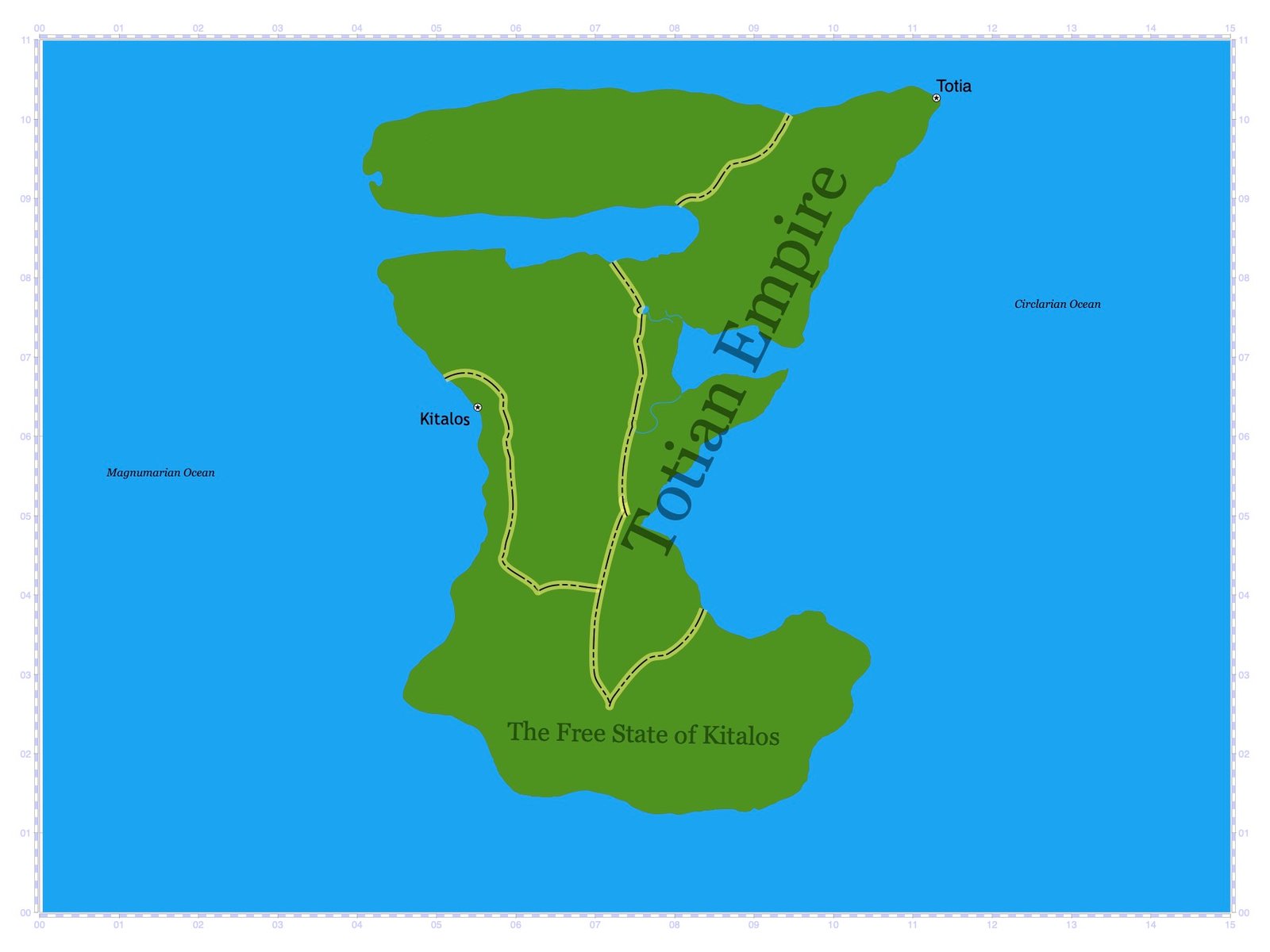
With its government seat in the cold, hard North, the Totian Empire extended South along the Circlarian Coast, stopping just short of present-day Egdir, where a natural boundary existed between the fertile lands of the Chemkan Peninsula and the Interior Desert of the South. During its expansion, Totia easily defeated nomadic groups who challenged them while other nomadic groups integrated into Totian society. Organized systems of communication developed while the Totian road system, though no portion of it outside the city of Totia was yet paved, boasted proper structure, bearing signs that gave directions and distances to certain locations. Up to this point, peace triumphed throughout the Empire with only minor occurrences of sea piracy. Nevertheless, organized Legions began forming around 815 BCE, commanded by Generals who reported to Emperor Alec. As trade flourished, human trafficking began to develop; for some wealth-seeking Totians were eager to reap the benefits of such a valuable transaction up in the North.
Kitalos
The city of Kitalos sat along the coast of the Magnumarian Ocean in the West, surrounded by warm and semi-arid lands. Kitalan territory by this point extended down the Coast and South into the tropical regions. And it was through mostly peace and diplomacy that nomadic groups integrated into Kitalan society, which tolerated neutrality among other nomadic groups. This helped to create a "chain" of allies, which started with the Kitalans and led to the Quitzdodals, the Tahns, and the Camarans who traded with Totia. This was the Western extension of the "Quartz Trail." As time went on, the Kitalans continued to preserve its principles of democracy, allowing for the establishment of local Councils under its jurisdiction, which would govern under the Kitalan Head Council Moral Code. Meanwhile, military service was voluntary, with mercenaries accounting for a large portion of it. Kitalos also had a well-developed system of paved and unpaved roads. Nevertheless, there were issues. Greed associated with the Quartz Trail led powerful merchant figures to coerce the Kitalan Head Council to pass favorable measures, which lightened the tax burden on the emerging wealthy classes. By 805 BCE, Kitalos had a top-down economic system with a weakening public infrastructure.
Quitzdodalan Society
The Quitzdodals were migratory, traveling between the Southern Coast of Remikra and the Escarpments. They were a far-flung population, and had distinguishable East and West sub-groups. Structured around extended families, the Quitzdodals traded between the Kitalans and the Tahns. By the late 800's BCE, the Quartz Trail helped them to develop an organized food supply pattern in accordance to the regular wet-and-dry seasons.
Tahns
The Tahns occupied most of the Interior Desert of Southern Remikra and migrated to the coastline during the dry seasons. They were friends with the Quitzdodalans to the South and the Camarans to the North, but were mostly neutral with the Kitalans. They grew wary of the Totians, who settled just across the River in present-day Egdir. Like the Quitzdodals, the Tahns were migratory and were managed by family clans. Furthermore, they benefited from trade associated with the Quartz Trail.
The Totian-Kitalan War, Beginning
Around January 805 BCE, the Tahns, wary of the new settlers, began spying on the Totian outpost situated in present-day Egdir. Zuk, a Vice Officer of the regional Watch, took notice of a band of Tahns on the other side of the River, and followed them, unnoticed, into the Interior Desert. It was in the Desert that Zuk saw a Tahnish encampment, led by a Tahnish woman named Karia. Zuk saw Karia as a viable candidate for human trafficking; and several days later, he returned to the Desert with a band of Totian soldiers, who succeeded in attacking the encampment and capturing Karia. In retaliation, other bands of Tahns united and struck the Totian lands in a sudden sweep, making it as far North as the Chemkan Mountains. They began the assault at night and used fly-daggers to cut down Totian defenses with ease. They assassinated Zuk and rescued Karia.
A Totian messenger was dispatched to the North, where, in April, he reached Emperor Alec and delivered the news of the South. Alec responded by sending a faction of one of the Northern Legions to aid the Legion in the South. This faction was commanded by General Zacharias, who noted the used of the Tahnish fly-daggers and created Totian replicas enhanced by spellfire. This worked well for the Totians when Zacharias arrived to the battlefield in September; and the Tahns were driven further South toward the Escarpments.
It seemed that the Tahns were in retreat. However, Karia fled to a Quitzdodalan encampment on the seaside of the Escarpments and pleaded for their assistance. The Quitzdodals obliged, and Karia was put in charge of Quitzdodalan reinforcements. This assault succeeded in driving Zacharias' flanks back to present-day Egdir. Nevertheless, the Quitzdodals sent a message to the Kitalans for help.
Meanwhile, Zacharias sent a messenger back to Totia for more reinforcements. The messenger arrived in December 805 BCE; and Emperor Alec called on his step-son, Bryan, to send the remainder of the Northern Legion to the South. Bryan obliged but only under the condition that he, instead of Alec's biological son, would succeed the Imperial Throne when the time came. Alec was opposed to such an ideal, so he sent a different Northern Legion, under a different commander, down to Zacharias. Bryan, upon hearing news of this, held a permanent grudge against Alec.
In March 804 BCE, the new Legion arrived on the battlefield beside Zacharias; and the Totians managed to punch through a line of Tahnish and Quitzdodalan defenses in the Interior Desert, South toward the Escarpments, while gaining back the desert territory lost in the months before. By this point, the Kitalans heeded to the Quitzdodalan messengers for assistance and had sent soldiers to set up reserve camps along top of the Escarpments. When Karia returned to them once again for urgent needs, the Kitalans launched their reserves into battle, expecting the Totians to be a brutal nomadic group. They were shocked, however, to learn that the Totians seemed well-organized and well-armed, bearing metal swords, armor, and shields. The Kitalans were equally armed and organized, creating a surprise for the Totians. With both sides displaying brutal force, the Kitalans and Totians, by May of 804 BCE, were engaged in direct conflict. And neither side seemed to be gaining or losing territory.