Preface
As trade grew with the "Quartz Trail," more wealth poured into the Kitalan and Totian states. As a result, each society grew in prosperity as territories continued to expand.
Totia
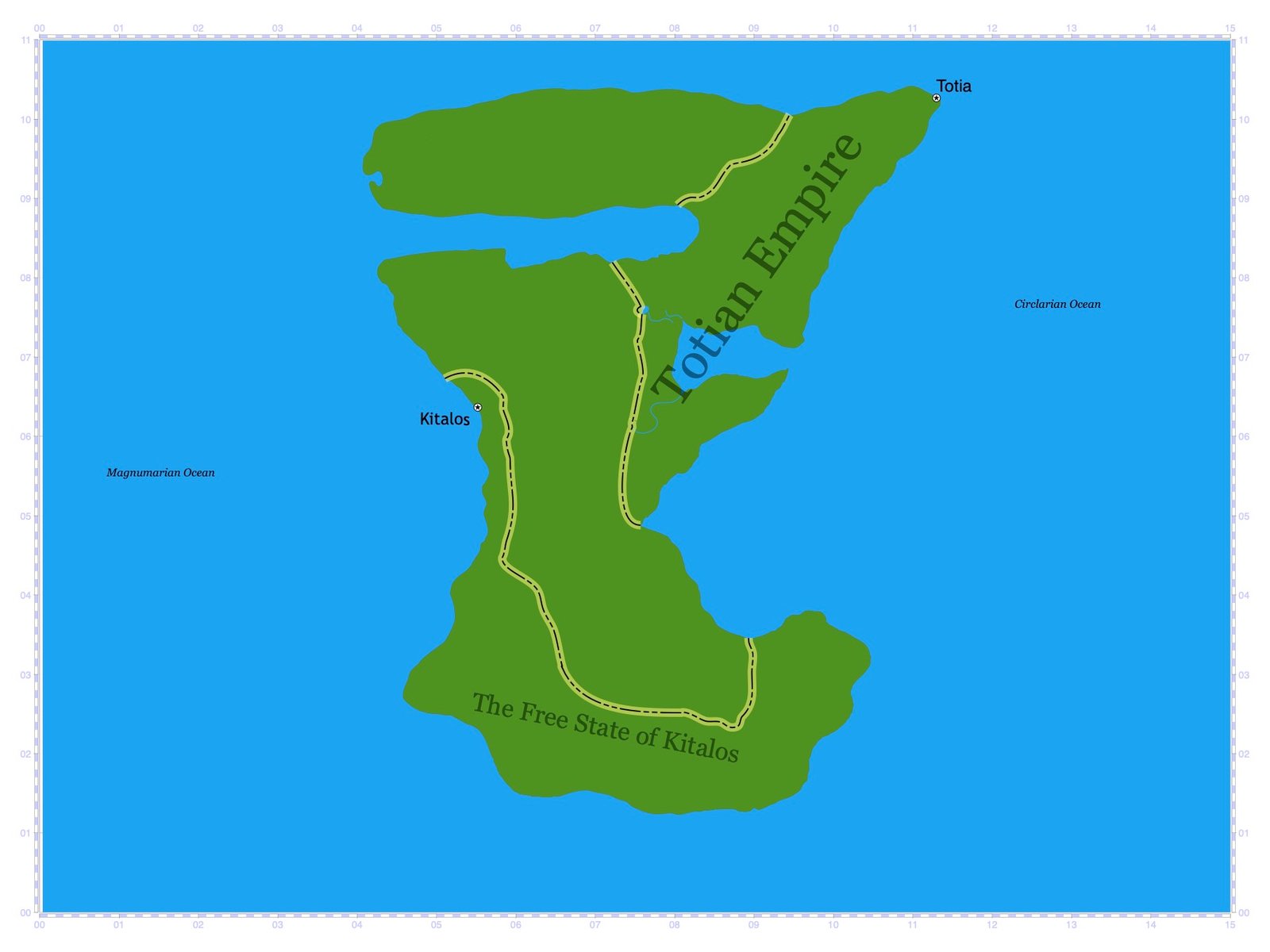
With an ongoing trade deal, the Totians did not oppress the Camarans, who roamed the lands to the West and South of the Inland Sea. However, more of this land fell under Totian Emperor Alec, who was relentless in his pursuit for additional wealth and power. And this began a sentiment of unease among the Camarans and Tahns. In 821 BCE, they pushed a treaty with the Totians to not claim land West of a meridian between the Wilderlands and the beginning of the Jo Reneed River, an agreement that Alec reluctantly signed.
The land between this meridian and the East Coast of the Inland Sea was relatively low-lying with small, rolling hills like in present-day Ereautea. The land was even lower and with less hills further South, with the Jo Reneed Valley bisecting the region. However, to the South and East of the Jo Reneed Valley rose the Chemkan Mountains, long and jagged ridges extending to just below the cloudline. In only one place, near the Southeastern bend of the Jo Reneed Valley, was there a navigable mountain pass, which opened up to the warm, gentle, sandy beaches lining the Circlarian Coast. Temperate vegetation, grasses, and trees dominated this region with exception to just South of the Chemkan Mountains, where there were hints of tropical life. In this Southern region, the Circlarian waters were extremely warm and brought wet weather during the summer. When warm, moist air blew in, the air current would be divided by the Chemkan Mountains. Hurricanes and tropical storms would brush up against the coastal side, while on the other side, the current would meet with cold air from the Magnumarian Shield and form rotating supercell thunderstorms, which would crop up throughout the Jo Reneed region. As the Totians noted, some of these storms would blow out into the Inland Sea and manifest into cyclones.
Up to this point, the inhabitants of Totia, originally North Circlarians, had mixed with the neighboring indigenous nomad groups to form the recognizable Totian ethnicity. As the Totians made their way into the lands South of the Inland Sea, they mixed with the Camarans, giving rise to what would become the Chemkan ethnicity. A regional dialect comprising of both the Totian and Camaran tongue began to emerge. Eventually, it would become its own language: Chemkan Vernacular. Along with language and ethnicity emerged also an influence on religion. Across the Totian Empire but originating from present-day Chemko emerged the belief that there was one Divine Being who ruled over the other Divine Beings, and that this one Divine Being was in command of the winds and the weather. From this arose the belief that a person could receive a blessing for ascending Mount Talphon, the highest peak in the Chemkan range, and spending three days there without eating. This gave inspiration to "Contalson," a fictional drama about a Watch Officer who received a blessing to defeat a rival over a piece of valuable land.
Emperor Alec granted liberties for Watch Officers presiding over various regions to enforce their own laws according to their needs. For example, many places through which treewalkers and traders would travel were frequented by bandits, comprised of outlaws and resisting nomadic factions, who would raid traveller camps, murdering the travellers and taking their valuables. In response to numerous reports of such occurrences, a Head Watch Officer had a right to enforce certain preventable measures such as requiring a traveller to have an escort and travellers not being permitted to have campfires.
Across the Chemkan range facing away from the Ocean sprung up new crops of cotton and hemp. Young men would be sent here from the North to work for wealthy landowners who had settled here, until the workers attained enough wealth in compensation to return to Totia and live comfortably.
Hemp had been utilized in trade and consumption during the pre-Ashen Years, and had been in circulation among the indigenous nomad groups since. However, the Totian Empire was the first settled society since the Ashen Years to cultivate it, noting its value and versatility. Another new crop used by the Camarans was cotton, which they collected along their migration routes and became the first to utilize it as a form of insulation during cold weather in the North. As wheat and barley crops grew North of the Inland Sea, fruits from South of the Chemkan Mountains were delivered by traders to Totia in exchange for large amounts of wealth.
Traditionally, bandits along the land routes would be found and executed by the Totian authorities. However, as time went on, Totian authorities began to discover the value of subjecting these bandits to a certain period of involuntary labor, creating a benefit for the landowners who did not need to expend wealth for workers from Totia. Such captives, though, were hard to come by.
Numerous incidents occurred where a message would not be delivered to a desired party owing to the fact that such a message would be subject to a variety of means of transit, making it easier to lose the message in the process. In 817 BCE, to address this, Emperor Alec issued a decree that all messages were to be carried on horseback to certain planned locations. This was arguably the establishment of the first official postal service in Remikra.
There was no uniform way to travel from North to South by land, unless one could do so on horseback. But horses were unaffordable for most Totian inhabitants. The most convenient and relatively affordable form of transit was by ship. Totian ships could sail South against the wind with a tacking strategy discovered by the Totians, and could sail North with the prevailing winds. Taking a ship was also safer, as those with ill intentions could be seen from afar at sea.
By 820 BCE, Emperor Alec fortified Totian land borders with Watches and Legions, as well as Totian water boundaries with Totian Navy and mercenary ships. As a result, the Empire continued to pass through an era of peace and prosperity.
Spellfire scrolls from the Library of the Citadel and various places around the known regions of Remikra continued to be collected and sent back to the main Library in Totia, where seventeen scholars and clerics gathered to study them. The scrolls were read, interpreted, and organized; and before long, a consensus was formed among the seventeen scholars that the Citadel Librarians of the distant past were trying to "build something." However, seventeen different postulations emerged as to what the actual agenda was, beginning a long and educational debate. Knowing that a consensus on one theory was either a long time in the future or would never happen, these scholars formed the College of Citadel Scholars in 811 BCE. Today the institution is named Cales University. Its curriculum is still based on the study of the Citadel Library Scrolls; and the debate on the mysterious agenda of the Citadel Library is still ongoing.
Kitalos
A handful of Kitalan explorers set out on a quest to climb the Escarpments and enter into the Interior Desert of Southern Remikra, where they encountered the Tahns. The Tahns maintained a neutral attitude toward the Kitalans and did not wish to integrate into Kitalan society. However, they allowed the Kitalans to have jurisdiction over some portions of desert territory, where the Kitalans were attracted to the Tahnish art of crafting sandstone into glass. Meanwhile, Kitalan territory along the Coast to the South and East continued to expand.
The ridge lines surrounding the Interior Desert were windy and cold. The Desert, itself, was dry year-around, with soaring temperatures in the summer and mild temperatures in the winter. The terrain was hilly, but not comprised of sand dunes like in other parts of the world. Low-lying vegetation was sparse and seldom green, with exception for occasional communities of cactus species. The new coastline claimed in the South and East was, like the surrounding coastline, very tropical in nature. The downward slope of the Escarpments gave way to beaches and low-lying territory, with the former crowded with palm trees and a variety of plant species. A wet and dry season prevailed here, with the former yielding relentless tropical rains.
The Kitalans continued to have contact with the Quitzdodalans and the Tahns, as well as even the Camarans in the East. However, there is speculation even today that the Kitalans may have come into contact with a group known as the Morsians, the existence of whom is a matter of debate among present-day scholars. The Morsians, according to written claims, were known to cast spellfire from their fingertips. Accordingly, they resided along the stretch of coastline between Kitalos and Totian territories. However, after numerous studies of the area, no conclusive evidence gathered by researchers suggests that the Morsians even existed. Nevertheless, history theorists and religious groups of modern society insist that they did.
By the 820s BCE, trade in the Kitalan territories had grown exponentially, with trade routes well-established. Kitalan merchants began to gain large amounts of wealth, with some merchants becoming more fortunate than others. The wealthier traders began buying not just more goods, but other merchant "businesses," forming conglomerates, or guilds. Guildowners were referred to as "high merchants" while the rest were known as "traveling merchants" because of the former's tendency to settle and simply collect wealth. This created issues for the Kitalan economy, for "high merchants," charging high fees for their "traveling merchant" memberships, also began charging higher prices for goods. In 829 BCE, the "traveling merchant" and working classes rebelled. The "high merchants" responded with violence via paid mercenaries from relatively neutral nomad groups. This did not bode well for "high merchants" when it came to Council elections. But then, in 821 BCE, the aristocracy, increasingly upset with high taxes, mastered its political sway by pitting working class factions against each other via paid promotions for the nomination of figureheads who disagreed among each other. As a result, an overwhelming majority of Council seats were won over by aristocratic favorites, who altered the Kitalan Tax Code to shift the tax burden to the "traveling merchants." Over the years, the burden would also be shared by other Kitalan workers. The aristocratic majority then voted to entitle the land "The Free State of Kitalos," celebrating the liberties enjoyed by the "high merchants."
Nevertheless, Kitalan trade continued to follow the "Quartz Trail."