Pimdan
During the war with Yelcreb, while many of them fled the country to join the ranks of the pirates, many Linbraeans, not wishing to be associated with those who joined the pirates, found settlement in the mountainous terrain in Northwest Wannonia. Here, they encountered the Lynds, who, during this time, were marginalized by Emperor Radion I's agenda to accept only Wannonian trade merchants in the cities and along the routes. As a result, the Lynds were forced to remain in the mountains, where there began to develop a distinct culture and community. Later on, Radion I carried another agenda: to exploit the region for diamond shale, a newly-discovered resource. Feeling oppressed, the Lynds began wanting sovereignty over their territory. In 944, they attempted to drive out Wannonian forces. But the plan failed, resulting in tightened Wannonian grip on power over the region. The arrival of the Linbraean refugees, however, presented the Lyndan population with an opportunity, as they formed a compromise with them. Accordingly to the compromise, the Lynds would help the Linbraeans to defeat the Yelcrebban Crown in the North in exchange for the Linbraeans helping the Lynds to gain sovereignty over their lands.
The Establishment of the Linbraean Kingdom
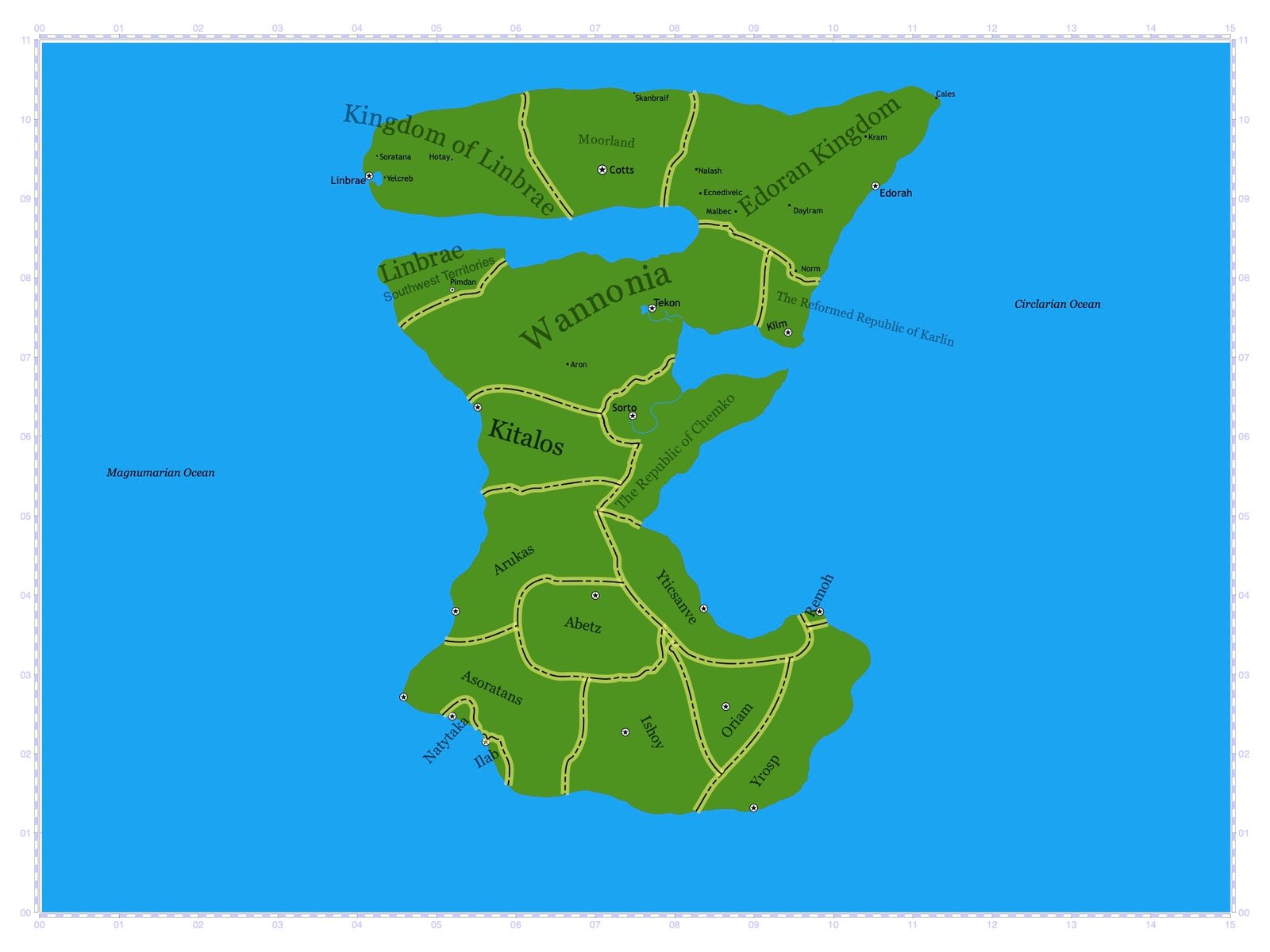
Born in Monassa in 915, Edrea was destined for the Throne. However, in 921, her mother, the Queen, was assassinated by a rival family, who took over the Monassan government, forcing Edrea and her remaining family to flee. Edrea and her family arrived in Soratana in the Yelcrebban Kingdom, where they remained until 928, when the war broke out. They then fled to sea, where the family joined a band of pirates, with Edrea's older sisters marrying into one of the pirate families. In 946, as she, herself, was arranged to marry a pirate, Edrea resisted and escaped, fleeing to Pimdan, an erected large settlement in the Lyndan territories. Between 947 and 951, Edrea ascended the ranks of the allied Linbraean and Lyndan forces and eventually brought them under uniform leadership, becoming the Head Commander of Pimdan. She then made a deal with the King of Marten, who agreed to join her in the Yelcrebban territories and help her win the war.
In 951, sea merchants not otherwise directly involved in the war circulated to Pimdan the ideas of the bullet rifle and the hot-air balloon. Under Edrea's leadership, mass-productions of both were carried out in Pimdan, as large numbers of soldiers were trained. And in September 952, Edrea launched her forces to the North.
En route to the destination, however, Martenian forces intercepted them and engage them in open conflict as part of a surprise attack and act of betrayal. But, unexpectedly to the Martenians, Edrea's balloon reinforcements, armed with cannon-shells, quickly defeated them.
As the Linbraeans invaded the North, Hotay and Yelcreb were felled, while Marten was destroyed and Soratana liberated. In November 952, Edrea was crowned the Queen of the Kingdom of Linbrae, which had its Seat in the former city of Marten, now named Linbrae after the Kingdom.
The Linbraean Takeover of Pimdan
However, Edrea's conquests did not stop with the defeat of the North.
Between March and May of 953, as promised, the Linbraens, under the command of Queen Edrea, launched a balloon assault upon Wannonian forces, driving them out of the Pimdanian Mountains. But as the Lynds assumed sovereignty over their land, Edrea was tempted by the wealthy resources in the region. In September 953, in an act of betrayal against the Lynds, she dispatched Libraean forces to slaughter them and bring the region under Linbraean control. Between October and November 953, Radion I attempted to counter the Linbraeans and regain the lost Northwest territory, but the Wannonian cannons were outmatched by Edrea's cannon-shell-armed balloons.
The Fall of Monassa
Edrea then turned her attention to her homeland: Monassa. Here, the rival family was still in power, reigniting the grudge Edrea had against them. Furthermore, Monassa had valuable resources, which would enrich the Linbraean Kingdom if traded without tariffs. In the spring and summer of 953, Queen Edrea recruited and trained more troops, building more ships and balloons, all of which she launched from the Linbraean Coast at the end of the year. Months later, these vessels arrived in Monassa, which they invaded in September 954. Before long, Monassa was brought under Linbraean control, as Queen Edrea installed, in the place of the rival family, a loyal duchy.
969-981: The Edoran-Furthish War
Between 900 and 965, the Edorans expanded overseas, conquering parts of the Meredythian (jzha-la-poel-gis) Islands, Hobland, and Tandeiyah. However, it was in the 960s that, beginning in Tandeiyah, they encountered the Furthish Kingdom, an equally powerful nation from Canticula. After a skirmish over a region of lakes and fertile lands, the two powers entered a war in October 969.
In the twelve years that would follow, the Edoran-Furthish War would take place in three regions: Tandeiyah, Hobland, and the Meredythian Islands. The Furthish Kingdom was initially pushed back, being outmatched by the advancement in Edoran weaponry. However, they would soon adapt the idea of building balloons and arming them with cannon-shells. Between 973 and 974, the Furthish regained land previously lost to the Edorans, putting the entire conflict into a gridlock. But then, in 978, the Edorans deployed a new invention: the compound aerovehicle, or the "cavie." Serving as the predecessor to the steam-powered airships that would follow in later years, such a device contained twine-powered propellors and a tail-fin for control, eliminating the need to rely on wind for navigation. Furthermore, each vessel had better spellfire defenses as well as bigger cannons and guns. With this, the Edorans made quick advances, regaining Furthish territory; and in October 981, the Furthish homeland in Canticula was invaded, and the Kingdom defeated.
Wannonia: The Little Drought, 971-981
Beginning in the spring of 971, the South Circlarian Stream (a global air current) shifted out into the Circlarian Ocean, drawing moisture away from the Central Plains. As a result, little to no rain fell over Wannonia; and before long, flaxweed and food crops began to fail. With food in short supply, Wannonian trade was brought to a standstill, as faction wars erupted over diminishing resources and famine claimed the lives of many. Furthermore, canal systems were partially shut down, while large swaths of Wannonian territory were overshadowed by the threat of wildfires.
The resulting faction wars triggered destructive political implosions within the ranks of the Imperial Court, which resulted in a coup and the assassination of Radion II in 980. In his place rose the new Emperor: Petraeus I, who claimed to have strong connections with the Alconist Divine.
In the spring of 981, after ten years of drought, rain finally returned to Wannonia. And in 982, crops yielded plentiful harvests. News then reached the Emperor concerning the happenings of the Edoran Kingdom, which had just fought a long and costly war with Furthing as soldiers were still thinly dispersed across the new territories. Such information, coupled with the recovery from the drought, gave Petraeus I a sense of opportunity for conquest. The only drawback was that Wannonia was outdated in terms of artillery; so an ally was needed.
Moorland: Change in Leadership and The Deal with Wannonia
Such an ally would be the Kingdom of Moorland.
For years, Moorland endured a stagnant economy and a corrupt establishment, while its monarchy kept mostly out of Remikran politics abroad. But then, in October 982, the monarchy was overthrown, as King Estaen I came to power with a quest for dominance over Northern Remikra. Acknowledging the agenda of the new Wannonian Emperor to the South, King Estaen I made a deal with Petraeus I, in which both countries would mutually invade the Edoran and Linbraean Kingdoms, defeating them. Wannonia and Moorland would then split the conquered lands fairly among themselves; or so they intended.
Speculation has been made numerous times in the past that both figures, of Wannonia and Moorland, respectively, each wanted to conquer the other, as well.