History of Cable Rail
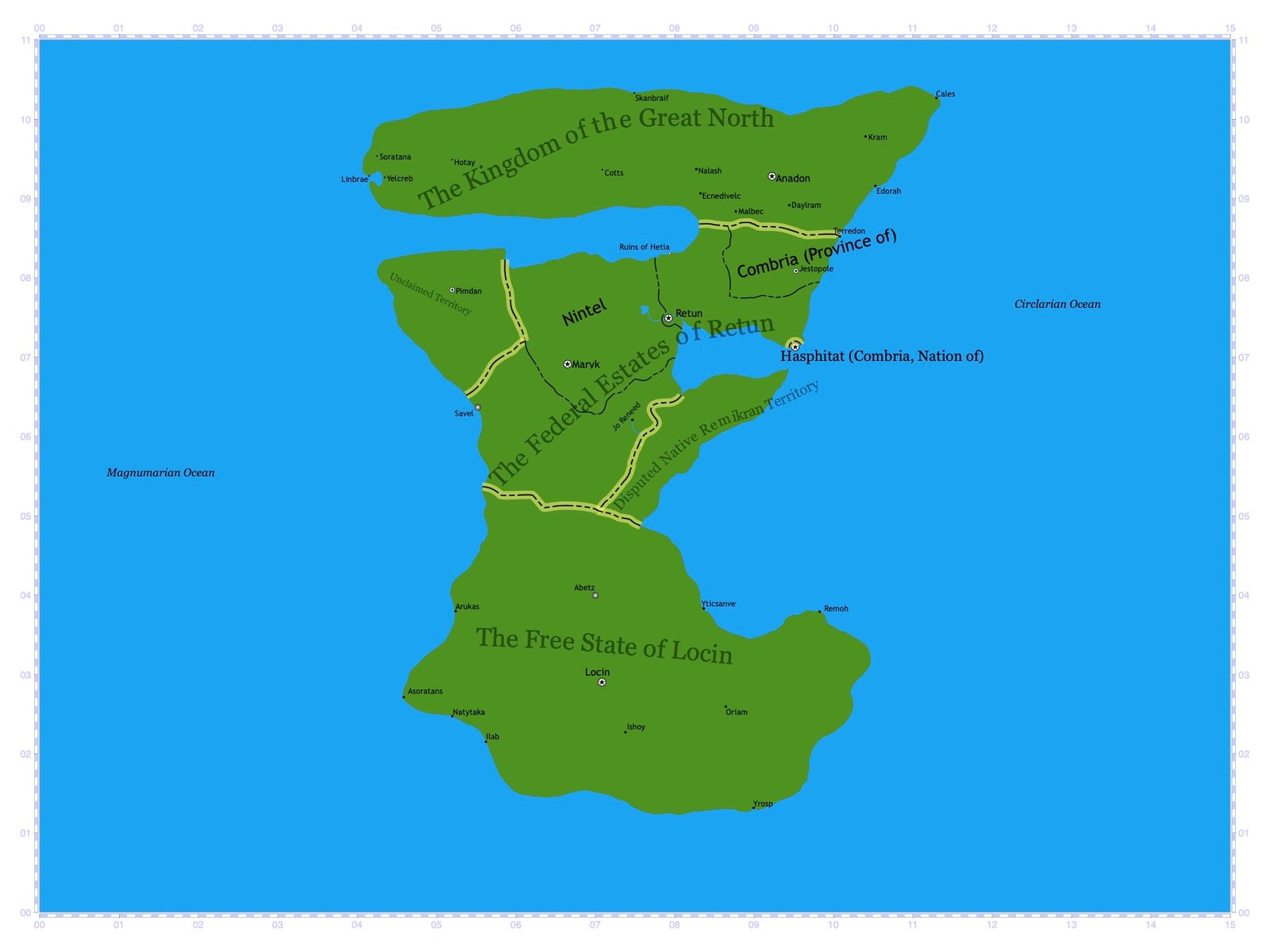
The idea of a cable rail train system was first proposed in the 1160s by John Mack to the Great Northern Crown. The invention would eventually be approved in that time for experimentation in Cales, but was never implemented commercially. The latter part of its success was brought forth by his grandson, Stephen Mack, who spent decades trying to put it on the commercial market. After determination that the Great North would never recognize him, Mack relocated to Hasphitat in the 1190s, where President Henry gave the desired approval. In 1201, the first cable rail network was established in Hasphitat, connecting the growing city to Bridgetown and Jestopole. The network would gain popularity and expand in rather quick fashion.
Nintelian Faction Feuds
For the first half of the century, life in the Central Plains of present-day Nintel was about survival, as its inhabitants relied on farming for food. Commerce, according to expectation, was built upon merit, reward by hard work. Most farmers who were successful used the wealth acquired from their commerce to expand upon their farms, families, and respective communities.
As early as the 1220s, though, as farms grew numerous, property disputes became a concern.
And it was property disputes, among numerous other things, that proved catalysts to the feuds carried out by rival factions, or local bands of allied families and friends. Faction feuds would prove infamous throughout most of Nintel's history from this point forward, and were caused by disputed land boundaries, last-minute bids at horse auctions, and conflicts of family wills, especially those involving marriages between factions. Many of these rivalries manifested themselves into physical fights and gun fights, but even more of them had subtle but costly consequences like biased lawsuits, fabricated prosecutions, and coerced legislative measures. The outcomes of the faction feuds usually involved change in ownership of livestock and property, as well as change in estate zone boundaries, usually to the favor of the winning factions.
Cable Rail, Zoning, and Provincial Proposals
In January 1243, the Federal Estates Council began a debate on the Cable Rail Restoration Act, where it aimed to refurbish the existing cable rail network, some of which sustained damage during the war, as well as expand the cable rail network to Maryk. However, it was the latter of the provisions that drew the most grievances, especially from Nintelian land owners. Zoning complaints reflected the notion that numerous crops and farmland would be bisected or otherwise inconvenienced by the rail line; and such zoning ramifications triggered new faction feuds. Nonetheless, the provision would pass and construction would begin in March 1244, to be completed by the summer of 1245.
The rail line proposition resurrected a call, made by Nintelians in 1243 only to have it fail in the House of Maryk, to make the territory of Nintel a province. This second proposition passed the House in January 1244 and subsequently made its way to the Federal Estates Council. And on 9 March 1244, Nintel officially became the second established province of the Federal Estates.