The East Wannonian Invasion
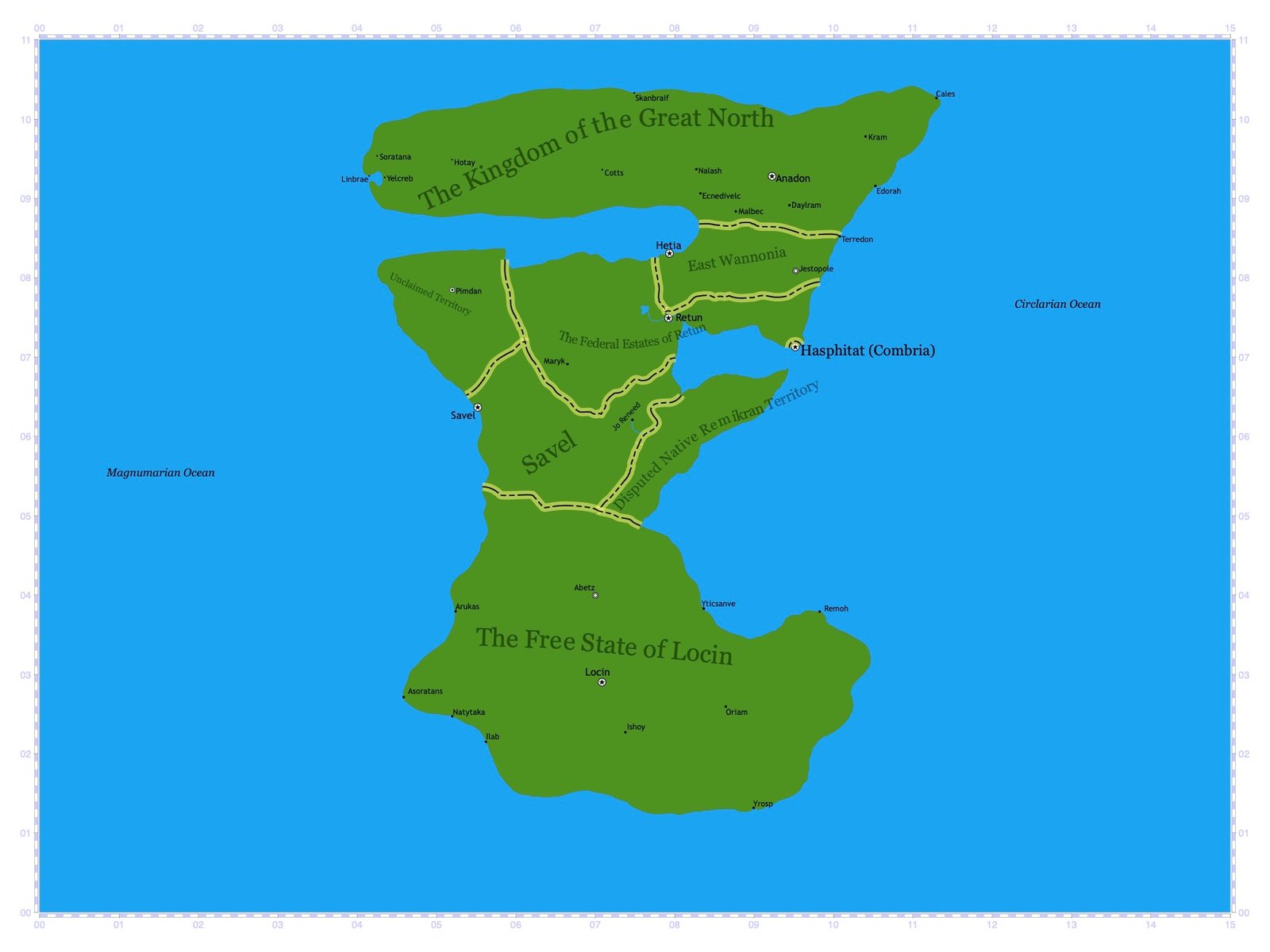
Between February and April 1239, in an attempt to invade East Wannonia by surprise, Richard Marren commanded North Combrian Navy and Infantry divisions to secretly station themselves around the city of Hetia. From that point, the plan was to fire upon the city and conquer it, assassinating General Zeyk in the process. The North Combrians would then drive outward and force remaining Hetian forces to surrender. On 5 May, they carried this out, firing relentlessly upon the compound. But Hetia, inspired by the Provan defenses during George Benson's attempt to conquer it, utilized "house cannons." And thus, Marren failed to bring Hetia under his control.
To make matters worse, General Zeyk had been anticipating this attack, due to a well-employed spy network, and relocated secretly to the seaport of South Masonia. Under Zeyk's orders, Hetian troops in Jestopole began firing upon forces from both Jestopole and Hasphitat. Promptly, Marren made an order for several of his divisions outside of the city to rush to his aid, but was killed before the message was sent out. Subsequently, Marren's troops experienced high casualties, as President Henry's forces were forced to retreat from North Combria. Marren's resources, including guns, bombs, and planes, were seized by the Hetians, as the House of Masons was torched. General Zeyk, commanding from South Masonia, preserved order and control over Jestopole and North Combria via martial law.
An urgent message was sent to President Henry regarding the events. And news of the East Wannonian invasion was confirmed on 12 May, as they captured Fort Braddock, driving the remainder of President Henry's divisions to the South bank of the St. Eschel River. In the weeks that followed, President Henry dispatched more infantry to the River in order to attempt a recapture of the North bank, while the Air Force positioned itself in reserve just behind it. Utilizing this arrangement, President Henry ordered numerous attacks upon key strategic points in the newly claimed East Wannonian territory, but most proved futile.
James Black Under President Henry
Born in 1202 to a notable family with significant roots in the Combrian armed forces, James Black, in 1220, joined the ranks of the military, himself, training initially in the infantry. Two years later, he advanced to a place in the Air Force, where he took part in his first real combat against pirates in the Meredythian Islands region. He then advanced to the Lieutenant General title in this division before retiring to the reserves, where he would fulfill his requirement to attend monthly trainings. In 1239, Black was called back into service, to take part in the war against East Wannonia, where he would be placed under the command of General Greg Marlin, who was ten years younger in age. Black felt that his experience better-qualified him to be the General.
While in immediate-reserve training at the Air Base in Hasphitat, Black utilized his position as Lieutenant General to gain insightful knowledge regarding the strategic layout of President Henry's forces. He noticed that most forces were concentrated along the front lines of Retun and the St. Eschel River, while too few forces were in Combria's interior, and strategic holes were present along the Circlarian and Inland Sea Coasts. With numerous sources informing him of the particularly aggressive behaviors of General Zeyk and his East Wannonian forces, James Black began feeling concerned over a possible East Wannonian invasion.
In May 1239, General Marlin presented Black with orders to move his immediate division to Knob Point, located along the St. Eschel River. Lieutenant General Black pressed him for more information regarding the matter, only to be met with refusal from the young General. Upon chance, President Henry, himself, arrived on base to greet and empower the residing soldiers. And Black took advantage of this by speaking with the President in person, voicing his concern over Marlin's agenda and the vulnerability of the nation. President Henry responded to this, accordingly, by admonishing Black's judgement, condemning it as the reason for Black's inability to rise past the title of Lieutenant General, and advising him to follow orders without question.
Later that month, the Air Force division, as per assignment, relocated to Knob Point, where General Marlin flew his aircraft division further North and instructed Black to remain on standby. Seeing lack of judgement and rationale in the information presented to him, Black, instead, dispatched his aircraft fleet to split and relocate as reserves to seemingly vulnerable locations. However, on the morning of 19 May, Black received an urgent message from the General to immediately report to an apparent battlefront near South Masonia, the location of General Zeyk. Over the next four hours, Black struggled to summon and mobilize his divided fleet of aircraft. By late afternoon, they arrived in South Masonia, where it was discovered that General Marlin was killed, and his forces effectively obliterated. Furthermore, East Wannonians shot down six of Black's thirteen planes, as Black, himself, survived but retreated to Knob Point. It was at Knob Point that Black received a letter of dishonorable discharge from President Henry, himself. Black publicly decried the happenings, blaming them on the command's lack of willingness to disclose sufficient information. Upon return to his home in Hasphitat, Black was met by his personal lawyer, who informed him that President Henry dismissed the public grievance and motioned for his prosecution.
In the wake of this, Black, according to personal memoirs, determined that President Henry's regime was corrupt and had a great abundance of favoritism, and that President Henry had lost common sense. Henry's decision to discharge and prosecute him made Black, accordingly, an outsider to the Chartered State of Combria. And thus, Black's loyalty to the nation was lost. He, instead, turned his sights to better opportunities in President Henry's rival to the West: the Federal Estates of Retun.
In the early morning of 1 June 1239, James Black boarded a train to a location close to the war-torn border, where he disembarked and continued the rest of the way on foot.
James Black in the Federal Estates
Upon crossing the border, James Black was arrested by Retunian forces. During the questioning that followed, Black explained that he had no loyalties toward President Henry, having been expelled from that system, but that he had inside information regarding the nation's strategic layout. Seen as a useful resource, Black was arranged to meet with Arnold Stone and the Federal Estates Council, where Black explained President Henry's "shell out" situation and concerns about East Wannonia. The Council determined that this was an opportune moment to attack and gain sovereignty over the remaining Combrian territories; and soon, they developed an agenda where a fleet of aircraft carriers would assemble to the Southeast of Elsa Island, and James Black would command bomber aircraft to attack President Henry's territories from the Inland and Cirlarian Sea coasts in a surprise maneuver.
On 1 October 1239, this agenda was launched. After two weeks of intense fighting, numerous swaths of Combrian territory were brought under Retunian control, but President Henry continued to resist with brutality.
The End of President Henry's Tenure
However, the war was beginning to take a toll on Combria's dwindling resources. The Retunian offensive prompted President Henry to enforce food rations in the Diamond District, which drew contempt from the population. Soon, riots broke out in the streets of Hasphitat, while President Henry's attempts to restore order proved futile. Just after midnight, on 18 November 1239, a group of protestors, armed with spellcaster talismans, broke down the locked doors and forced their way into the Chadwick Building. As they succeeded in fighting their way up the levels toward President Henry's official and personal quarters, the protestors formed an agenda to force the President to abandon his post.
Upon hearing news of this President Henry immediately ordered State Secretary Terrace Bryan to dictate a letter of resignation and to leave it on the President's desk. The President then gathered his family in residence and left on an airship that had been hidden in the roof sector of the government structure. To avoid any possible sightings from below, President Henry ordered the navigator of the vessel to allow the vessel to drift away silent without its beacon lights. Ten miles out at sea, the engines and lights came to life as the vessel diverted toward Elsa Island, on the opposite end from where Black's forces were assembled.
On the next day, Paul Mackwell became the next President of Combria, allowing the Federal Estates to keep the territory it gained during the invasion, and, furthermore, sold more territory so that only a five-mile wide area of land surrounding the earth-bound Northern sides of the Diamond District remained under Combrian jurisdiction. On 21 November, feeling that he had fulfilled his role, Mackwell resigned.
With Combria effectively defeated, the Federal Estates focused its agenda on its most pressing concern: East Wannonia.