Combria and Gymia
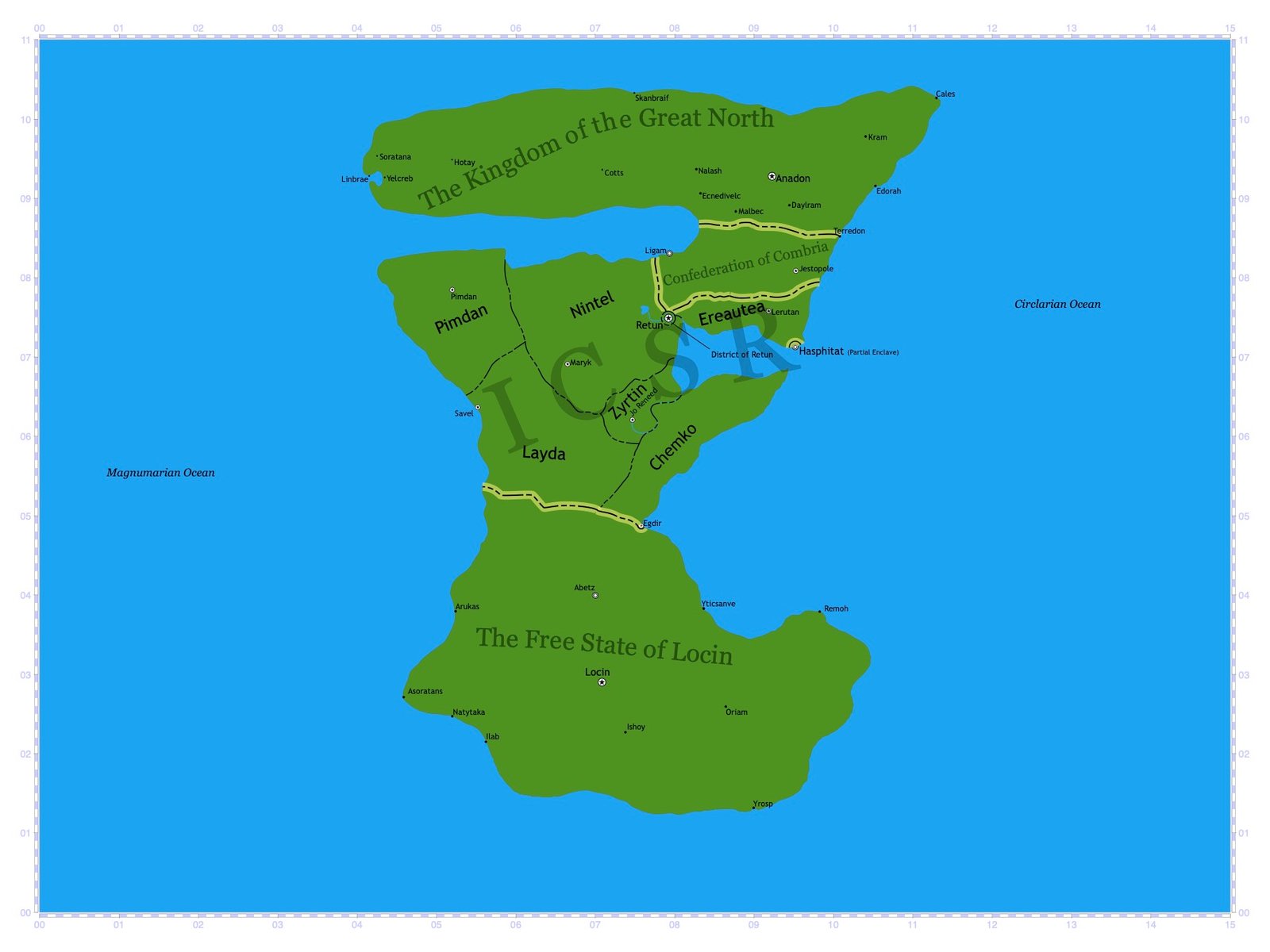
The newly independent nation of Combria ultimately was presided over by the nationalist Combrian resistance leader, George Henry, who administered Combria in the same fashion as the original Chartered State of Combria under President William Jeson. He retaliated against the Commonwealth with a heavy tariff on hubstone resources. This had incredible influence on the province of Gymia, where the tariffs put a strain on the economy. Prime Minister Finzi responded to Gymian economic hardship with another expansion in welfare distribution. Gymian constituents protested against this, however, asserting that the measure would worsen the rate of inflation, and demanding that Finzi engage in direct armed conflict with Combria.
The House of Archives
Established in Retun proper in 1278, the House of Archives served the purpose of housing important data and documents; for example, curriculum for the Global Academy of Ancondria.
However, in the summer of 1320, Paul Tourney, employed by the Commonwealth Department of Education as a research consultant for the recent agenda, was asked to weigh the validity of a certain curriculum employed in one of the Global Academy satellite campuses in Hobland. Conflict of interest arose when administrative frustrations related to the Archival House, prompted Tourney to fabricate critical pieces of information. Finzi, very soon, discovered this dishonest act and launched an investigation, during which Tourney was found guilty and removed from his position. On 2 June, disgruntled over the matter, Tourney returned to the House of Archives and set it ablaze. The fire was eventually contained, but the library was effectively destroyed with valuable documents lost. Finzi implemented measures in an attempt to salvage remaining artifacts, with little success. Tourney was arrested on 17 June, and was later found guilty of arson and sentenced to ten years in prison.
However, not everyone was in agreement with Finzi over the matter. In fact, this led to further resentment from the population of Gymia, who began to see Finzi more and more as a corrupt figure.
1320 Election
Leading up to 1320, Finzi and the RAD Party were opposed by the Umbol Coalition, which, formed under Peter Umbol and continued to grow after his death, carried the agenda to rid the Commonwealth of policies imitating those of the old Federal Estates of Retun, or the Early Republic. By 1320, the Umbol Coalition was headed by Mark Baret, who grew up in the Basin District and fought on behalf of Finzi and Umbol during the war in 1309. In 1318, Baret announced his candidacy for Prime Minister, determined to challenge the incumbent Holz Finzi, and winning the primary election in 1319.
Finzi, during this campaign, aimed to continue the established darkfire industry policies and the ongoing Archival House recovery efforts, while engaging in diplomacy with Combria in a hopeful attempt to gain back its jurisdiction. Meanwhile, Baret decried Finzi's agenda for being too centralized, and pushed for a private commerce organization to have more sway on the darkfire industry. He also wanted to abandon Archival House recovery efforts and launch an armed offensive against the insurgent Combrian nation.
Baret's idea for the war with Combria rang well with those in Gymia, but was otherwise not popular with the remainder of the Commonwealth. And thus, on 16 September 1320, Finzi won re-election.
Darkfire Fallout, Economic Downturn
Darkfire floans had a sharp drop in yielded quantity in the beginning of 1321. Finzi implemented more strategies in an attempt to boost such quality, only it to fall even further. It was at this point that darkfire began to drop in value even relative to the Commonwealth Qor, whose value continued to drop due to inflation. In June of that year, Commonwealth tradestone markets crashed. Finzi responded to this with a government buyout, a provision signed into law in 1309 with the intent to prevent what happened in 1301. Between 1314 and 1318, the measure previously took effect, successful in preventing complete downturns. But in 1321, funds for this measure ran dry, allowing the June 1321 downturn to continue.
Ballot for Gymian Secession
The resulting job loss and lowering of living standards prompted numerous Gymians to petition for their province to secede from the Commonwealth, citing the grievances of corruption in Finzi's administration and economic hardship. On 15 September 1321, the measure was brought to the Gymian Provincial Council in Ligam, where it was met with intense support from the local population. However, with the majority of the Provincial Council composed of Finzi-loyal representatives from previous elections, the measure was ultimately voted down.
The Independent Commonwealth of Gymia
Angered by this, Terry Bayne, a leading figure in the ballot measure, staged a coup, which succeeded in overthrowing the Provincial Council. And once again, the province of Gymia gained autonomy from the Retunian Republic, this time forming the Independent Commonwealth of Gymia. Similar to the system in Combria, Bayne became the President of Gymia. The Supreme Court in the Basin District declared this act of secession illegitimate, since it had superseded democratic processes, and thus gave Prime Minister Finzi the authority to dispatch troops in order to end Bayne's regime and place Gymia under martial law until its democratic institutions could be restored. Finzi acted on this emergency power, and Retunian troops confronted Bayne's forces on 21 September 1321, starting civil conflict.
Initially, the people of Gymia, angered by the hubstone tariffs, had disdain for the newly independent nation of Combria. However, in light of Finzi's attempted intervention in Gymia, Combrian President George Henry sent Terry Bayne a proposition to annex the Gymian territories and provide a common defense for them against Finzi. President Bayne agreed to this and signed the Treaty of Consent to Annexation. On 23 September 1321, the two autonomous provinces of Combria and Gymia merged to form the Combrian Confederation.