Context
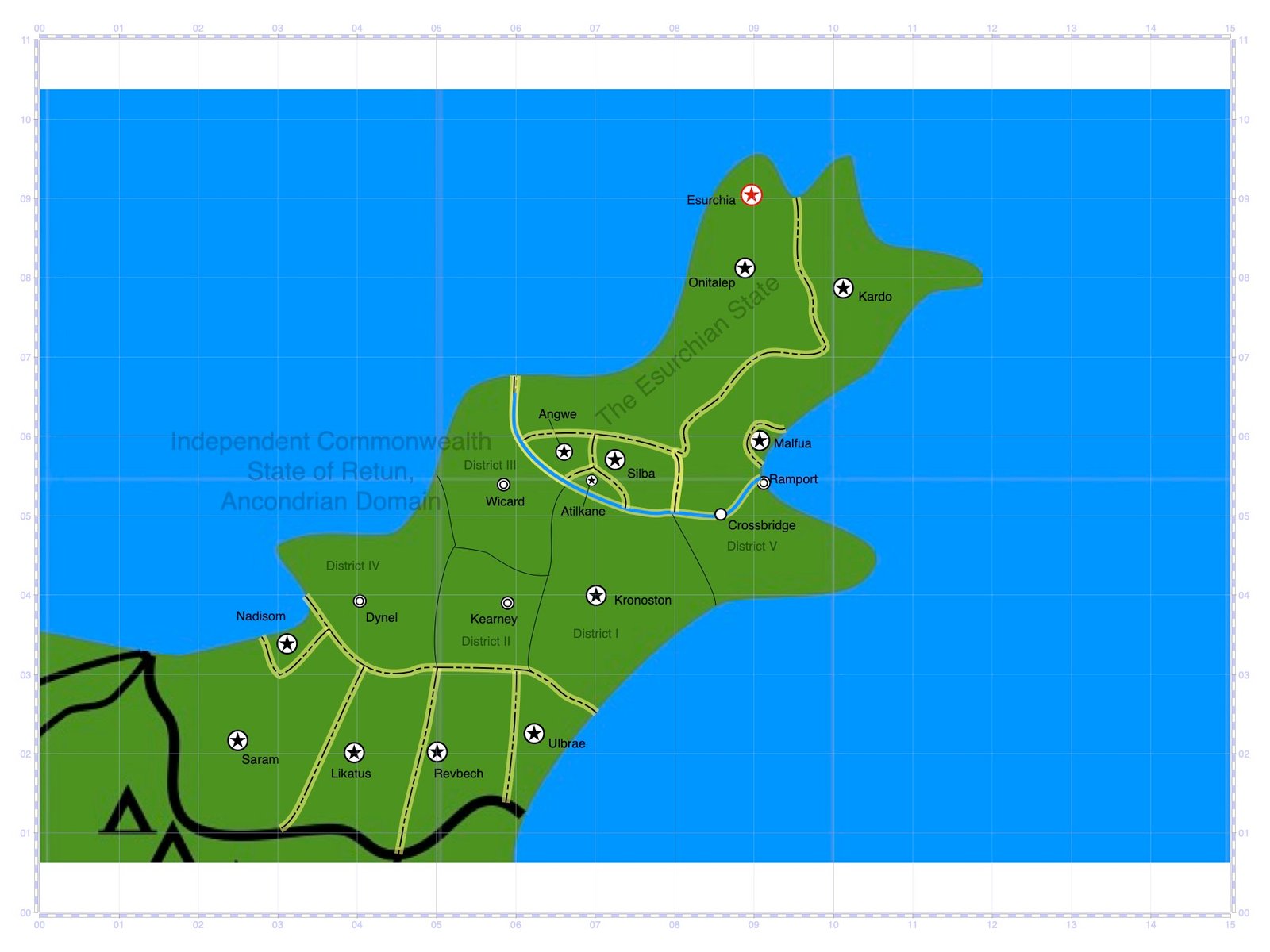
In the 1310s, the Ancondrian nation of Kardo designated a part of its Northwestern jurisdiction as the Territory of the Havenlands, a territory to serve as a haven and refuge for immigrants. This designation became well-known for its unusually progressive provisions, including the allowance for people to enter this territory without passports, visas, or other customs requirements; the allowance for people to live here without paying any form of taxes to the Kardan government; and the protection of this territory from military or civil intervention by the Kardan government.
Regarding the latter, the lands within the Havenlands Territory were administered and managed solely by their respective property and estate owners, whether said land belonged to a private business or to an encampment or community. Also established here since the 1310s was the Community Freeway Association, which built and maintained two highway networks: the Inland Freeway Network and the Coastal Freeway Network. The Freeway Association was a privately owned business that pledged, from the beginning, to fund construction and regular maintenance solely through donations from surrounding communities and businesses; therefore, it promised to promote free travel and to never charge tolls.
This was noteworthy, considering that each of the two freeway networks consisted also of ramps leading to and from the highway as well as numerous side-roads connecting a large number of the Havenland communities and encampments.
All of this was helped by the above-mentioned policy dictating that the government of Kardo would not militarily or civilly intervene in Havenland Territorial affairs. However, this policy included an Exemption Clause that reserved the right for Kardo to intervene if an external threat established itself in the Havenlands and became an imminent threat to Kardo itself. Over the passing years, Kardo, especially under conservative administrations, did all that it could to avoid invoking this Exemption Clause and would, instead, call for any disputes between two or more Havenland entities to be resolved independently.
The cause for House Onitalep to migrate to the Havenlands began in the year 1313, when they, through oathcrafting methods, as would be exposed later on, backed a populist uprising in the Ostar-Nabuka region (Northeast of Canticula), which pushed the federal government of the Southerly Confederation of Ostar and Nabuka out of its capital: Aldonya. This government was forced to move its seat to the neighboring city of Kronlon. Meanwhile, Aldonya was renamed Kysornen and its surrounding territory became an independent nation: the City-State of Kysornen. Between 1314 and 1340, House Onitalep ruled over the City-State of Kysornen with an iron fist, as they oppressed free speech, crushed political opposition, and attempted to erase the local darkfire community. They also imposed high taxes on the middle class and acquired or infiltrated independent businesses to extract as much wealth as possible, much like a private equity firm would. Furthermore, House Onitalep extracted as much wealth and labor as possible from working-class members, which grew as the above-mentioned policies squeezed large numbers of people out of the middle class.
In the late 1330s, large numbers of these working-class people, fed up with the oppressive policies of House Onitalep, began forming unions and super-unions. In 1341, they banded together and carried out a general strike, a measure to which House Onitalep responded with brutal crackdowns. In 1342, the leading members of the working class formed the Labor Party of Aldonya, which submitted a petition of grievances against House Onitalep to the Congress of Circlaria, seated in Cenofan. The Congress of Circlaria responded with a full inquiry, which obtained major insight into the oathcrafting measures used by House Onitalep since 1313. They published these findings internationally and publicly declared House Onitalep to be an illegitimate government. This created a popular mandate for the masses to stage a coup legally.
Though this coup was mostly non-violent, it was effective in driving House Onitalep from power. In its place, a conference held in early 1343 established a new government, renaming the city of Kysornen back to Aldonya and re-establishing the former City-State territories as the Four Democratic Counties of Aldonya. Each county therein was authorized, by a new constitution also enacted during the conference, to mostly self-govern, except that it was mandated to send elected representatives to participate in a yearly Caucus in Aldonya city-proper. Meanwhile, some of the first laws signed at this conference imposed heavy reparations and taxes against House Onitalep for the damages they caused.
Rather than comply with such measures, the leaders and members of House Onitalep opted, instead, to move to the Havenlands.
When House Onitalep settled in the Havenlands in the year 1343, their member-Councils, Esurchia, Kilma, and Onitalep, each established their own Community, named Esurchia, Kilma, and Onitalep, respectively. Initially, like the power-dynamic structure they maintained during their years in Aldonya, the Council of Onitalep was, on paper, first in the chain of command. However, the Council of Kilma rivaled Onitalep in practical terms. Meanwhile, the Council of Esurchia, at the bottom of the command chain, was the weakest entity. However, this would change in the years to come.
In the late 1340s, Kilma set out to engage in trade with neighboring Havenland communities. Onitalep did the same, albeit with more aggressive tactics. For example, Onitalep commonly used the "siege approach," imposing checkpoints on routes between these communities and forcing them to sign unfair diplomatic or trade agreements. Numerous communities affected by this would file grievances against Onitalep to the government of Kardo; however, Kardan leadership continued its tradition of refusing to invoke its Exemption Clause.
Meanwhile, the Council of Onitalep set up checkpoints on side roads that were not part of the Freeway Association Networks, and imposed traffic tolls. In 1349, they began setting up toll booths at Network side-road entrances, prompting outreach from the Association itself. Onitalep responded with a proposal to purchase the Inland Freeway Network. However, the Association rejected this.
Those communities neighboring Kilma, feeling threatened by the expanding influence of the Onitalep Council, called on Kilma to help defend them. Kilma responded accordingly, and Onitalep retaliated by taking over those neighbors by force. However, Kilma pushed back, retaking the communities with even more force.
By the latter half of the 1340s, both Kilma and Onitalep gained a reputation for ruling over their respective neighbors, imposing the same oppressive and authoritarian policies. Before long, they began encroaching on communities bordering the Community of Esurchia. Esurchia, in response, took over its neighbors in the same fashion as that of Kilma and Onitalep. And this gave way to endless fighting, broken only by a treaty penned by the Council of Onitalep in 1350. This agreement ended the violence, established equal distributions of territory between itself and Kilma, and assigned provisions of consolation accordingly. This agreement, as had been tradition in the Greater House Onitalep, left the Community of Esurchia at a disadvantage.
The Havenlands: Change in Balance of Power
In the late 1350s, in a desperate bid to make up for the losses incurred from the 1350 agreement, the Community of Esurchia set out to establish trade and diplomacy with political entities in the region. In 1359, they established a deep-trade agreement with the Independent Commonwealth State of Retun. Shortly after, Esurchian figures began imposing on the Retunian population exaggerated testimony about oppression from the Councils of Onitalep and Kilma, along with propaganda calling for the recovery of lands and assets lost in the fallout in Aldonya. The Council of Onitalep responded to these narratives by publicly declaring the Esurchian Council an internal threat and making a threat of its own to sanction Esurchian trade and travel.
Perceiving further oppression from Onitalep and Kilma, the Retunian Commonwealth, primarily through its dominant lightfire trade corporation, West Horizon, opted to defend the Esurchian Community and its interests by providing military resources. Wishing to avoid further conflict, the Councils of Onitalep and Kilma de-escalated the ensuing tension with an agreement of mutual continuance between them, the Retunians, and the Esurchians. However, the Community of Esurchia opted to seek supremacy in the area and therefore approached the Freeway Association about possibly purchasing some of its properties. The Freeway Association, at the end of these talks, agreed to sell both Freeway Networks, each in its entirety, to the Esurchian Community, a move that led historians, years later, to voice suspicion that the Esurchians had practiced oathcrafting in the process.
Regardless, the Retunian Commonwealth helped to broker this deal with the assumption that the Esurchian Community would continue to allow free travel through the Networks. The Esurchian Community would break with this assumption, however, setting up numerous toll booths whose toll rates were left subject to the arbitration of the Esurchian officers who staffed them. The tolls were very expensive.
Provoked by this move, the Communities of Kilma and Onitalep, during the second week of September 1360, invaded and overtook all of Esurchia's neighbors.
On 21 September 1360, now armed with resources from West Horizon and the Retunian Commonwealth, the Community of Esurchia retaliated by taking back is neighbors, taking back the neighbors of Onitalep and Kilma, and then toppling those two government seats. On 24 September 1360, the Councils of Onitalep and Kilma officially surrendered, after which the Community of Esurchia declared itself, and the entirety of the Havenlands, to be a new nation: the Esurchian State.
The Esurchian State governed its territory in a brutal, totalitarian fashion, as its leaders became increasingly hell-bent on war and global domination. Other communities within the Havenlands who voiced dissent against the State were subdued or eliminated by the ruling Esurchian forces. Those who did not dissent pledged their fealty to the State.
Many people fled the Havenlands, most of whom made a call to the government of Kardo to intervene. However, the government of Kardo refused to recognize the Esurchian State. It continued to refuse to invoke its Exemption Clause, paving the way for the Esurchian State to grow in power and prepare for the infamous Esurchian War. This event would have major implications for Ancondrian and global politics in the years to come.