Introduction:
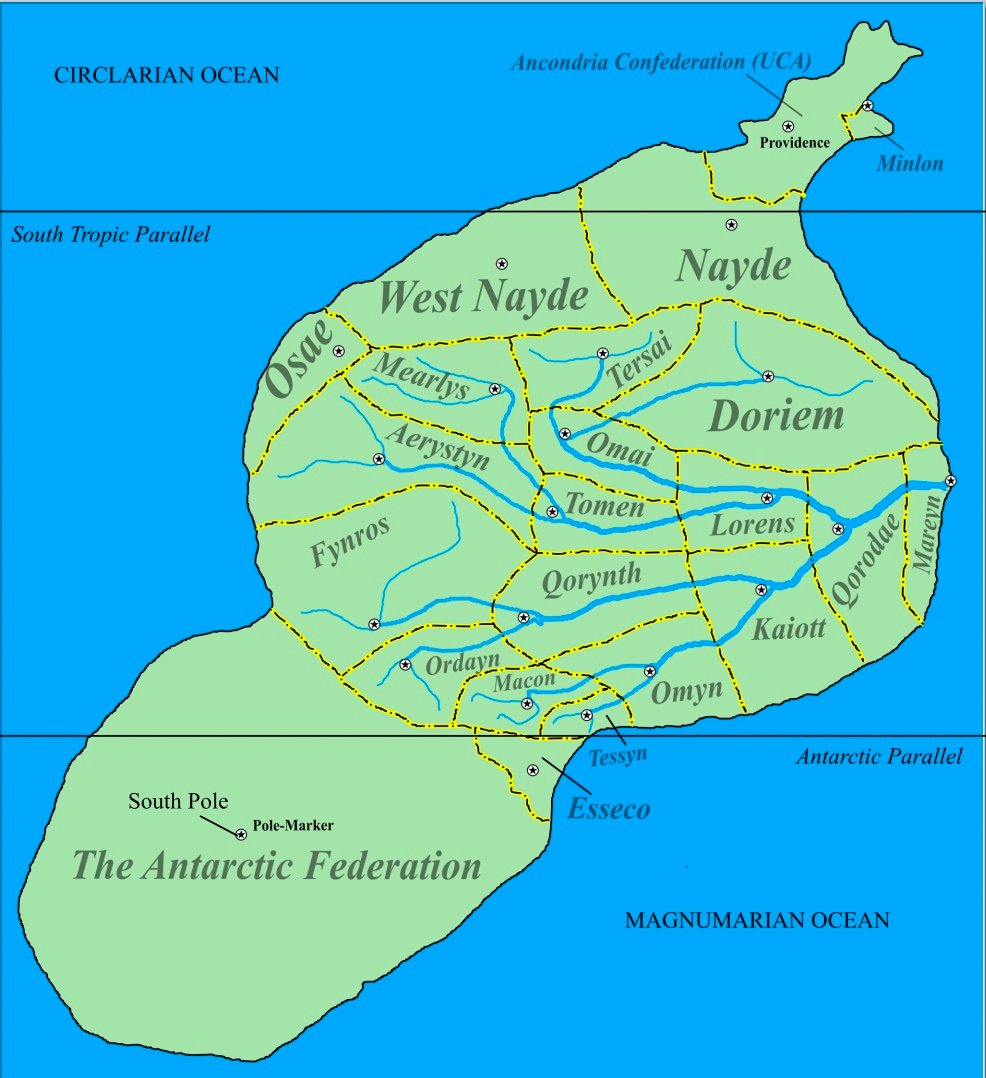
Qorodae, the largest trading hub in Greater Ancondria, is known for its ultra-modern appearance, most significant in its Point District, located at the junction of three rivers. Though it lacks the mighty "supertowers" of Minlon, the Point District has its vast number of modern high-rise residences, businesses, shops, and banks. Situated just behind the Point District, also boasting of ultra-modernity, is the Public Courtyards, home to the government seat of the city-state, an incumbent-appointed-presidential council, or IAPC. These two blocks, and elsewhere in the city, are accessible by POD vehicles, the most convenient form of gyroplane transit since the 1370s.
Lining the river banks are the Slope Districts of Qorodae. Here, every home and shop is also accessible by POD vehicle; though, everything is more compact, as these districts are home to the bottom 99 percent of the population. The overall landscape here, to the visual aficionado, leaves more to be desired.
The other two major cities in the Qorodae City-State also have modernized landscapes, though they are more economically blighted. The rest of the city-state is rural, taken up by farms with varying levels of modernity and economic standing.
Regardless, no one would have guessed that this nation, on multiple occasions, served as part of the Great Ancondrian War. Spanning 70 years, the Great Ancondrian War was initially sparked by discord over the practice of drake domestication, also known as drake-keeping, but would later devolve into total chaos by its end.
This, of course, leads to a very important question: What was the Great Ancondrian War?
Discovery of Ancondria:
Factors leading to the outbreak of the Great War of Ancondria date all the way back to when the supercontinent of Ancondria was first discovered. In 1263, a group of Cabotton University students aboard an airship blown off-course by a storm in the Magnumarian Ocean photographed a collection of islands. In 1268, these photographs were examined and cross-examined by a group of Cabotton University professors, who discovered that not only were these islands uncharted, but the photographs also showed, barely visible and off in the distance, vast mountain ranges. From the late 1260s and into the 1270s, numerous Circlarian nations sent out survey teams to document the region, discovering the supercontinent and, in short time, establishing settlements, starting with Northeast Ancondria. This attracted entrepreneurs, particularly those representing the Retunian lightfire company, West Horizon, to visit Ancondria with the intent to conduct trade and diplomacy with the natives. Before long, business interests began spread all over the supercontinent.
Discovery of Edom:
Shortly after the first encampments began springing up in Northeast Ancondria, survey teams discovered the ruins of the fabled city of Edom, which was significant as the city had been presented in Alconist scripture as well as other religions and ancient lore. And until such a discovery, speculation often ruled, among secular scholars, that Edom had been a fictitious place.
This discovery, of course, went against the beliefs, particularly, of the followers of the Alconist faith, who had been taught that Edom was an eternal and holy city. This provided quite the chaotic backdrop for the 1272 Discord of the Remikran National Debate Committee, held, that year, at Cabotton University. On one side of this debate, scientists and experts used documentary evidence in the argument that this was the site of what was once the ancient city of Edom; while on the other side of the debate, Alconist Evangelists argued that the ruins were of a mockery of Edom, and that the holy and eternal city of Edom exists elsewhere. With the extensive pieces of evidence providing a better case for the former, the scientist faction's argument was voted by a majority of the audience in attendance to be more sound, thus winning the Discord. Angered by this outcome, supporters of the Evangelist side infamously rioted in the streets of Cabotton and its University, causing a great deal of property damage and drawing a great deal of publicity to the event, as well as the ruins of Edom. Thus, a lucrative business opportunity emerged for West Horizon, initially in terms of tradestone investments.
Establishment of Nayde:
The land surrounding Edom is flat and low in elevation, with some parts even below sea level. The climate, year-round, is dry and hot, and is much hotter than in Northeast Ancondria, despite Northeast Ancondria being closer to the equator. And the east Edomian region has a dry season between April and September, and a wet season between October and March.
The Edomian Region also marks the beginning of drake country. Drakes live mostly in the Great Ancondrian River Basin while none live in Northeast Ancondria. The Edomian Region, on the other hand, was historically an in-between region, with drakes initially living in its southern portion. However, since ancient times, human domestication brought drakes further north, even within 100 miles of the Escarpments marking the boundary with Northeast Ancondria.
In 1272, West Horizon founded the city of Aeris, located just south of the ruins of Edom, and the lightfire corporation established the surrounding land as the independent nation of Nayde, named after George Nayde. This new nation would be presided over by a provisional democratic government structure run by elected native Ancondrians acting on the advice of West Horizon representatives. The initial agenda put forth was for this government to vote in a constitution directing Nayde to function as a three-branch democratic government, under a similar structure to the Retunian Republic in faraway Remikra.
1299 - The Nayde Coup:
However, the elected council under Nayde's provisional government was marred in debates arising from conflicts of interest between West Horizon and the local native Ancondrian community. Chief among such debates was the ancient and hallowed practice of drake-keeping. West Horizon had intended to sell its commercial aircraft to local Ancondrians, with aviation being the largest business bloc of West Horizon at the time. Some locals invested in such aircraft, but many others wished to continue to use drakes: the more traditional flying alternative in Ancondria. Drake-keeping had been derived from the ancient practice of keeping lothars, the larger cousins to the drakes. However, lothars had died out thousands of years ago, thus leaving drake-keeping as the only viable alternative until modern times. However, drakes had proven useful, serving as modes of transit, assets to farms, and even vessels of war.
Local native Ancondrians who kept drakes proved stubborn in preserving their traditions, keeping and using drakes while refusing to invest in West Horizon aircraft and machinery. Living along the southerly slopes of Nayde, lining the River Basin region, this stubborn refusal proved a stumbling block for West Horizon business interests, as drake-keepers constituted a large majority of the local natives living in Nayde.
To create the market demand they desired, West Horizon attempted to lobby the provisional government of Nayde into legislating against drake-keeping, even going so far as having House Maderon, seated in the Northeast Ancondrian city of Silba, spread testimony on the moral wrongness of the practice. However, on 7 November 1297, the provisional government of Nayde finally passed its constitution. Though it established a satisfactory Retunian-like government structure, it also contained a core provision authorizing local Naydan communities to vote, through self-determination, on whether or not to ban the practice drake-keeping. In the view of West Horizon leadership, this was a decision compromising too far on the aforementioned business interest.
Thus, West Horizon decided to coup this government.
Since well before the 1260s, there existed a fringe faction within the native Ancondrian community who hated the Elders in surrounding Edom; and the Elders constituted a majority of the provisional government in Aeris. West Horizon took advantage of such resentment and rallied the fringe-members into a coup d'etat, arming the insurgents with weapons and giving their organized militant groups a handsome amount of funds. On 2 March 1299, these insurgents, now armed with planes, tanks, and advanced weaponry, overtook the city of Aeris and forced the provisional government to flee. In its place, West Horizon established an IAPC government, staffed by Ancondrian and Circlarian figures hand-picked by West Horizon representatives. And this new government instituted a total ban on drake-keeping.
The ban was devastating to local economies; though West Horizon took advantage of this situation and succeeded, through strong incentives, in gaining a strong client base throughout all of Nayde. Meanwhile, in faraway Remikra, West Horizon acted to protect itself from bad publicity by paying Retunian media platforms to either be silent on or downplay the events of Nayde. Back in Ancondria, West Horizon hired Remikran employees to oversee "start-up" contract business, which, on paper, were separate businesses, with separate business titles, but were economically tied to West Horizon in the form of a "quid-pro-quo subsidiary" system. In such an apparatus, West Horizon gave money and capital to these establishments, in exchange for a cut of profits going from these establishments back to West Horizon, as well as each establishment honoring the "advised business decisions" made by West Horizon.
1300 to 1313 - Drake-keeping and Regional Tensions:
Qorodae was a significant city throughout the history of Ancient Ancondria, enjoying a temperate climate and an economy dominated by drake-keeping. Beginning in the late 1270s and early 1280s, West Horizon began trading with them, initially selling them modern machinery. By 1300, Qorodae was relatively modernized. Throughout the Point District, which emerged as a significant block in the 1290s, there stood modern streets and buildings. Upper-class individuals here took onto cars, airships, devices, and other assets of West Horizon innovation. The lower social classes contrasted, with some factions pitted against one another over favors from the upper class and West Horizon, while others, who were drake-keepers, began resenting the "establishment" over a ban on drake-keeping being considered.
In 1302, West Horizon, through its aforementioned start-up contractors, implemented a plan to establish an IAPC government in Qorodae, with the intent for such a process to be "smoother." In March of that year, they summoned local native Ancondrian leaders, who got elected to a provisional council government, while West Horizon publicly presented an agenda to set up Qorodae as a democratic republic with the Retunian structure. However, between April and November, West Horizon heavily lobbied council members to amend the constitution in the ongoing debates so that it the government would follow an IAPC structure. This amended constitution, and consequently the IAPC government structure, was voted into law on 9 December 1302.
Mareyn would be established in the same fashion in 1303. And from 1304 to 1308, this was followed by the establishment of the IAPC-run States of Doriem, Lorens, Tomen, Omai, Tersai, Areystyn, and Mearlys. Then West Horizon lobbying influence expanded southward to establish the IAPC-run States of Fynros, Qorynth, Kaiott, Omyn, Ordayn, Macon, Tessyn, and Esseco.
Meanwhile, Nayde would expand its jurisdiction westward into the mountainous regions, acquiring land along the West Coast for the first time in 1309.
With every establishment of a modern Ancondrian State came a total ban on drake-keeping within said State. Some local inhabitants adapted and began conducting business with West Horizon and its start-up contractors, though most drake-keepers would move southward to where it was still legal. Some of these migrants had to move multiple times, however, leading building resentment.
1313 to 1314 - The Beginning of the Great Ancondrian War:
By May 1312, the region that would become the State of Ordayn was the last remaining place in the Great Ancondrian River Basin where drake-keeping was legal. However, Fayrlong, a West-Horizon-backed start-up contractor, was beginning to lobby the provisional government into banning the practice. Unlike previous times, though, the drake-keeper community began protesting and carrying out measures of resistance.
Meanwhile, Constance, another West Horizon contractor, had been falling well behind Fayrlong in terms of competition. A break came, however, when drake-keepers approached the struggling establishment, requesting for them to produce weapons. After gaining approval from West Horizon, Constance obliged and sold the native Ancondrians lightfire-produced, spellmatter-made bow-and-arrows, as well as basic talismans. Fayrlong submitted a complaint against Constance to West Horizon on this; however, West Horizon advised them of the previous standing agreement and allowed Constance to continue this business, which began to draw incredible profits. Before long, Fayrlong began selling weapons to drake-abolitionists, native Ancondrians opposed to drake-keepers. Meanwhile, West Horizon drew royalty profits from both contractors, a practice little known to the public until decades later.
On 12 October 1312, armed insurgents, all of them drake-keepers, overthrew the provisional government of Ordayn and established an IAPC government that promised to keep drake-keeping legal. Shortly thereafter, this new government called upon all of Ancondria to arm themselves, and drive out West Horizon, along with the drake-abolitionists.
Between October 1312 and October 1313, start-up contractors Mendiler, Blake-Lynn, and Morrison joined forces with Constance and began selling bow-and-arrows and basic talismans to drake-keepers and their supporters throughout the Great Ancondrian River Basin. During this same period, coups took place, setting up drake-keeper-favorable IAPC governments in Fynros, Qorynth, Kaiott, Omyn, Macon, Tessyn, and Esseco. On 12 November 1313, General Kendor of Ordayn proclaimed the nation and the allied southerly Ancondrian States to be members of an international organization known as the "Confederation of Ancondrian States." In response, Constance and its fellow contractors began selling drake-flame-throwers to these nations. Challenging this drake-keeper coalition, Fayrlong joined forces with fellow contractors Meredin and Dredmark, who began helping the drake-abolitionist Ancondrian States of Doriem, Lorens, Tersai, Omai, Tomen, Mearlys, Areystyn, Mareyn, and Qorodae to arm themselves, which involved selling them cannons and helping them to construct special reinforced stone fortresses.
It is important to note that, through the aforementioned apparatus of West Horizon and its "independent" contractors, Ancondrian States on both sides of this grand political discord were purposely armed with outdated weapons and assets. This was because West Horizon intended to not only maintain hegemony over international Ancondrian affairs, but also to leave room and incentive for States on both sides to upgrade, and thus create further lucrative profit opportunities for West Horizon. Such an approach, however, was not the case for Nayde, for West Horizon had armed them with modern military weapons and assets to protect core West Horizon outposts there.
For tens of thousands of years, drake-dueling had been a staple tradition throughout the Great Ancondrian River Basin. Such occurred through a competitive hierarchy beginning with the smaller competitions in the west and ending with the final championship in Qorodae, a cycle that would occur once every 12 years. In the end, the winner of the final championship would journey all the way to the ruins of Edom, where he or she would claim the Silver Prize-Crown.
The ban in Qorodae on drake-keeping dealt a major blow to this tradition. The end of drake-dueling sparked sympathy among drake-keepers throughout the Great Ancondrian River Basin, who united with the Confederation and resolved to forcibly retake Qorodae. Upon hearing news of the gathering effort, the Qorodaean military was alarmed, and, not understanding West Horizon's intent to purposely sell outdated weaponry, heavily armed itself with West Horizon cannons, bow-and-arrows, and basic talismans. Employing West Horizon's rapid lightfire construction methods, Qorodae also established five vast reinforced stone fortresses around the city as well as thick reinforced stone walls around Qorodae proper itself.
On 17 November 1313, Kender, the main city south of Qorodae proper, proclaimed itself an independent city-state and legalized drake-keeping. On November 18, Qorodae proper declared this move illegitimate and dispatched forces to capture Kender. On November 19, forces from the Confederation sent a drake-rider armada, armed with drake-flame-throwers, who carried out a surprise-attack on Qorodae proper. On November 20, despite its best attempts at defense, Qorodae fell to drake-rider forces.
On 21 November 1313, the drake-abolitionist States in the north united around Nayde and declared War on the southerly States, beginning the Great Ancondrian War.
1320s to 1340s - North versus South:
It is important to note that during this time, the entrepreneurs of West Horizon and their "independent" start-up contractors (i.e. Fayrlong) lived, personally, in and around the province of Ereautea in faraway Middle Remikra. There, they were on close and friendly terms, meeting up frequently for dinners and social events, and, with one another, seeing the ongoing conflict in Ancondria as a subject of friendly and harmless competition. On a regular basis, these entrepreneurs held conferences during which they laid out a schedule of varying investments and business directives to various contractors, all of which directly responsible for the events to come in Greater Ancondria. And such determinations would be determined in "playful" environments; even a "random hat card draw" was used on some occasions, according to multiple observers.
Meanwhile, in Retun proper, West Horizon petitioned for an exemption from the new business accountability laws being enacted by Finzi and the RAD Party (The contractors were, on paper, headquartered in their respective Ancondrian States, and thus did not have to worry.). Finzi capitulated to such petitions, thus allowing West Horizon to conduct its business model accordingly. Peter Umbol, initially a Council member serving on behalf of the RAD Party, was livid about this decision, and broke away from the RAD Party to form the Peter Umbol Coalition. Peter Umbol would die in 1317; and his Coalition would eventually evolve into the Realist Party, which won a majority in Retunian government in 1332-33 with its leader, Alex Schraber, becoming the next Retunian Prime Minister. However, by 1333, half of the Realist Party, including Alex Schraber, had family members with stakes in West Horizon. Therefore, Schraber, going against the intent of the late Peter Umbol, would continually flex his veto power to stop the Realist Party from holding West Horizon accountable.
During the early part of the Great Ancondrian War, the cannons, fortresses, and other resources sold by West Horizon and its start-up contractors to the drake-abolitionists were no match for the terrifying drake-riders of the Confederation. The Confederation would, with the greatest of ease, overtake Mareyn and Lorens in 1314, Tomen and Areystyn in 1315, Mearlys, Tersai, and Omai 1316, and Doriem in 1317.
In 1318, locals in the mountainous western region of Nayde, many of them drake-keepers historically, felt that they were defrauded by the alternatives proposed by West Horizon and its contractors, especially in the face of Nayde's nationwide ban. And the easy victories by the Confederation gave them a feeling of empowerment. On 19 September 1318, assisted by forces from the southerly Ancondrian States, these mountain-dwellers rebelled and drove out Naydan forces, establishing the independent republic of West Nayde. In October 1318, Nayde and its allies attempted to retake West Nayde, but drake-keeper forces, as well as weapon upgrades from West Horizon and its contractors, helped West Nayde keep their enemies at bay. Fayrlong and its allied contractors then decided to shift their business focus toward helping the drake-abolitionists retake the northerly Great Ancondrian River Basin States.
This effort was slow-going at first, due to the need to defend Nayde from its enemies. In 1323, however, Fayrlong and its fellow contractors received approval from West Horizon to begin selling upgraded cannons, crossbows, and talismans to the drake-abolitionists. They recaptured Doriem in May and Tersai in June. In September, they attempted to recapture Qorodae, but here, drake-keeper forces held their ground, bringing the campaign to a stalemate.
In 1324, thanks to West-Horizon-approved upgrades from Constance and its fellow contractors, the drake-keepers pushed the drake-abolitionists back to having Doriem. However, the drake-abolitionists, in 1325, successfully retook Qorodae. In 1326, the drake-keepers retook both Qorodae and Doriem, pushing the drake-abolitionists back to Nayde. In 1327, Fayrlong and its fellow contractors received approval from West Horizon to begin selling the drake-abolitionists specialized spellfire-powered shields to protect against the drake-flamethrowers, along with many other upgrades. With this, the drake-abolitionists, by the end of 1328, retook Doriem, Qorodae, Mareyn, Kaiott, Lorens, Tomen, Omai, and Tersai. In 1329, the drake-keepers retook Tersai, Omai, Tomen, Lorens, and Kaiott.
In 1330, the drake-abolitionists carried a counteroffensive that gave them control of the Ancondrian States of Doriem, Lorens, Tersai, Omai, Tomen, Mearlys, and Areystyn. Meanwhile, the drake-keepers had Kaiott, Qorynth, Omyn, Fynros, Ordayn, Macon, Tessyn, and Esseco. Frequent fighting took place along the boundary of the two zones while the Ancondrian States of Qorodae and Mareyn were contested by the two coalitions on a regular basis, with sporadic, consistent guerrilla raids that resulted in casualties as well as territory being captured and lost.
Such would be the case throughout the 1330s and 1340s, as the Great Ancondrian War ground to large-scale stalemate. Meanwhile, Fayrlong and Constance, along with their contractor counterparts, drew profits from weapons sales on their respective sides; and drawing a cut of such profits from both sides, West Horizon, during this period, made an enormous gain in wealth.
Between 1347 and 1348, West Horizon received subsidies from the Lake Maern Reserve 100-Week Project. Though West Horizon was not in financial straits, this windfall was seen by corporate as beneficial, considering, by 1348, that the Great Ancondrian War, their primary revenue source, was dying down as only occasional skirmishes occurred. In 1347, a group of Alphaesianist extremists, known as the Cephyrrians, approached the Great Ancondrian Fellowship for a request to set down roots somewhere in Ancondria, to which House Maderon responded by having the Fellowship turn the Cephyrrian petitioners over to West Horizon. In 1348, West Horizon responded by inviting the Cephyrrians and the start-up contractors to a Conference in the Great Hall of Cabotton University between September 22 and 24 of that year. To note, this was nicknamed the "Big Secret Conference" by students and locals, and would be quickly forgotten when, the following year, the Great Hall would serve as the venue for the famous meeting that established Library of Circlaria. Meanwhile, by the conclusion of the "Big Secret Conference," West Horizon had gotten Congress of Circlaria to issue a special property claim writs for the Cephyrrian Community to set down roots in the southwesternmost region of West Nayde. Start-up contractors allied to both Constance and Fayrlong agreed to provide weapons and resources for this Community in case West Naydan forces attempted to intervene; and Nayde agreed to fully back the Cephyrrians if needed.
This agreement would extend the Great Ancondrian War by dramatically altering its course.
Osae and the Shift:
On 5 May 1349, after moving to the region, the Cephyrrian Community established the southwesternmost tip of West Nayde as the independent nation of Osae. Though a republic on paper, Osae was, in practical terms, a strict theocracy. And though the establishment of this new nation violated a promise made during the "Big Secret Conference" to not do so, there was another clause in that agreement preventing the other Conference members from enforcing that promise. Thus, Nayde, West Horizon, and its contractors turned a blind eye toward the Cephyrrians on this.
West Nayde declared the formation of Osae to be illegal, and invaded the new nation on May 7. Immediately, Nayde and its allies joined Osae and not only defeated West Naydan forces, but, on 9 June 1349, toppled the West Nayde government, replacing it with an IAPC regime.
In September 1350, Osae, now armed with a deep military arsenal and seeking to spread Cephyrrianism abroad, overtook the neighboring Ancondrian States of Maerlys and Areystyn. Until this point, both drake-keepers and drake-abolitionists assumed that freedom of religion would not be contested. In Ancient Ancondrian culture, each community had its own pantheon and cared not for the pantheon of other communities. With Osae's new ongoing agenda, both drake-abolitionists and drake-keepers saw Osae as a common threat. And on 22 October 1350, the northerly Ancondrian States of Tomen and Omai, along with the southerly Ancondrian States of Qorynth and Fynros, broke away from their initial Great War alliances and allied with each other against Osae, being helped by West Horizon start-ups from both the Constance and Fayrlong factions. On 2 November 1350, seeing these States as a mounting threat, Osea overtook all four nations.
Initially, the Confederation alliance was angered at Qorynth and Fynros for leaving. Seeing that those Ancondrian States had been overtaken, the Confederation recognized Osae as the real enemy, and attempted to fight back. However, between December 17 and 23, 1350, Osae easily swept through and overtook Ordayn, Macon, Tessyn, and Esseco, effectively ending the Confederation alliance.
On 2 January 1351, unsatisfied by the wavering commitment of the West Nayde's IAPC government, Osae invaded the nation, toppling the old IAPC government and replacing it with a new one that was more loyal. Then, between February 3 and 17, Osae launched an offensive that overtook Tersai, Doriem, Lorens, Kaiott, and Omyn.
In 1352, West Horizon established a new set of start-up contractors to back an anti-Osae coalition, known as the Secularists. Between September 21 and 24, the Secularists pushed Osaean forces westward so that the War drew to a new stalemate, this one being between West and East, rather than North and South. In the West, and allied to Osae, stood the nations of West Nayde, Mearlys, Areystyn, Fynros, Ordayn, Macon, Tessyn, and Esseco. In the East, and allied against Osae, stood the nations of Nayde, Doriem, Lorens, Kaiott, Qorodae, and Mareyn. Meanwhile, Omai, Tomen, Qorynth, and Omyn would be heavily contested by the two coalitions, thus earning this region the nickname "Alley of Death," or the "Alley of War." And this same region was what earned a majority of profits for West Horizon from both sides. Such profits would come from the start-ups Handley and Merk from the pro-Osae side, and the start-ups Tennley, Brendin, and Samuels from the anti-Osae side.
1350s to 1370s - West versus East:
Most of the latter period of the Great Ancondrian War occurred in the "Alley of War." In this region, both sides set up bases, which were subject to endless back-and-forth raids and captures. There were, however, occasional in-roads into the other territories of each side. For example, Osaean forces invaded Lorens in December 1355, while in March 1357, Secularists carried out an invasion of Ordayn. However, both incidents were short-lived.
In terms of weaponry, Osae had ultra-modern technology, becoming the first River Basin Ancondrian State to have updated equipment from the current century. This forced all of the other parties to purchase upgrades from West Horizon and its contractors.
Meanwhile, the practice of drake-keeping became gradually more and more obsolete, as both industrial development and the Great Ancondrian War gave local Ancondrians the incentive to adapt to West Horizon technology, especially in the art of war. However, there still remained a community of drake-keepers, mostly keeping drakes for civil purposes, who continually petitioned for a lift or compromise on the drake-keeping bans.
The End of the War:
In 1370, after public exposure of its grossly unethical business decisions, both in events surrounding the Great Ancondrian War and the Esurchian War, West Horizon shuttered its business. This left start-up contractors like Fayrlong and Constance to either close their doors or to truly carry on independently. The bigger and more powerful of contractors would, of course, pursue the latter option. These contractors received a windfall in November 1370, when they were acquired by central banks of the Ancondrian State of Malfua. However, with the contractors now under their jurisdiction, Malfua began phasing out war asset production plans between 1371 and 1379.
In 1379, Osae and its allies, having deeper military arsenals, pushed east and overtook all Secularist Ancondrian States, except for Qorodae and Mareyn. In 1380, the Ancondrian Peace Corps, a progressive international non-profit force formed the previous year, armed the Secularists and helped them to retake all Ancondrian States except for Osae and West Nayde. In 1381, Malfua armed Osae and its allies, helping them to retake all Ancondrian States, including Qorodae. On 15 March 1381, they arrived at the gates of Qorodae proper and began the Siege of Qorodae. During this Siege, which lasted until October 1382, forces from both sides were in a gridlock, though international organizations were capable of getting critical supplies past siege lines.
On 21 October 1382, an envoy from the United Confederation of Ancondria (the new nation having formed in Northeast Ancondria), or UCA, arrived and convinced both sides of the Siege to agree to a cease-fire and attend a peace conference the following year. On 15 May 1383, at the conclusion of this Conference, which was presided over by the UCA, all Ancondrian States signed the Peace Treaty of Qorodae, thus ending the Great Ancondrian War.
Provisions under this Treaty included the legalization of drake-keeping only for civil purposes, and an authorization for each Ancondrian State to determine its own laws and constitutional provisions surrounding the subject of religious freedom. The Treaty also called for international limits on militarization, which could only be exceeded with unanimous consent from all other Ancondrian nations. Before the Treaty passed, and after careful negotiations, Osae was granted a higher limit on its military power. Also, thanks to lobbying from Minlon and the Kingdom of Gyrosak, the Treaty Conference voted down a measure to create an official Ancondrian Union of Ancondrian nation-states.
However, the Treaty would mark the beginning of peace in the Great Ancondrian River Basin for the first time since 1313.
Overview on the Decades Since:
Qorodae would keep pace with the rest of Greater Circlaria in terms of technological innovations, adopting POD vehicle transit not long after its introduction in 1375; though such progress has been inconsistent across social classes. The overall Great Ancondrian River Basin over the decades to follow had richer social classes embracing modern technology and lower social classes keeping to traditions such as drake-keeping. Meanwhile, the landscape of Nayde over the same period has been marked by a growing influence of Gyrosakian businesses, especially after the discovery of rich henshale deposits in the region. The nation of Osae progressed since the War as a theocracy, even though it was a republic on paper, and has been notorious for a rigid social hierarchy similar to that of Minlon. Like Osae, West Nayde stood as a theocracy, especially through its IAPC government, except that the dominating religion, here, has been Alconist Evangelism rather than Cephyrrianism. In 1457, a coup in West Nayde brought about more religious freedoms, though political tensions have remained since.
Present-Day:
West-East dynamics present through the latter part of the Great Ancondrian War still exist to this day, with Ancondrian States in the western part of the Great Ancondrian River Basin predominantly religious and conservative, and Ancondrian States in the eastern part predominantly liberal and secular. Instability reigns in the former "Alley of War" as conservative versus liberal factions in these States continually volley for political power through occasional internal coups.
It is important to note, though, that virtually all Ancondrian States, both liberal and conservative, are still governed, at present, by IAPC government models. The only exceptions are the Antarctic Federation, the UCA, and Minlon, though the latter two are de facto authoritarian regimes even though they are republics on paper. Multiple activists and organizations, both at home and abroad, are pushing for the formation of an Ancondrian Union, and for this Union to vote in the same fashion as Canticula did on 16 May 1313, during which each member-nation voted, by popular referendum, on which type of government structure to adopt. The Kingdom of Gyrosak, however, has been behind the largest effort to obstruct a similar movement in Ancondria, due to economic implications that would result should this motion one day take place.