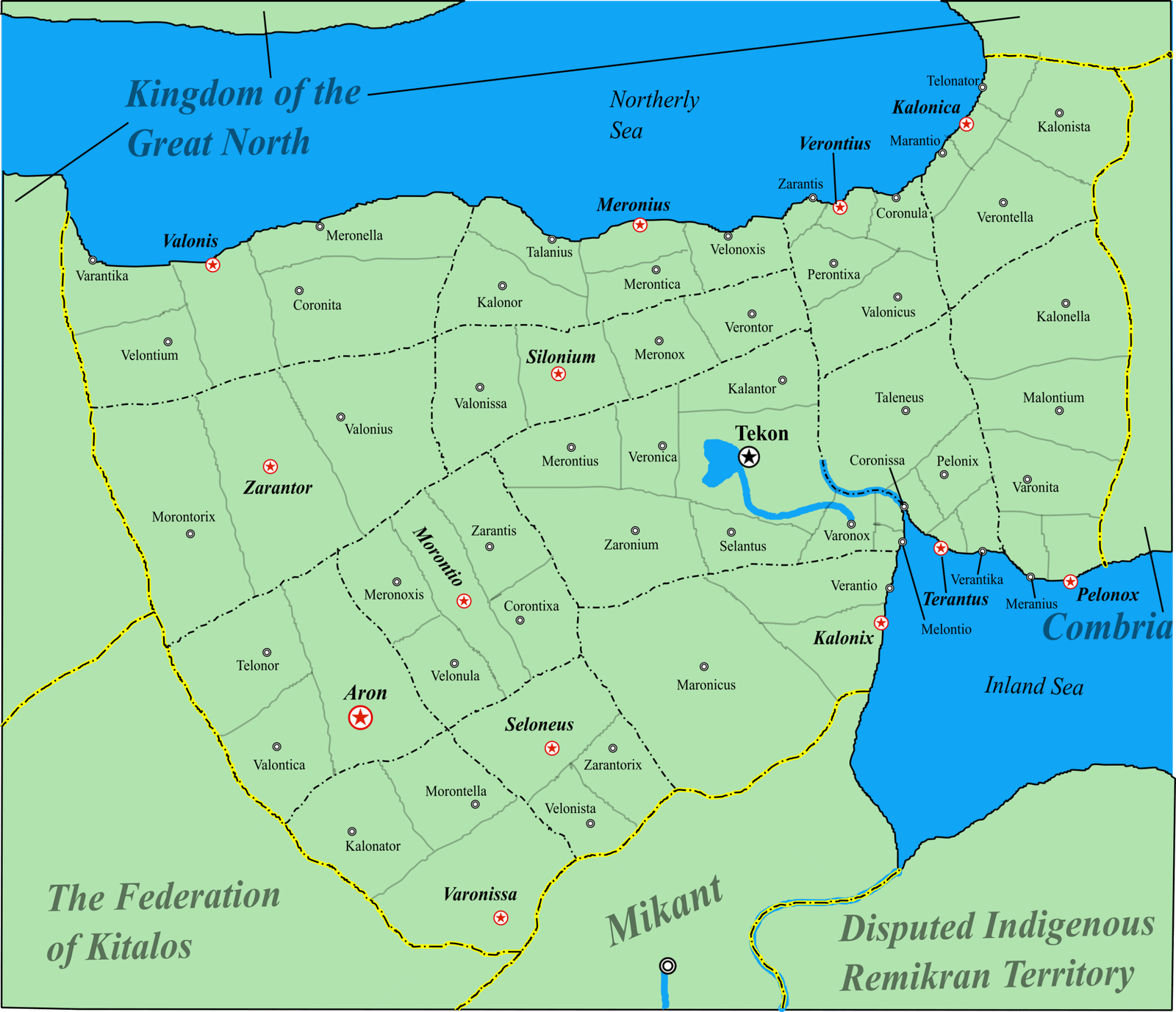
Introduction
A typical October day in Tekon, the Imperial Capital of Wannonia, consisted of clear days and clear nights, with the latter illuminating the vast network of streets below with starlight and the glow of Juno Major. Day and night, the landscape throughout the region was silent, broken only by the sounds of harvest in the vast flaxweed fields and the noise of daily business in the Imperial City. The air would be cold, crisp, and dry, in contrast to the wet weeks of the late summer rainy season. The region smelled of autumn leaves in the countryside, along with the faint smoke of the urban centers. All of this left one with a feeling of satisfaction after a successful yearly harvest.
Absolutely nothing of that atmosphere existed on 17 October 1176, however. This day, the sky was orange and filled with thick, dark smoke. Tekon was filled with the sounds of war, death, and chaos. From a distance, another orange glow emerged, growing with every passing moment.
Every Wannonian within the city gates felt dread, for they knew the world they knew was coming to an end.
The popular myth was that the Great Fire of Tekon came in the night. In fact, the inferno leaped the gates of Tekon just after 1:00 PM.
Believed to have been caused by dry lightning a few miles south of Lake Maern, the wildfire "superstorm" would be blown by prevailing Northeasterly winds toward the Imperial Capital. Many thought that the Westrunning River would stop the blaze. However, in a short time, the embers leaped the banks and started new fires on the other side.
Tekon was known for its vast stone structures, but those only stood in the center of the capital, and accounted for less than ten percent of the dwellings. Everything else was built from wood. Thus, within hours, Tekon would be virtually nothing but smoldering wreckage.
This was a devastating tragedy, for many things were lost, including ancient structures dating as far back as the 700s BCE, as well as historic pieces of literature, spellfire scrolls, family heirlooms, and other valuables.
On 4 April 1177, nearly six months later, a little fall of rain finally broke the decade-long drought in the Lake Maern region. But down below, Tekon was no more. A desolate, ash-filled urban wasteland replaced its streets and buildings, and the Empire it governed for nearly two thousand years had been swept away from existence.
In the year preceding the Great Fire, many had stayed in the vast Imperial Capital, clinging to hope for Wannonia's future by siding with one of five militarized factions vying for the Imperial Throne. But the Great Fire dashed those hopes. Everyone who could do so fled. Many Wannonians fleeing to the North Coast gathered to establish a settlement on the future site of the Retunian city of Ligam. Meanwhile, militant groups spread outward across the Plains of the dead empire, continually scavenged the landscape for food and resources, and fought other factions for territorial control.
This leads to one very important question: How could Tekon, at one point the most powerful city in the Ancient Circlarian Realm, controlling a vast Empire that, at its peak, exerted influence across the Circlarian Ocean, vanish in fire, smoke, and ash?
712 BCE: The Foundation of Wannonia
In June 712 BCE, the Order of Tekon, formed by numerous figures opposed to the West Totian Empire, gathered in the city of Maern and held a special ceremony of diplomacy that began with the breaking of bread and the sharing of wine. Later that evening, they assembled and voted to have the people they led, as well as the city of Maern, the city of Tecere, and all surrounding territories, proclaim the establishment of the Republic of Wannonia. This began a war with the West Totian Empire, which Wannonia won, leading the Totian Empire to withdraw and the Wannonian Republic to grow.
A Brief History of Wannonia
Spanning Middle Remikra between the North Coast and the Magnumarian Shield, and reaching the coast of the Inland Sea, the Republic of Wannonia was, ultimately, the last remaining nation whose official language was the ancient Circlarian tongue of Aerdn, and an elected Senate governed it. This Senate presided over Provinces and local jurisdictions, each with its own democratic government. The Clergy carried out judicial power through a hierarchical organization. Peace was kept by five Legions, numerous Provincial Legions, and numerous local defense forces. Meanwhile, elections were carried out every September.
Early on, Wannonia enjoyed a free-trade economy, a large middle class, de facto religious freedom, and a consistent network of transit and communication, including its famed canal network. Issues down the road, such as slavery and the flaxweed industry's economic hegemony, would prove controversial in perpetuity, and Wannonia would be forced to fight and defeat Totian Emperor Kylan in 681 BCE. Nonetheless, Wannonia would enjoy a long period of peace and prosperity, including a brief period in which Wannonia claimed territories in Canticula.
As the years passed, however, the Wannonian government became increasingly hierarchical and nepotistic. Its institutions grew increasingly authoritarian, with higher officials appointing lower officials, including representatives, rather than filling posts democratically. In 558 BCE, Marius Cartus became Head Consul Commander, a newly created executive office over Wannonia. They appointed new figures to the Senate, which in turn voted to suspend itself indefinitely. In 537 BCE, a popular figure named Korladi, after navigating the government in Tekon to his favor, became the first Emperor of Wannonia. Though Wannonia would withdraw its influence in Canticula not long after, Wannonia, from this point forward, was arguably considered an Empire.
Standing in the heart of Middle Remikra as one of the most powerful nations in the region as well as the Circlarian Realm, Wannonia would see over 1500 years of varying degrees of prosperity and resilience, sustaining such challenges as plagues, climate change, political instability, Imperial Throne challenges, territorial gains and losses, and variable diplomacy with its neighbors. Around the 700s to 800s CE, the Edoran Kingdom began to surpass Wannonia in terms of industry, trade, and military technology.
To counter this challenge, Wannonia joined forces with the Kingdom of Moorland and, in 985, invaded the Edoran Kingdom and its ally, the Linbraean Kingdom. Wannonia and Moorland hoped to subjugate both Kingdoms, while Wannonia hoped to return to the greatness of its past. However, in 991, the Linbraeans and Edorans pushed back, defeated the Wannonians, and forced them to sign harsh territorial and trade concessions.
Thus, from the 990s to the 1170s, Wannonia went through its autumn years, forced to comply with tight restrictions on trade, particularly maritime trade.
Tensions Between Wannonia and Combria
By the early twelfth century, growing sentiment emerged, yet again, for Wannonia to return to greatness. Emperors Clastye I and Clastye II capitalized on this, with the latter succeeding the former in 1150. In 1135, Arthur Chadwick, President of the neighboring nation of Combria, invaded and conquered Jurango. However, in the process, Combria incurred high costs, leading Chadwick to call upon Wannonia for both loans and military aid (as the Great North deemed Chadwick's invasion illegal). Wannonia obliged after Chadwick agreed to high interest rates on the loans and promised to give some Jurangan territory to the Wannonians, as well as help restore the trade and influence Wannonia had lost since the 990s. With Wannonia's aid, Chadwick defeated Jurango. However, Chadwick then backed out of his promises and repayment, leading to tension between Combria and Wannonia.
The Combria-Wannonia War
In the years that followed, the two nations engaged in back-and-forth diplomatic friction. Beginning in 1142, Wannonia began arming itself and erecting a border wall while Combria did the same. In 1144, Chadwick and Wannonian Emperor Clastye I signed a fragile peace agreement to reduce such armaments. However, in 1150, Clastye I died and was succeeded by Clastye II, who ignored the 1144 agreement and began exacting heavy tolls on travelers from Combria to compensate financially for Jurangan territories denied to Wannonia. Chadwick responded by tightening border entry measures. In 1151, Clastye II continued militarizing both Wannonia and its border wall, and demanded that Chadwick deliver on the former Jurangan territories. Instead, Chadwick sent more Combrian forces to the border. Further North, at Null's Edge, Wannonian and Combrian forces clashed, as Chadwick's forces struck first, beginning the Wannonian-Combrian War.
Initially, for most of the war, which lasted from 1151 to 1164, Chadwick had military superiority. However, toward the end, Wannonia deployed military upgrades, which drove Chadwick's forces out of Wannonia. And in October 1164, Wannonian forces invaded Combrian territory. Chadwick, being denied aid from the Remikran Union, surrendered to the Wannonians on November 2 of that year and signed a treaty, which allowed Combria to keep all of its pre-war territories but required Combria to pay reparations to Wannonia.
Combria may have been defeated by Wannonia in 1164, but not before Chadwick deployed a special air force unit to drop Flaxweed Blight spore specimens on flaxweed crops in Southwest Wannonia. This would sow Wannonia's downfall in the years to follow.
The Downfall of Wannonia
In September 1164, just before Combrian forces retreated out of Wannonia, Combrian President Arthur Chadwick ordered the deployment of a special air task force, which dropped exploding containers over remote flaxweed plots in Southwest Wannonia. Each container held a specimen of Flaxweed Blight spores, which, parasitic in nature, would infect and kill flaxweed plants by sapping water and nutrients. Ironically, unlike other blights, molds, and fungi, Flaxweed Blight thrived best in semi-arid climates like that in the region because it could spread more easily in this environment through the rapid release of floating spores.
The impact was minimal at first. Only three plots of flaxweed farmland were affected, and all within the borders of the County of Kalonator. Nevertheless, as a precaution, the government of Kalonator proper banned Wannonians from the affected townships from entering city limits. And farmers would combat the Blight by burning affected crops. Meanwhile, news of this spread as wild stories heard in the streets of Aron and Tekon, though the matter was never taken seriously at first. In Aron, flaxweed prices rose slightly, but Tekon felt no such impact. The Imperial government in Tekon opted to leave it to local authorities to deal with the issue.
The year 1165 saw the problem significantly worsen. Between May and September of that year, during the flaxweed growing season, the Blight destroyed crops throughout the Counties of Kalonator, Valontica, Aron proper, Morontella, and Varonissa proper. Many farmers fled those regions, seeking better land Eastward or a better life in the Imperial capital. However, fearing their migration would spread the Blight (a fear later justified), the Imperial government in Tekon intervened, locking down the Provinces of Aron and Varonissa. Under such measures, no one was allowed in or out of the affected Provinces. Locals rebelled against the measures, but Tekon intervened brutally. Meanwhile, scientists that year discovered that burning infected flaxweed plants actually helped the Blight to spread. Heat from the fire would put a given Blight spore in distress, during which it engaged in a special survival mechanism by rapidly releasing as many spores as possible. Furthermore, because the Blight sapped their water, affected flaxweed plants were drier than healthy ones, making them more susceptible to burning.
Scientists also discovered that Blight spores could not survive underwater, so Tekon ordered walls to be built around Blighted areas and each enclosed area filled with water. Furthermore, Tekon outlawed the burning of Blighted crops and imposed prison time for violators.
Meanwhile, flaxweed and flaxweed-made goods, including food, fuel, and essential materials, began to rise in price, to the point that the Wannonian economy began to experience inflation. The vast costs of the aforementioned proper water-pool Blight containment measures compounded this. The Imperial government had to pay soldiers and law enforcement troops to enforce bans on crop-burning; draw large amounts of water from nearby sources to fill the water-pools; and pay laborers to construct the water-pools.
Relations between Wannonia and the Kingdom of the Great North had been frosty since the 1000s, though not hostile. Furthermore, the Great North had sided against Chadwick during the Wannonia-Combria War; thus, Wannonia hoped the Kingdom would aid it in addressing the growing crisis. So in October 1165, Wannonia reached out, and the Great North responded by offering five-year loans to the ailing nation, with repayment set at fifteen percent interest. With no other viable options, Wannonia agreed.
In 1166, with more financial backing from the loans, the Wannonian Imperial government was better able to enforce quarantines and Blight containment measures, slowing inflation and the Blight's spread. That year, the Blight destroyed flaxweed crops only in Kalonator and Valontica, while Wannonian lands elsewhere had normal growing seasons. Nevertheless, as a precaution, the Provinces of Aron and Varonissa remained locked down.
The year 1167 saw the Blight destroy crops throughout Kalonator, Valontica, Telonor, and Morontella; thus, the Provinces of Aron and Varonissa would remain locked down.
In 1168, the Blight destroyed crops throughout Telonor and Morontorix. Being outside the locked-down Provinces, locals in Morontorix fled the region for better prospects Eastward. Not long after, the Province of Zarantor came under lockdown. Meanwhile, the lockdown would remain in the Province of Aron while the lockdown was lifted for the Province of Zarantor.
Then, in April 1169, the Great Drought began.
With the ongoing Drought, the rains became less or absent altogether. This, combined with the dehydrating effects of the Blight, made flaxweed crops throughout Wannonia especially susceptible to wildfires, which dry lightning from thunderstorms sparked as rain clouds evaporated in the dry air. Such wildfires would accelerate the Blight spread, thanks to the aforementioned survival-distress reproduction mechanism. And the smoke from these fires would trigger more dry lightning, starting even more fires. Hence, a vicious cycle would emerge.
With this in action, the Blight, during the growing season of 1169, destroyed flaxweed crops throughout the Counties of Varantika, Velontium, Morontorix, Telonor, Valontica, Kalonator, Varonissa, and Aron. This was followed by wildfires that destroyed blighted crops throughout Kalonator. Under Tekon's orders, the Provinces of Zarantor and Aron remained under lockdown while Tekon locked down the Provinces of Valonis and, once again, Varonissa. This sparked local uprisings in the affected provinces, to which the Imperial government, once again, responded with brutal crackdowns.
This time, however, an outspoken Wannonian commander named Heron Blasia came forward and rallied the locals to his cause, citing grievances against the Imperial government and declaring that locals should have the right to freedom of movement and the right to decide whether to burn Blighted crops. The Provinces of Walonis, Zarantor, Aron, and Varonissa declared Heron the new Emperor of Wannonia. The incumbent Emperor, Clastye II, declared this an insurgency and vowed war on Heron and his forces.
From this point forward, the Imperial government, too preoccupied with this open rebellion and many more to come, stopped enforcing quarantine and containment measures.
On 7 October 1169, Wannonian forces under Clastye II clashed with forces under Heron in the Plains West of Tekon, beginning a civil conflict. Shortly thereafter, the Province of Morontio declared for Heron. Clastye II's forces clashed with Morontian forces at Zarantis, which Clastye II would capture before making way for Morontio proper.
At this point, however, Endro Morix came forward. From the Northwest region of Wannonia, Endro cited grievances over exploding prices for flaxweed and flaxweed-made goods, rising taxes, and increased conscription into the military amid the crisis in the West. In November 1169, the Provinces of Verontius and Kalonica declared Endro the new Emperor of Wannonia and began an additional open rebellion. This forced Clastye II to withdraw Imperial forces from Morontio and address the new crisis.
Meanwhile, the Wannonian canal network, essential to trade and travel throughout the nation, came under strain as containing the Blight required vast amounts of water. Between 1165 and 1168, local governments, particularly from the Southwestern regions of Wannonia, allowed for water to be drawn from local canal networks, as the region was usually semi-arid. This caused only minor inconveniences, as local traders and travelers were forced to use Wannonia's road system, which was notoriously inconsistent and poor quality. In 1169, with water sources nationwide depleted thanks to the onset of the Great Drought, the Imperial government in Tekon mandated that all local canal networks be tapped for Blight containment. This weakened local economies, leading to mass migrations and, later, uprisings.
By the end of 1170, all national and local canal routes were drained, leading to nationwide economic collapse.
Both the crisis in the West and the crisis in the Northeast brought Tekon to a standstill, as all sides suffered massive casualties. Furthermore, the fighting posed additional wildfire risks and further strained food, water, and other resources.
In March 1170, Tekon began imposing rations on such staples.
Between May and September 1170, the Blight destroyed crops throughout the Counties of Telonor, Valontica, and Kalonator, while Valontica saw a large portion of the wildfires. Although this was smaller than the Blight and Wildfire damage the previous year, it, combined with the ongoing wars, led Wannonia to default on its loans from the Great North in October. In response, the Great North cut off further credit to Wannonia, leading to the complete collapse of Blight containment infrastructure and straining military resources.
The two crises continued through the year 1171, during which the Blight unleashed its most destructive outbreak yet, wiping out crops throughout the Counties of Varantika, Valonis, Velonium, Morontorix, Zarantor, Telonor, Aron, Valontica, Kalonator, and Varonissa. Of those areas, wildfires destroyed crops throughout Valontica and Kalonator.
In October 1171, there emerged a Wannonian figure named Morsico Ren, who was declared Emperor (nicknamed "Emperor of the Bridge") by the Provinces of Terantus and Pelonox.
Up to this point, Emperor Clastye II had censored news of the Imperial pretenders from the public. However, in 1172, seeing an advantage, Clastye II relaxed censorship of news about Morsico and Endro and, after planting false information, caused the two pretenders to turn against each other. Leaving them to fight it out, Clastye II withdrew his forces from Morsico and Endro, and sent them back to Heron's forces in the West. Soon, Clastye II's forces moved in and captured Morontio. It was only after this point that Clastye II's forces were slowed by Heron's.
Between May and September 1172, the worst Blight outbreak yet occurred, destroying flaxweed crops throughout the Provinces of Valonis, Zarantor, Aron, and Varonissa, as well as the Counties of Talanius, Kalonor, Valonissa, Meronoxis, Valonula, and Velonista. Meanwhile, wildfires destroyed Blighted crops throughout the Counties of Telonor, Valontica, Kalonator, and Morontella.
In March 1173, Morsico and Endro came to a diplomatic compromise and united their forces against Clastye II. Soon after, Morsico and Endro would be joined by the Province of Meronius.
Between May and September that year, the Blight destroyed crops throughout the Provinces of Valonis, Meronius, Zarantor, Silonium, Aron, Morontio, Varonissa, and Seloneus, as well as the Counties of Kalantor, Veronica, Merontius, Zaronium, and Maronicus. The year 1173 also saw the first recorded wildfire "superstorm," which destroyed the large domestic trading hub of Aron proper and drove Heron's forces Eastward. Meanwhile, lesser wildfires destroyed crops throughout the Provinces of Aron, Valonis, Zarantor, and Varonissa as well as the Counties of Talanius, Kalonor, Valonissa, Meronoxis, Velonula, and Velonista.
In response, Emperor Clastye II locked down the borders of the Tekon Imperial District to protect and prioritize the interests of the Imperial Capital, leaving the rest of Wannonia to fend for itself.
During the growing season of 1174, the Blight destroyed crops throughout the Provinces of Valonis, Meronius, Zarantor, Silonium, Aron, Morontio, Varonissa, Seloneus, and Kalonix as well as the Counties of Selantus, Varonox, and Melontio. A second wildfire superstorm destroyed Zarantor while lesser wildfires ravaged the Provinces of Valonis, Zarantor, Morontio, and Kalonix, as well as the Counties of Melontio, Varonox, and Selantus.
In June 1174, Heron called a conference between Morsico and Endro, during which they formed a plan to topple Clastye II and his regime by inspiring an insider within the Imperial District to stage an insurgency as a distraction. Heron, Morsico, and Endro would then mobilize their forces to topple Tekon and overthrow Clastye II. Heron, Morsico, and Endro planned to hold an election afterward to choose the next Emperor, the three of them putting themselves forward as candidates.
On 6 September 1174, they carried out the plan. Lyfall Norum was the appointed insider, who rose within the Imperial District and proclaimed himself Emperor of Wannonia, in accordance with the plan. Clastye II sent forces to put down this rebellion. That was when the forces of Heron, Morsico, and Endro moved in, easily crossing the borders of the Imperial District and reaching the city gates of Tekon in a short time. Also with ease, they overcame the City Watch and stormed through the gates, only to be met with resistance by the Imperial Guard, led by Mirium Gondin.
The Imperial Guard would hold the invaders at bay until 7 September 1174, when an unknown assassin killed Emperor Clastye II. As a result, the Imperial Guard's morale collapsed, allowing the combined forces of Heron, Morsico, Endro, and Lyfall to move in and overtake the Palace. This drove the Imperial Guard into the neighboring Market District.
However, when Heron, Morsico, and Endro announced their planned Imperial election, Lyfall voiced contempt against this and continued to press his claim as the next Wannonian Emperor. This led to brutal infighting over the next two years.
Between May and September 1175, the Blight destroyed flaxweed crops throughout the entire Imperial Province as well as the Provinces of Valonis, Meronius, Zarantor, Silonium, Aron, Morontio, Varonissa, Seloneus, and Kalonix. This final outbreak, the worst outbreak of the period, led to the collapse of the flaxweed industry and the extinction of the flaxweed plant altogether.
Meanwhile, in Tekon during that same period, Lyfall rallied his forces against Heron, Morsico, and Endro in an act of open rebellion. Before the Imperial election could take place, Lyfall's forces overtook the Palace. However, Mirium's forces soon pushed Lyfall's forces out. Lyfall ran to Heron, Morsico, and Endro, suing for peace and asking for help. Morsico agreed to forgive Lyfall and join forces, but Heron and Endro, refusing to agree with Morsico's decision, deemed Morsico a traitor and turned against both him and Lyfall. Thus, conflict erupted, and the conjoined forces of Meron and Endro drove out Morsico and Lyfall's forces and retook the Palace. Morsico and Lyfall's forces would, in a short time, strike back and retake the Palace.
At this point, a conflict of interest led to in-fighting between the forces of Morsico and Lyfall. Meanwhile, Heron and Endro placed the Palace under siege, but were, in turn, attacked by Mirium's Imperial Guard, still camped in the Market Square. In response, Heron crafted a plan of resistance, but soon Endro accused Heron of placing Endro's forces unfairly on two front lines between the Palace and Market Square; as a result, Endro's forces refused the orders. Heron responded to this with the kidnapping and killing of top commanders in Endro's forces. The remainder of Endro's forces retaliated, giving birth to another internal conflict.
Such conflicts ravaged the streets of the once peaceful and prosperous Imperial Capital well into 1176. In April of that year, Mirium's Imperial Guard bypassed the forces of Endro and Heron and invaded the Palace. Faced with a common threat, Lyfall and Morsico set aside their ongoing conflict and moved to unite, but it was too late; Mirium retook the Palace. In May, Lyfall and Morsico renewed their hostilities against the forces of Endro and Heron. In this assault, Heron himself was killed. Morsico and Lyfall hoped to overcome Endro in the same way, but in that confrontation, Lyfall was killed. Afterward, Morsico offered peace to Mirium; they united and killed Endro while subjugating his forces. But then, another conflict of interest emerged between Morsico and Mirium, leading to back-and-forth possession of the Imperial Palace until October 1176.
Between May and September 1176, wildfires destroyed land and property throughout the Provinces of Varonissa, Aron, Seloneus, Morontio, and Kalonix, the latter of which would be destroyed by a wildfire superstorm in June of that year. And in September, Aron fell victim to yet another wildfire superstorm.
On the night of October 16 and 17, 1176, multiple wildfires broke out Southwest of Lake Maern. A branch of one moved South and destroyed Selantus, while the others converged and formed another wildfire superstorm. This superstorm, between 9:00 AM and 12:00 PM on October 17, was found to be moving northeast and set on a course to miss the Imperial Capital. However, embers blown by the prevailing Northeasterly winds landed on parched land just before the Westrunning River and started smaller fires. In short time, these merged and formed a larger inferno, which sucked in the energy of the larger superstorm to the South and pulled it toward the River and the Imperial Capital, accelerating in its spread. Minutes before 1:00 PM, the wildfire superstorm leaped the banks of the Westrunning River; minutes after the top of the hour, it burned through Tekon's city gates and began igniting the wooden dwellings within.
As mentioned before, most structures in Tekon were wooden; and so were its goods and assets. The firestorm destroyed everything, including homes, shops, businesses, smithies, libraries, spellcrafting repositories, and churches. Some people in Tekon believed the stone structures in the center of Tekon, like the Palace, would protect them from the inferno, and so sheltered there. However, when it arrived in this district, the fire destroyed the stone structures' interiors and wooden components. Most people sheltering within would perish. Though much of the Palace was destroyed along with its archives, a sealed stone chamber below, containing important books, manuscripts, and spell-crafting materials, would survive.
Meanwhile, those having more wisdom than to believe in such myths as stone structures or rivers offering fire protection evacuated Tekon as early and quickly as possible. Many followed Mirium, who fled Northeast and established numerous makeshift settlements along the North Coast. These settlements were intentionally established in hidden places to avoid the rival militant factions that would emerge throughout the former Wannonian territories after Wannonia's downfall, and to remain largely hidden from Combrian settlers in the years to follow. One of these settlements would evolve into the compound of Hetia, which would develop into the Retunian city of Ligam in the distant future.
Over the settlement that would become Hetia, Mirium would be made the governor-general, a post he would hold until his peaceful death in 1207.
Meanwhile, Morsico led his followers out over the Plains to scavenge for food and resources. Along the way, numerous sub-factions broke off and challenged Morsico as resource disputes arose. In 1178, during one of these confrontations, Morsico was killed, after which the sub-factions would turn on each other in open conflict. These factions would also fight other Wannonian groups from leftover communities throughout Wannonia.
By the end of 1176, all of Wannonia was a desolate wasteland, and nomadic militant Wannonian groups continually fought over its scant, dwindling resources. Most Wannonian towns were abandoned and, in a short time, were wiped from existence by uncontrolled wildfires or the elements. The flaxweed plant, killed by fire or the Blight, became extinct.
Restoration of the Lands Left Behind
Throughout the 1180s and 1190s, these nomadic groups became increasingly united under the infamous bandit leader, Desterran Korabi, who began carrying out coordinated attacks and robberies against rival nomadic groups as well as cross-continental travelers from Combria and the Great North. The Great North initially responded by deploying special peacekeeper units. The emergence of civil unrest in the Great North around 1200, however, forced these peacekeepers to withdraw, emboldening Korabi's forces.
However, Combria invaded the region on 13 October 1201, ending Korabi's reign of terror. Afterward, the dead flaxweed fields were sown with special minerals and fertilizers, and permanent Combrian farmers later settled them, dedicating them to crops such as wheat and corn.
Meanwhile, the ruins of Aron would be rebuilt into the city of Maryk, and the Plains of Middle Remikra would serve as a new breadbasket for Combria, and later on, the Retunian Republic.