Introduction:
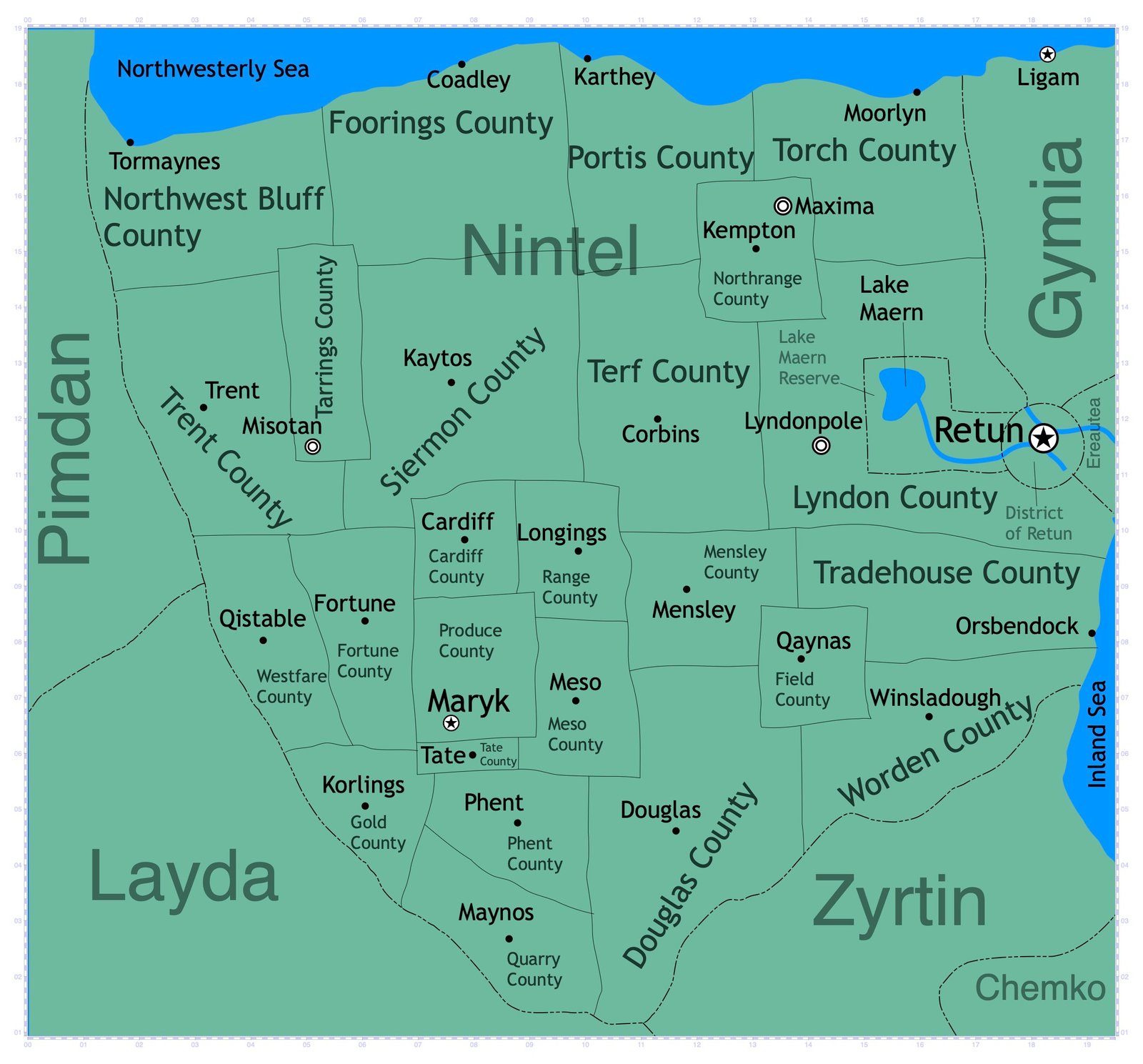
Less than 100 miles from the West Kalledon Garden Reserve, the remnants of a large fence stand, towering over the varied landscape and surrounding what was once called the Lake Maern Reserve.
Within the former Reserve stands the beautiful urbanscape of Pallenmore, the capital of the Republic of Maerna, which includes the Government District of Hilltop along with the various waterfront districts, marked most significantly by the Willows, a high-end restaurant. Across the street stands the Willows Amphitheater, a frequent venue for concerts and other events. And adjacent to Pallenmore lies the vast and pristine waters of Lake Maern.
The shores around Lake Maern were once a place of mystery, and, for a time, made up an attractive national park under the Chartered State of Combria. Environmental preservation has always been a priority here, but the area has seen societal growth. Boats here traditionally serve trade and transit routes that come to a crossroads at Planks Isle, located in the center of the Lake. Meanwhile, surrounding the Lake is a greenway, in the center of which runs a bicycle path. This was once home to the towering fences and concrete walls of the Mount Carris Perimeter.
This, of course, leads to the question: What was the Mount Carris Perimeter?
Early Life of Holz Finzi:
Arguably the most important person in the history of the Mount Carris Perimeter was Holz Finzi. Born on 8 June 1226 in Westport, Ereautea (along the St. Eschel River in the present-day Maernian province of Odey), Finzi was observed, at an early age, to demonstrate extreme intelligence, as well as a mysterious capability to engage in spellcrafting and grow a garden of plants and vegetables, using just his hands. Though such an innate gift was remarkable, this presented issues for Finzi's parents, who worried about the legal liabilities of allowing an individual under the age of 18 to practice spellcrafting (illegal under Congress of Circlaria international law). Finzi was also unable to focus on the rigid Combrian education curriculum taught to him and his peers, while also being unable to resist demonstrating his gift publicly. Numerous behavioral modification approaches failed to address these issues.
In 1235, his father's job transferred the Finzi family to the Ereautean town of Ebony Valley (present-day Menderae, the provincial capital of Odey), where the young Finzi was made to enroll in a new school. Here, a school psychologist intervened and diagnosed Finzi with Involuntary Darkfire Conjuration Syndrome, or IDCS. At the time, mainstream Combrian society shunned individuals with this "affliction," believing that darkfire "controlled the mind" (Later on, experts confirmed that at its worst, darkfire only creates alternative neural energy channels that indirectly influence emotions.). Combrian society also believed that darkfire "resurrected the dead" (It only restores strength in weakened living things.), and that darkfire-crafters were either reckless or morally corrupt.
Therefore, both society and the medical community believed that IDCS was best treated through a form of "conversion therapy," a practice that had, since after this period in history, been deemed an unethical practice due to the harm inflicted on patients. Nevertheless, in spring 1237, Finzi was sent to a special residential facility for this kind of treatment. Here, he met Monyka Raeam, who warned him that some residents were forced into extraction therapy, the most brutal form of conversion therapy, and often deadly. It was at this moment that Finzi realized that society's view on darkfire conjuration was wrong and oppressive. In the course of this realization, he and Raeam formed a conjoined philosophy that darkfire conjuration was, in fact, a practice that served important life purposes such as the growing of food; thus, Finzi gained affirmation that his ability was a gift, indeed, rather than an affliction.
Together, Finzi and Raeam stole journals, from which they learned about a massive darkfire quarry under the Lake Maern National Park and Mount Carris region. After careful planning, Finzi, Raeam, and seventeen other patients escaped the residential facility and secretly traveled to Mount Carris. On the slopes of Mount Carris, they planted seeds they brought with them and established a system of food and agriculture. They then established other basic infrastructure such as water and shelter. During this period, they discovered the darkfire-crafting talents of Finzi as well as themselves, and were able to work well with the underlying quarry. Thus emerged a famous quote reportedly stated by Finzi: "Give to the quarry, and the quarry will give to you."
Upon hearing of these deeds, Finzi's parents formally disowned him.
In the summer of 1237, after one of Finzi's largest works of darkfire conjuration thus far, Mount Carris discharged a large cloud of darkfire xelox. Though harmless, the incident triggered panic across the Chartered State of Combria during which two revolutionary figures in New Hasphitat (later named Retun) were blamed, prosecuted, and executed, thus sparking the Retunian Revolution in 1238. During this conflict, Combria attempted to send deployment units into the Lake Maern region; however, Finzi's darkfire defenses caused inflicted the troops with mind disorientation. Later on in the conflict, the short-lived nation of East Wannonia attempted the same thing, only leading to the same results. Thus, Finzi and his followers survived the conflict.
The Lake Maern Region - 1237 to 1257:
Dating as far back as the 1220s, well before the arrival of Finzi, already stood numerous encampments established by far-left Combrian figures around the Lake Maern region. Between 1237 and 1243, however, the number of such encampments increased manyfold, lining the north, south, east, and west shores of the Lake. This was the result of many individuals with IDCS, who had been inspired by the story of Finzi and Raeam, having escaped their environments to join what became known as the Greater Mount Carris Community. And they did so through an underground system, which included concealed boats, submarines, and airships.
In 1243, Finzi, Raeam, and other leaders of the Greater Mount Carris Community signed and enacted a constitution known as the Order of the Mount Carris Mode of Governance, which established an organized government structure as well as an agenda of promotion. Within the government structure, housed initially in informal compounds on the eastern slope of Mount Carris, Finzi would serve as the Head Conjurer and Chief Advisor, while executive roles were vested in a Consul, elected every year, who presided over a group of lesser advisors. Meanwhile, the legislative role was fulfilled by a Council consisting of members elected on a yearly basis, who were presided over by a Council Leader, also elected yearly. Fulfilling the judicial role was a Tribunal of Arbitrators, each of whom was elected to serve for life unless a petition or unexpected circumstance caused their vacancy. Meanwhile, each group of encampments was assigned a jurisdiction over its surrounding land, with such land called a Canton and the head encampment called a Compound. Each was run by a smaller regional government of similar structure, elected but usually led by darkfire cartel leaders on a de facto basis.
The main agenda of the Greater Mount Carris Community was for Finzi and Raeam's philosophies to spread as far abroad as possible, teaching new darkfire communities and their allies five main provisions: that darkfire-crafting is not innately morally corrupt, that society had been wrong to propagate it as such, that one must give to their respective darkfire quarry in order for the quarry to give back to them, that all must push for societal acceptance or societal reform (or replacement), and that the overall agenda must be carried out by an organized system of Promoters. Such Promoters would trade darkfire byproducts in secret and recruit followers, both institutionalized and abroad.
The 1257 Conflict:
Throughout the Early Retunian Republic during the 1240s and 1250s, leaders and citizens alike were very much opposed to the practice of darkfire engagement, thanks to a charismatic radio host named Reonard Chaney. In 1243, the Retunian Civil Guard was established, initially assigned to subdue the compound-canton system of the Greater Mount Carris Community. Such Cantons and Compounds proved resilient, though, re-establishing themselves after every raid.
However, within the Greater Mount Carris Community, there emerged a rival named Wain Berron. Priding himself as a darkfire ranger in his ability to master multiple darkfire quarries simultaneously, Berron grew jealous of Finzi, vowing to take back the Lake Maern Darkfire Quarry. On 23 October 1252, Berron attempted to overthrow Finzi's democratic government, while also triggering the Quarry to "reset" in order to remaster it. The trigger succeeded; however, Berron failed in his attempt to overthrow Finzi, who had him imprisoned. In December 1252, Finzi offered to release Berron and have him serve one of the Cantons in the Southwest part of the Mount Carris region, where he was popular. Having lost everything, Berron agreed to this arrangement, and would elected as a leader in this area.
On 22 January 1257, after a sophisticated experiment led by Finzi, Mount Carris released the largest darkfire discharge yet, sending a harmless darkfire cloud that traveled as far as both North Kempton and the Basin District of Retun. This triggered a nationwide panic; and between January 23 and 24, the Retunian Civil Guard responded with a raid into the southwest portion of the Mount Carris region, where they confronted both Finzi's disorientation measures and forces under Wain Berron. On 1 February 1257, Berron retaliated with an attack that destroyed Retunian Civil Guard encampments just outside the Mount Carris region. Finzi ordered Berron to stop with this counterattack, but Berron refused. In response, Finzi launched forces against Berron. And on February 2, Berron retaliated with forces that drove those of Finzi up the Mount Carris summit toward Finzi's personal compound. On February 3, the Retunian Civil Guard launched reinforcements, which shot and killed Wain Berron; meanwhile, the Retunian Civil Guard blamed Finzi for Berron's actions, launching a counterstrike against Finzi's forces and Berron's holdouts alike.
On 4 February 1257, James Black, the incumbent Prime Minister of the Retunian Republic, called for a cease-fire and a subsequent peace conference.
The Establishment of the Mount Carris Perimeter:
At the conclusion of the peace conference in late February 1257, both the Retunian Republic and the Greater Mount Carris Community signed a document known as the 1257 Compromise. This Compromise drew an official border around the region immediately surrounding Lake Maern and Mount Carris, establishing an independent political enclave known as the Mount Carris Perimeter. As part of the Compromise, Finzi and those of his allies with IDCS were forbidden to leave the Perimeter, while individuals with IDCS outside the Perimeter were forbidden to enter. Meanwhile, per the Compromise, any person not afflicted with IDCS, inside or outside the Perimeter, was allowed to travel into and out of the Perimeter, provided that the individual could pass a medical and criminal background check as well as pass security screenings on either side of the border. Any history of interaction with darkfire cartels was an automatic disqualification in that case. And the most important provision of this Compromise was the establishment of a strict no-fly zone spanning the Perimeter and a surrounding land area ten miles from its edges, to be enforced by a no-warning missile strike system.
Initially, the Perimeter border was lined with no fence or physical barrier except for near high-traffic routes. However, after a considerable amount of lobbying from conservative evangelist groups, the Retunian Council passed a budget, in 1259, for the funding and construction of a border wall. The measure would be signed by Prime Minister James Black shortly thereafter. Construction would begin on 2 May 1261, after Edward Jackson became the next Prime Minister, and would be completed by 2 September 1262. The Wall, made of reinforced concrete, stood 50 feet tall and 100 feet wide. And this barrier would stand until the year 1309.
Within the Perimeter, major constitutional reforms would soon take place. In 1264, such reforms, upon the advice of Finzi, called for significant restructuring of the Mount Carris government as well as the building of venues to support its institutions. Soon to be housed in the new Abode near the top of Mount Carris, Finzi would serve as the Head Conjurer and Chief Advisor as well as the Leader of the Darkfire Tradestone Market. Housed in the High Manse, located above the Cathedral along the eastern slope of Mount Carris in what would become the municipality of Carris-Pier, a Consul, elected on a yearly basis and tasked with presiding over a Cabinet, would serve executive functions. The Assembly Hall, located in what would become the Hilltop District of North Bank, would house the legislative branch, which would consist of an elected Deputy-Consul presiding over the Upper Chamber, populated by two representatives from each newly-restructured Canton, and a Speaker of Council, who presided over the Lower Chamber, filled by 100 representatives elected yearly by rank-voting. And located in a new Hall of Justice in what would become South Wendel, three Justices, presiding over one lesser Justice for each Canton and working along a parallel hierarchy of Arbitrators, would serve judicial functions.
To note, all public offices within the Mount Carris Perimeter were elected to one-year terms with no term limits. The exceptions were the Justices and Arbitrators, who were elected to lifetime positions.
Meanwhile, the Mount Carris Perimeter was divided into five Cantons: Canton West, whose capital was Carris-Pier, Canton North, whose capital was Wendel, Canton East, whose capital was North Bank, Canton South, whose capital was South Wendel, and Canton Center, whose capital, this one spanning the entire Canton, which was the smallest Canton of the five, was Planks Isle.
Each Canton adhered to a uniform type of government structure, in which the executive branch consisted of three elected Commissioners, which included two Regular Commissioners plus a Chief Commissioner, the legislative branch consisted of a unicameral Council headed by a Council Speaker who presided over two elected Councillors from each of the Canton's five districts, and the judicial branch consisted of a Canton Court Justice of Arbitrators of each subservient District. Each Canton was divided into five Districts, each District adhering to its uniform government structure type, in which the executive branch was presided over by an elected Magistrate, the legislative branch was fulfilled by an elected Council Speaker over five Councillors, one from each Estate, and the judicial role was fulfilled by one District Arbitrator over five Mediators, one from each Estate. Each District was divided into five Estates, each Estate adhering to its uniform government structure, in which the executive role was fulfilled by an elected Beholder, the legislative role was fulfilled by a gathering of household representatives, one from each household, presided over by one Speaker, and the judicial role was fulfilled by one Mediator.
The Sisters of Maerna and the Finzi Brotherhood:
In 1258, shortly after the conflict and Compromise of 1257, the male soldiers within both Finzi's and Berron's units signed a pact of mutual consolation and unity, thus establishing the Finzi Brotherhood. In 1259, in response to the notorious Finzi Brotherhood policy excluding female individuals from membership, such female members established the Sisters of Maerna. Throughout the latter decades of the 1200s, the Brotherhood became known for their works of hard labor while the Sisters became known for their contributions to education as well as political philosophy.
Between 1264 and 1268, the Finzi Brotherhood constructed roadways, piers, non-magnetic cable rail lines, and non-magnetic mesh train lines, which connected the capital municipalities of each of the five Cantons. To note, such municipalities underwent development and modernization by the Finzi Brotherhood as well
Carris-Pier, the capital of Canton West, was home to the High Manse, which housed the executive branch of the Mount Carris Perimeter government. Also in Carris-Pier, the Cathedral, abandoned since the fall of Wannonia, was restored by the Brotherhood to serve as the venue for the Darkfire Tradestone Exchange. As part of this restoration, a building addition was added on the Cathedral's north end to serve as the headquarters for the Mount Carris Perimeter Healthcare Department. Wendel, the capital of Canton North, became home to the headquarters of the Mount Carris Perimeter Department of Agriculture. North Bank, the capital of Canton East and at one point the abandoned site of the North Bank Trading Company, became home to the Assembly Hall, serving the legislative branch, as well as the College of Hilltop, from which the Sisters of Maerna would administer a local university education curriculum as well as the standards of the Mount Carris Perimeter Department of Education. South Wendel, the capital of Canton South, was home to the Hall of Justice, as well as the headquarters of the Mount Carris Perimeter Departments of Housing, Transit, and Communication. And Planks Isle, encompassing Canton Center, became home to the headquarters of the Departments of Water, Energy, and Sanitation, as well as a major trading hub and the Central Bank of Mount Carris.
Other notable places within the Mount Carris Perimeter included the ruins of Tekon, not inhabited but serving both as a tourist and education site, and the abandoned site of the South Bank Trading Company, converted by the Mount Carris Perimeter government into the South Bank Prison.
During this period, the Sisters of Maerna administered the Mount Carris Perimeter Department of Education, headquartered at Hilltop College in North Bank. This College presided over a hierarchy of local Colleges, one for each Canton Capital. Each Canton College presided over one Secondary School for each of its constituent Districts; and each Secondary School presided over one Primary School for each Estate. Parallel to the College and School hierarchy was established a Library for each College and School, headed by the Hilltop College Library. And each Canton, District, and Estate also had its own Public Library, independent of the school system. For each College, School, and Library, a Peer Review Committee was appointed by the Sisters to evaluate and discuss academic documents produced in said jurisdiction.
Although the law under the Mount Carris Perimeter called for gender equality, de facto norms assigned certain genders to certain roles. Male individuals dominated government executive roles, such as Consul and Magistrate, while an equal but contested share of males and females filled legislative chambers. Nearly all Justices, Arbitrators, and Mediators were male-dominated while mostly females filled accompanying clerical and secretary duties. In the Department of Agriculture, males dominated employer roles, while a share of males and females held employee positions. In the Water, Energy, and Sanitation Departments, nearly all positions, except for clerical and secretary duties, were male-dominated. In the Departments of Housing, Transit, and Communication, only males held employer roles while am equal share of males and females held employee roles. In the Healthcare Department, nearly all doctors were male, with a few exceptions, while nearly all nurses and staff were female, again with a few exceptions.
In the Primary and Secondary Schools, more females than males were teachers while nearly all headmasters were male. Most College professors were male while all headmasters here were male. Within all ranks of both public and school library systems, nearly all librarians were female, with a few exceptions.
Within resource extraction industries, such as mining and fishing, nearly all roles were exclusively reserved for male members of the Finzi Brotherhood. The same held true for manufacturing. In retail, all employers were male, while males and females made up an equal share of the retail employee sector. The same held true for the service and banking sectors.
Life in the Overall Society of the Mount Carris Perimeter:
For the childhood phase of a typical Mount Carris Perimeter citizen, every event was a family event, as in all family members did the same activity with each other in a given time. This applied to breakfast and the morning routine, homework and after-school studies, dinner, a family activity like swimming or a board game, and bedtime routines. Every weekend, a typical family would take a day trip to the Town Square of their home District capital. Every month, they would take overnight trips into the Canton Capital. And one every summer, families took extended trips to places like Mount Carris, the ruins of Tekon, or Planks Isle.
In Primary School, everyone, including students, their families, and teachers, knew each other and interacted closely with each other, inside and outside of school hours. During Secondary School, there was less parental and teacher input, while students developed bonds and interactions with each other through activities such as study groups, sports, and debate teams. During College, such student groups were smaller, with bonds among students of similar study paths, while young adults during this period would venture out through internships and field studies to form professional relations and colleague-ships.
For young adults, life at work involved team accountability as well as employer-versus-employee relations. As it would later become normal throughout the Retunian Republic, employees of every workplace within the Mount Carris Perimeter voted candidates to employer positions on a yearly basis. Outside the workplace, young adults sought romantic partners and, subsequently, opportunities to begin new families. However, it is important to note that the Mount Carris Perimeter was also home to a very large population of neurodivergent individuals, who sought to bond with one another through such common interest communities as queer spaces. Others, meanwhile, sought to bond with each other through darkfire engagement spaces.
Toward the end of life, adults sought security and comfort. Alongside this, they made contributions to institutions such as libraries, as well as sought late-life education opportunities.
While living such lives, individuals inside the Mount Carris Perimeter were taught different doctrines to those outside of the Perimeter. Inside the Perimeter, according to what became known as the Perimeter Doctrine, individuals were taught to believe that, before Finzi, the outside world, especially Wannonia (which fell in the 1170s), was innately hostile to darkfire communities. Accordingly, after Finzi was born, Combrian society tried to kill him through conversion therapy; however, he and his followers escaped institutionalization and set down roots along the shores of Lake Maern, establishing the Greater Mount Carris Community. Over the years that followed, he led this Community to withstand attacks from Combria, East Wannonia, and the Retunian Republic, the latter of whom sought to destroy the Community during the 1257 conflict. Wain Berron acted selfishly, instead of uniting with Finzi against a common enemy. However, according to the Doctrine, Finzi won by saving the Community through negotiations; meanwhile, Berron paid the price for his actions. The Perimeter Doctrine also stated that those with IDCS were more susceptible than others to being influenced by deviators like Wain Berron. Therefore, no one with IDCS outside the Perimeter could be trusted; thus the reason for the Wall. And this would be an accepted norm by the Greater Mount Carris Community until the 1280s and 1290s.
Meanwhile, those outside the Perimeter were taught the Chaney Doctrine. According to this Doctrine, before Finzi's birth, darkfire conjurers, either through ill intent or recklessness, presented an ever-present danger throughout society and history through its tendency to control minds and allow users to conjure the dead. Such influences, in fact, never existed in the field of darkfire-crafting; however, these myths were pushed aggressively by Reonard Chaney, after whom this Doctrine was named, and who many followers saw as a wise man giving warnings to the general public about the "dangers and evils of darkfire." According to the Chaney Doctrine, Finzi was a dangerous darkfire fugitive who, along with 18 fellow darkfire conjurers whom he manipulated, broke free of the Combrian healthcare system and overtook the Lake Maern National Park. There, he established a "dark realm over which he would establish the direct control of the minds of those who chose to follow him," and "drove out all innocent life forms." Additionally, according to this Doctrine, Finzi imposed such authority through violent darkfire cartels under his command. And during the 1257 conflict, Finzi tried to overtake the Retunian Republic to which the Retunian Civil Guard called its troops to arms "in defense of this free nation." Meanwhile, Wain Berron tried to overtake Finzi for selfish reasons, sowing division and inner corruption within the enemy. This proved a lucky break as well as an opportunity for the Retunian Civil Guard to "defeat the greatest threat to Retunian freedom." According to the Doctrine, Prime Minister James Black won but decided to forgive his enemy, negotiating peace and compromise instead of completely crushing Finzi. Though the Doctrine implied the notion that Black's decision was controversial, the Prime Minister was seen as a national hero regardless. And under the Chaney Doctrine, individuals with IDCS within the Perimeter were seen as dangerous and needing to be contained, while those with IDCS outside the Perimeter were in need of treatment, and would be a danger to themselves and others if they were to enter the Perimeter and meet their counterparts within.
To note, both Doctrines contained falsehoods; however, it was the falsehoods of the Chaney Doctrine that were the most damaging to both Retunian and Circlarian societies.
In order for those without the IDCS "affliction" to pass through Mount Carris Perimeter borders, inbound or outbound, they had to pass both medical and criminal background checks. For the medical background component, travelers were required to have paperwork, updated yearly, from physicians demonstrating examinations indicating negative test results for IDCS, with a provision allowing travelers to obtain second opinions from different doctors if they felt that initial positive diagnoses were false. For the criminal component, felonies (which included any and all offenses related to darkfire engagement) were grounds for automatic and permanent disqualification. A misdemeanor, by contrast, was forgiven, provided that such a record was accompanied by a "certificate of rehabilitation."
These regulations were enforced by agencies along the Mount Carris Perimeter border, both on the Retunian side and on the Mount Carris side. On the Retunian side, along with the no-warning anti-aircraft missile system, the Retunian Coast Guard patrolled waterways lining the border while the Army patrolled adjacent land areas. The ports of entry on the Retunian side, which consisted of the North Gate, South Gate, West Gate, East Gate, and the River Gate, were staffed by the Retunian Border Patrol.
Meanwhile, on the Mount Carris side, the Mount Carris Perimeter Maritime Guard patrolled waterways lining the Perimeter border, while the Mount Carris Perimeter Rangers patrolled adjacent land areas within the Perimeter. Meanwhile, the Mount Carris Border Patrol staffed the aforementioned ports of entry on the Mount Carris Perimeter side.
Compliance and enforcement were clean endeavors until the arrival of Roger Jeson, a direct descendent of the late William Jeson. Born in 1231, Roger Jeson graduated, in 1253, with a business degree, shortly after which he purchased commercial property along the southerly shores of Lake Maern in pursuit of a unique profit opportunity in the tradestone industry. In 1256, Jeson was cited for shoplifting, after which he attempted to have his attorney convince the judge in the subsequent hearing to grant a continuance since the time of the hearing was inconvenient for Jeson's schedule. However, that attempt failed, resulting in the attorney being arrested on the spot for contempt of court and a bench warrant being issued for Jeson. After spending a short time in jail, Jeson would be sentenced to 40 hours of community service and one year of probation. However, Jeson repeatedly put off serving this light sentence through a relentless pursuit of court appeals.
By 1264, this presented an issue for Jeson. His commercial property was located inside the Perimeter; however, in accordance with the 1257 Compromise, Jeson was unable to travel to this property because, in the course of appealing his sentence, he lacked the "certificate of rehabilitation" paperwork. However, Jeson hired an unnamed underwriter, who altered his paperwork based on a small legal technicality, thus clearing him for entry. The Retunian authorities stationed at the South Gate, having Jeson family connections and agreeing to related unauthorized payments, let the businessman through, while the Mount Carris authorities detected nothing, considering his paperwork to be passing. This set a precedent for both Border Patrol agencies while Roger's unethical practices bled into other industries, giving rise to a black market.
In 1271, Endry Mac, an individual born inside the Perimeter, was able to pass a medical background check, but, like Roger Jeson, was unable to pass a criminal one. Jeson's underwriter, now working with Mac, approached the Mount Carris Perimeter authorities at North Gate, determined by the underwriter to be the weakest link on the Mount Carris side. By this point, most Retunian-side guards were accepting payments and underwritten documents to let through individuals otherwise disqualified, including such passages at the North Gate. Thus, Endry Mac was allowed through into the Retunian Republic and back. By the mid-1270s, underwriters on both sides began facilitating medical second-opinion appointments to underwrite paperwork in a similar fashion.
Out of this growing corruption emerged an illegal social network known as the Ringers.
In 1273, the Retunian government under Prime Minister Edward Jackson caught wind of the emerging Ringer network, but would not be able to address the issue at that time, due to more pressing matters involving the Acrean Republic. In 1277, the Jackson Administration finally intervened but chose to do so while keeping a low profile of the issue, in order to preserve a good image for the Republic on the international stage. On 2 March 1277, Jackson established the Mount Carris Perimeter Border Anti-Corruption Program, which hired officers in the Border Patrol and paid them large yearly bonuses for good behavior as well as the reporting of other officers engaging in Ringer corruption. Through enactment of 1257 Compromise provisions, Jackson convinced Finzi to establish the Mount Carris chapter of this Program. Both sides of the Program would continue, with mixed levels of success, until the year 1309. However, notorious dynamics would arise as those officers who were part of the Program gained the nickname: Copper-Stoppers.
Along both sides of the Perimeter, there were always more Ringers than Copper-Stoppers. However, between the 1280s and 1300s, there was a steady increase in incidents involving Ringers outing Copper-Stoppers to everyone else, followed by a Ringer, or a group of them, assassinating the targeted Copper-Stopper. In other cases, the outed Copper-Stopper would agree to join the Ringers in exchange for continued secrecy, though it was difficult to gain trust from Ringers in this situation. Either way, this meant that in a de facto sense, a typical Copper-Stopper did not last very long on the job.
Despite government efforts to keep the Program low-profile, people on both sides of the Perimeter began resenting Ringer corruption. Most beneficiaries of the Ringer Community, most of them bankers, celebrities, multiple Retunian Prime Ministers, and even Finzi, himself, were given "golden tickets" to come and go from the Perimeter as they pleased, while everyone else was subject to the 1257 Compromise provisions. On the Retunian side, Ringer corruption was opposed by the Moralists, a demographic of older Retunian conservatives who believed that the Retunian government was becoming increasingly dishonest and corrupt, as well as the Young Progressives, a group of younger and extremely liberal Retunians who considered darkfire apartheid to be a method for those in power to divide and conquer. This very same Young Progressive demographic comprised of up to 90 percent of those on the Mount Carris side who were opposed to the system.
A very touchy issue stemming from Ringer corruption was education. Ringers and their families, on both sides, were entitled to more up-to-date higher education opportunities than non-Ringers in the Mount Carris Perimeter. IDCS-afflicted Perimeter citizens outside the Ringer group wishing to pursue higher education were subject to the Hilltop College system, which received books, curricula, and assets from Cabotton University. However, such resources were donated to the Mount Carris Perimeter by Cabotton University because they were outdated. Thus, there emerged a major educational disparity between those outside the Perimeter and those within.
Ceri Mains:
Shortly after her birth in North Bank on 7 March 1261, Ceri Mains was diagnosed with IDCS, and would thus be disqualified from leaving the Mount Carris Perimeter. Despite this, in 1279, she enrolled at Hilltop College as a gifted student in mathematics. In 1280, she began making note on how all books and resources were no less than twenty years out-of-date. Upon inquiry into this, Mains learned about the Cabotton University donation system. And in 1281, Mains convinced Hilltop College leadership to petition Cabotton University into sending more up-to-date academic material, a request that Cabotton University quickly and decisively rejected.
Within the Ringer group, someone in Ceri Mains' position would have been able to utilize the "golden ticket" initiative. However, Mains was not part of this group. Instead, she constructed a custom-made submarine, escaped the Mount Carris Perimeter, and enrolled at Cabotton University in fall 1281 under the disguise of an individual named Mary Kormann. However, Retunian authorities discovered that Mains was on campus and locked down the University. Mains escaped to Tandeiyah, but was caught and extradited a short time later.
Ceri Mains' extradition case was a high-profile case in Retunian society, considering that it was found to be related to the ongoing Weyne-North Feud. In the end, Mains would be extradited back into the Mount Carris Perimeter, where she was initially sentenced to time in the South Bank Prison. However, after a petition from Young Progressives on both sides of the Perimeter, Mains was commuted to house arrest.
The Ceri Mains incident sparked outrage against the ongoing Ringer corruption ordeal. Prime Minister Jackson managed to relocate and switch-up Ringer officers so that they would be protected from Young Progressives, some of whom began the Legalize Darkfire Movement at Cabotton University. Meanwhile, inside the Perimeter, Ringer officers were outed and blacklisted by numerous businesses and community groups. However, there was slight division here among the Young Progressives, with some gravitating toward the Finzi Brotherhood, who supported a call-to-arms and a fight for freedom, and the Sisters of Maerna, who supported a more peaceful approach through education, petition, and diplomacy.
In 1282, the Retunian government gave concessions to Cabotton University, Hilltop College, and Holz Finzi, signing an agreement with all aforementioned parties to have more up-to-date academic materials and resources given to the Mount Carris Perimeter education system. As a result, Young Progressive protests died down for a time.
The Airship Karodyn Crisis of 1299:
More trouble would come, however, when the Airship Karodyn crashed upon the southerly slope of Mount Carris.
In the 1257 Compromise, a provision dictated that any child with IDCS, found within the Mount Carris Perimeter, who was not under parental or state custody, would be automatically brought under the state custody of the Mount Carris Perimeter; likewise, any similar individual under similar status found in the Retunian Republic would be automatically brought under Retunian state custody. There was, however, no clause under the Compromise, nor was there any under any Retunian or Mount Carris law, addressing children under medical care by a private healthcare provider; no one on either side of the Compromise considered the need to address such a circumstance.
Shortly after become Prime Minister of the Retunian Republic in 1297, John "Red" Waltmann signed into law the National Healthcare Act, part of which considered children under private residential care to be "in lieu of state custody"; though this did not easily translate, in legal terms, to the Mount Carris side of the Compromise, because they did not recognize "in lieu" custody statuses. There was a plan to address this legal gap, but the effort was low-priority and slow-going.
Before the passage of the National Healthcare Act, the healthcare system of the Retunian Republic consisted of a patchwork of county-wide healthcare systems, each with varying degrees of quality, and each county system serving as a public client to private healthcare businesses at fixed prices. Under this system, for IDCS conversion therapy, intake facilities stood separate from long-term residential facilities; and due to the chaotic inconsistencies of the aforementioned system, IDCS patients were frequently enrolled in intake facilities, then transported, most commonly by airship, to long-term residential facilities.
The National Healthcare Act signed by Waltmann contained provisions to merge intake and residential facilities in accordance to federal standards. However, implementation would take years; thus, such a myriad still existed in the year 1299.
In November of that year, an arrangement was made for the Airship Karodyn to ferry ICDS-afflicted children from an intake facility at Three Points, Ereautea to a long-term residence in Lyndonpole, Nintel. Such a flight between the two healthcare organizations had never been made before, and the flight crew consisted of temporary-contract pilots who lacked solid experience, as was the norm for an airship industry looking to minimize labor costs.
On the evening of 10 November 1299, this flight left Three Points, bound for Lyndonpole. Per the flight plan, the Airship Karodyn flew down and over the beacon south of the Basin District. However, the flight crew, after that point, misread the beacon markers and mistook North Kempton for Lyndonpole. Thus, they, in error, turned north-northwest, placing their erroneous path directly over the aforementioned no-warning-no-fly zone over the Mount Carris Perimeter. Cockpit voice recordings examined later on showed that the flight crew expressed mild confusion at the unfamiliar beacon markers they saw, but did not probe far enough to realize their drastic mistake. Thus, they flew into the restricted zone, and the Airship Karodyn was struck by missiles. The Airship managed to continue flying in its initial direction for a short time, bringing them into the Perimeter, but the stricken vessel's ability to maintain altitude was severely compromised. Very soon, they crashed upon the southerly slope of Mount Carris. All of the children survived; however, the Navigation Officer and Flight Captain were killed. Mount Carris Perimeter authorities arrived on the scene and, per legal provision under the 1257 Compromise, committed the children to emergency foster care under the Mount Carris system. On November 12, two days after the incident, the Hall of Justice in South Wendel ruled that, since the children were determined to be under neither state nor parental custody, that they would be moved to permanent foster care within the Perimeter.
This, however, brought to light the aforementioned legal gap between Mount Carris and the Retunian Republic. On November 13, the Waltmann Administration sued the Mount Carris Perimeter Embassy, in order to reverse the Hall of Justice decision and have the children transported to the Retunian Republic and committed to "in-lieu-of-state custody" as provisioned in the National Healthcare Act. During the emergency hearing in the Retunian Supreme Court on November 18, Waltmann's request was approved. However, Finzi ordered the Mount Carris Perimeter government to refuse the order on the grounds that the Mount Carris government did not legally recognize "in lieu" custody status. Finzi further stated that returning the children to Retunian state custody would be a humanitarian violation, considering that the children would be placed in conversion therapy while under Retunian custody. On November 19, Waltmann responded to this refusal by ordering military tanks, planes, ships, and airships to surround the Mount Carris Perimeter and go to stand-by status. Waltmann then gave the Mount Carris Perimeter until 5:00 AM on November 22 to hand over the children, or face a full-scale invasion.
Mount Carris Perimeter authorities responded with mandatory shelter-in-place orders for its citizens; meanwhile, on the Retunian side, while Waltmann pulled legal clauses to keep mainstream media silent over this stand-off (again, to preserve a good public image of the nation), a lot of independent Retunian platforms discussing current events made this, nonetheless, a high-profile matter.
On 21 November 1299, mere hours before the expiration of Waltmann's ultimatum, Ivella Ogden stepped in and proposed for the Waltmann Administration to grant special immunity to the children and guarantee them "sanctuary therapy" instead of conversion therapy in the event that Finzi decided to hand them over. At 11:13 PM that evening, Finzi and Waltmann agreed to this compromise. Thus, the stand-off ended peacefully.
1300-09 - The End of the Mount Carris Perimeter, Establishment of the Lake Maern Reserve:
Though the Legalize Darkfire Movement, having been started after the Ceri Mains crisis, abated to a certain degree in the years to follow, the movement returned to a fever pitch following the 1299 Airship Karodyn crisis.
Matters were made worse for all political factions, in 1301, when the Hasphitat Tradestone Exchange collapsed, leading to nationwide economic devastation. In 1302, seeing such widespread hardship, Finzi put forward an idea crafted by Monyka Raeam, who had passed in 1295 at the age of 80.
This idea, titled the Bill of the New Society, called for the nationwide legalization of darkfire engagement, and the allowance of all individuals, regardless of IDCS affliction status, to travel freely throughout the Mount Carris area as well as elsewhere. The Bill also called for the promotion of darkfire legalization globally, the establishment of an international Darkfire Community organization, and the establishment of an economy based on darkfire-floan-backed tradestones (the latter being an idea conceived in the faraway Ancondrian city of Ramport). In 1302, the Young Progressives from both sides of the Perimeter Wall called upon Finzi to hold a conference on this. From this demographic came a group of avid supporters of the Bill, naming themselves the Finzi Coalition. After the conference, in November 1302, a petition to endorse the provisions of the Bill, the petition being backed by over 20'000 signatures from both sides of the Perimeter Wall, was sent to the desk of Prime Minister Waltmann, who promptly rejected it. This triggered backlash, as supporters of the New Society began staging protests in cities all throughout the Republic, including the Basin District. Waltmann cracked down on the protests and signed provisions criminalizing New Society endorsements, stating that such endorsements violated the 1257 Compromise. Despite this, over the years to follow, New Society protests would only grow.
An trading fallout in the faraway Ancondrian city of Ramport triggered another economic crash in the Retunian Republic in 1307, which turned out to be the worst economic year thus far. On February 6 of that year, New Society protestors staged the biggest demonstration yet in the Basin District and brought functions there to a standstill. In response, Prime Minister Waltmann dispatched the Retunian Civil Guard to restore order. Meanwhile, New Society backers began endorsing Holz Finzi as a Prime Minister candidate for the upcoming 1308 federal elections.
Pushing back against the Finzi Coalition and New Society advocates, conservatives opposed to both Finzi and Waltmann gravitated around a charismatic figure named Walter Scott Mason. A member of the ultra-conservative Black-Booker Movement, Mason prided himself in being a loyal fan of the late Alexander Morgansen, who, in the 1240s, had voiced a belief that the newly-established nation of Retun should be governed as an incumbent-appointed presidential council like the Chartered State of Combria. Mason blamed the ensuing economic hardship on a supposed alliance between Waltmann and Finzi, accusing Waltmann of employing political tactics to keep himself in power and conspiring with with banks to consolidate economic privilege for himself, Finzi, and the Darkfire Community. Mason vowed to eradicate Finzi, the Darkfire Community, and political dissidents "through force, even lethal force, if necessary." Mason also adopted the slogan "Give the Republic back to the people," while critics sounded the alarm on Mason's quieter agenda to liquidate democratic institutions in an attempt to gain absolute power. Meanwhile, Rotary Legions loyal to Mason joined forces and formed a terrifying para-military group known as the Knights of the Common Good, or KCG.
Mason was, effectively, promoting violence against the Darkfire Community during his 1308 Prime Minister election campaign, which Finzi realized made Darkfire Community members, both inside and outside the Perimeter, especially vulnerable. This led Finzi to make a critical decision: to launch a direct counter-agenda, the first since 1257. This occurred through the formation of what became known as Finzi Legions, who built compounds throughout the Republic and armed the occupants of each to defend them. This operation was very secret, since it violated the 1257 Compromise; however, Mason's agenda, which included a plan for a full-scale invasion of the Perimeter, also violated the Compromise.
Mason carried his far-right campaign on behalf of the Diplomatic Party, which had been considered a mainstream-conservative political party since the Acrean War. Running against him was the incumbent Prime Minister John Waltmann, on behalf of the mainstream-liberal Progressive Party, who sought to preserve the status quo while implementing moderate liberal policies to fix the ongoing economic issues without giving too many concessions to the New Society Movement. Running on behalf of the newly-emerged Libertarian Party was Karl Rens, who vowed to privatize all infrastructure. And running against the other three candidates was Holz Finzi, who promised full darkfire legalization and the implementation of the provisions of the New Society Bill.
The 1308 election had the highest voter turnout in history; however, the Retunian Supreme Court declared slightly more than half of all ballots as illegitimate because they had been for Finzi, who the Court declared an illegitimate candidate. Excluding the Finzi ballots, Mason won the popular vote. However, Waltmann won the Public Assembly vote and therefore, according to constitutional protocol, the election itself.
Having won the popular vote but not the Public Assembly vote, Mason refused to concede. In November 1308, he called a meeting in Tandowyn with all significant KCG leaders, where they sought to plan a coup. However, this plan was foiled when a defector from one of the Finzi Legions assassinated Mason. Though Finzi was quick to declare that he was not responsible, the KCG blamed him nonetheless. This sparked a period of frequent attacks between KCG and Finzi Legions throughout the Republic, known as Bloody November. Prime Minister Waltmann deployed the Retunian Civil Guard against the Finzi Legions while ousting known KCG members from the Retunian Armed Forces.
In January 1309, Waltmann began his third term as Prime Minister, the inauguration ceremony occurring under stiff security measures. That year, Finzi and KCG Legion members were targets of martial law detentions, sparking controversy from both liberal and conservative factions over basic freedom violations. Meanwhile, Finzi Legions grew in membership, while on the other side, Jefferson Davis, a Retunian Supreme Court Justice, became the de facto leader of the KCG and established a KCG Legion in the Basin District. Thus, martial law forces struggled to contain fighting in the area.
On 13 April 1309, seeing this situation as the beginning of the Retunian government faltering in power, Finzi secretly relocated to concealed headquarters in Retun proper. On September 6, Waltmann was killed by his appointed Governor-General, William Irving, during a personal duel; Irving would then commit suicide. Ninety minutes later, Marshall Nolan, per constitutional protocol, was sworn-in as the Interim Prime Minister, but a sudden KCG attack on government venues caused the Retunian government to disband; and for the next 36 hours, the Finzi and KCG Legions fought openly with each other for control over the Basin District. On 7 September 1309, the Finzi Coalition won the struggle and repopulated the Retunian government, leading it in the passage of the Fourth Constitutional Amendment, and thus fully legalizing the practice of darkfire engagement. Immediately after, the gates of the Mount Carris Perimeter opened permanently. And on 23 September 1309, the last remnants of the Perimeter Wall were demolished, as the site home to the Wall was converted into a nature reserve belt lined with a bicycle path. The lands of the former Perimeter, and the lands in between it and the Retunian Capital, were established as the Lake Maern Reserve.
Overview of 1309 to Present:
From 1309 onward, those with the IDCS affliction, as well as those darkfire-crafters and their allies, were granted freedom to come and go from the Lake Maern Reserve as they pleased. The Lake Maern Reserve was lined with fences and gated entrances; however, such measures were placed to create a safe space, not an open-air prison, for the Darkfire Community. Throughout the 1310s, provisions from both the New Society Bill and the Ramport model were implemented throughout the Retunian Republic, now the Retunian Commonwealth, which sparked economic revolution. However, in the 1320s, over-extraction of the Darkfire Quarry led to economic and societal struggles, worsened by the arrival of the Neurovirus pandemic. The Realist Party addressed the ongoing darkfire economic issues with collective privatization of the Darkfire Quarry of the Lake Maern Reserve in the 1330s; however, success was limited. Then, between the 1340s and 1350s, Prime Minister Robinson of the RAD Party signed initiatives to return the Quarry to public community ownership and to implement the 100-Week Project, which sparked an economic boom that enabled the Retunian Commonwealth to remain resilient, even in spite of the Esurchian Occupation and War of the 1360s. In 1375, Prime Minister Meghan Wen signed a constitutional provision for the establishment of the Darkfire Decision Committee, which oversaw lesser, but more frequently-occurring, darkfire extraction schedules similar to the 100-Week Project twenty years previously. Such an approach would dominate quarry extractions and the Lake Maern Reserve economy until the end of the 1440s.
In 1451, Edna Howlizer, a renowned scientist, introduced strongly Alpha-based darkfire script alphabets, generated by maternal bloodstones, which dramatically raised the quality of darkfire extraction output. This, however, sparked backlash from paternal bloodstone families, led by the Dickens family, who engaged the Howlizer faction in a social struggle that would last through the decades to follow.
In 1476, the Sayleronian Maritime State began engaging in darkfire trade with the Lake Maern Reserve, sending over scholarly representatives who supported Edna Howlizer's findings and sparking the Pallenmore Uprising of 1478-79. This birthed the Matriarchy Movement, which swept the Retunian Commonwealth throughout the 1480s and 1490s.
In 1503, the Lake Maern Reserve became the District of Pallenmore, the capital of the newly-established Republic of Maerna. And in 1507, after nationwide and international agreements, Mount Carris was demolished as major adjustments were made to the Lake Maern Reserve Darkfire Quarry.
Conclusion:
The Perimeter Reserve Belt, lined in its center with the Perimeter Reserve Bicycle Path, are all that remain of what was once the Wall enclosing the Mount Carris Perimeter, which is no longer even an official jurisdiction. Memories of the Perimeter are long gone, but knowledge of it is still gained through history courses. Each municipal area of the former Perimeter is thriving through modern urban development while Lake Maern continues to attract visitors year-round. The region is much more settled that it was in the past, yet it still offers itself as a place of mystery.
And the Darkfire Community here carries on its legacy to this day.